



World’s Fastest Jet Shatters Records as Engineers Boast “We Forge a New Body Before the Sun Sets” in Historic 30-Hour Cycle
 By
Adam Kovács
By
Adam Kovács
| IN A NUTSHELL |
|
In the ever-evolving realm of defense technology, Northrop Grumman has achieved a remarkable milestone with its accelerated production of the F-35 Lightning II, a state-of-the-art fighter jet. The company now delivers the center fuselage for these aircraft every 30 hours, a significant leap forward that underscores not only technological prowess but also the strategic imperatives driving modern military manufacturing. This breakthrough is emblematic of how automation and innovation in production processes meet the growing demands of both domestic and international defense sectors.
The Significance of the Center Fuselage
The center fuselage of the F-35 Lightning II is a linchpin in the aircraft’s design, playing a crucial role in its operational capabilities. This component integrates key systems such as the bifurcated inlet system and internal weapons bay. These elements are essential for the aircraft’s stealth capabilities, allowing it to operate undetected in hostile environments. Northrop Grumman’s production of this fuselage is a testament to their engineering expertise and dedication to high-quality manufacturing standards.
The center fuselage also accommodates the inflight operating doors, including the weapons bay doors and their drive systems, which are critical for the aircraft’s combat readiness. The precise edge alignment and specialized coatings of the fuselage further enhance the F-35’s stealth features, ensuring that it remains a dominant force in modern aerial warfare. With over 1,400 center fuselages delivered, Northrop Grumman showcases its ability to meet the rigorous demands of the aerospace sector.
Revolutionary Integrated Automated Technology
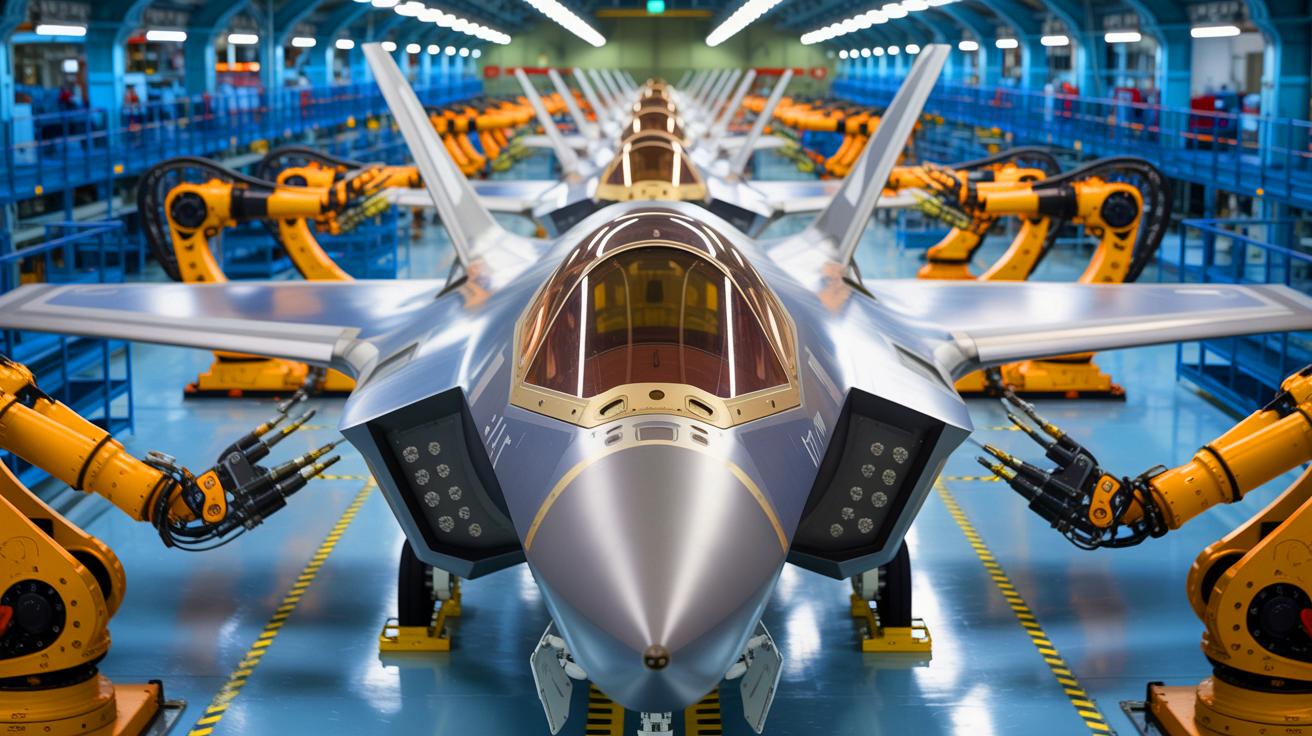
Northrop Grumman’s production success is largely attributed to its Integrated Assembly Line (IAL), a facility that employs cutting-edge robotics and automation. This advanced technology enables the company to maintain high production rates and meet the exacting engineering standards required for the F-35. The IAL is designed to handle all three variants of the F-35, demonstrating remarkable versatility and efficiency in its operations.
The IAL utilizes automated guided vehicles, robotic drilling, and mold-in-place coatings to ensure precision and consistency. These technologies, along with data-driven analytics, enhance quality control and streamline the manufacturing process. Beyond the center fuselage, Northrop Grumman is also involved in producing the F-35’s radar systems and communication subsystems, underscoring its comprehensive role in the aircraft’s development and lifecycle support.
Advanced Manufacturing: A Blend of Human and Machine
Northrop Grumman’s IAL represents a pioneering approach to military aircraft production, merging human expertise with machine precision. This synergy is crucial in assembling the center fuselage, which consists of over 3,000 parts and involves up to 115 assembly positions. The facility, comparable in size to a football field, assembles approximately 10 million parts annually, achieving remarkable efficiency by completing one center fuselage every 30 hours.
This blend of human and machine capabilities allows Northrop Grumman to maintain its position as a leading partner in the F-35 Lightning II program. The company’s commitment to innovation and excellence in manufacturing continues to push the boundaries of what is possible in aerospace technology, setting new standards for the industry as a whole.
The Future of Defense Manufacturing
Northrop Grumman’s advancements in defense manufacturing have far-reaching implications, extending beyond mere production efficiency. The rapid production of F-35 components enhances the strategic capabilities of the United States and its allies, ensuring reliable support and technological superiority in a fast-changing global security landscape. The integration of advanced manufacturing techniques not only optimizes current processes but also paves the way for future innovations in aerospace technology.
As the global security environment continues to evolve, Northrop Grumman’s progress in manufacturing technology ensures that the F-35 remains a formidable asset in aerial combat. The ongoing refinement of these processes prompts a pivotal question: How will further technological advancements in manufacturing shape the future of defense and global security?
Continue reading