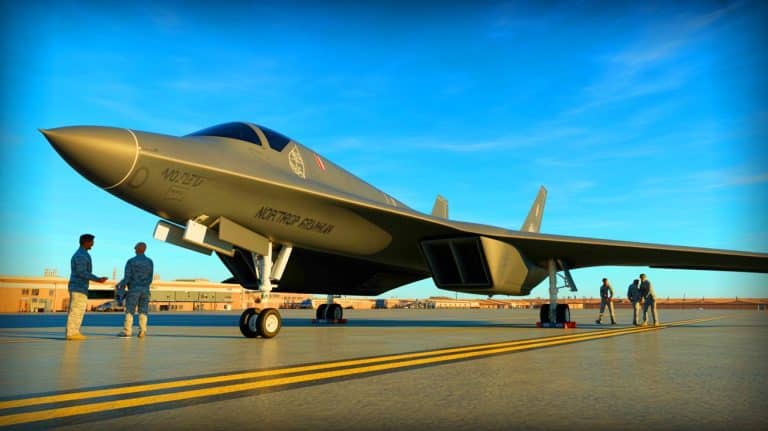



“They Fixed What America Couldn’t”: China Sparks Outrage After Claiming to Solve Fatal Flaw in US X-47B Stealth Drone
 By
Adam Kovács
By
Adam Kovács

| IN A NUTSHELL |
|
In a groundbreaking development that could redefine the future of stealth aviation, Chinese engineers have reportedly overcome a significant obstacle in the design of stealth aircraft. By leveraging a new software platform, they claim to optimize hundreds of variables simultaneously without the heavy computational costs typically required. This breakthrough was demonstrated using the U.S. Navy’s X-47B stealth drone, a project that was previously hindered by design trade-offs. Now, this advancement promises to make the design process more efficient, potentially revolutionizing the next generation of low-observable aircraft.
Breaking the ‘Curse’ with Efficiency, Not Brute Force
The traditional approach to optimizing stealth aircraft design involves extensive computational power, often leading to prohibitive costs and inefficiencies. However, the Chinese researchers have employed a novel “DeepSeek-style methodology” that emphasizes efficiency. This method integrates unified field modeling, allowing them to incorporate radar-absorbent material (RAM) effects directly into aerodynamic equations. By reusing electromagnetic solutions, they have transformed complex trillion-level calculations into manageable matrices on existing hardware.
This innovative technique, as reported by Stephen Chen at the SCMP, could significantly reduce the time and resources needed for China’s military aviation programs at a time when defense budgets are on the rise globally. The curse of dimensionality, a common challenge in computational design, often leads engineers to simplify models, thereby compromising on certain design aspects. However, this new method sidesteps such compromises, allowing for a broader exploration of materials and shapes without the typical exponential penalties.
Why the X-47B Matters Here
The X-47B holds a special place in the history of U.S. unmanned aviation. It was one of the first drones capable of autonomously taking off, landing on carriers, and refueling mid-air. Despite these achievements, the program was canceled in 2015 due to unresolved issues with balancing stealth, aerodynamics, and propulsion. By retro-optimizing this airframe with 740 parameters, the Chinese research team aims to address these trade-offs directly.
Their paper highlights the critical role of component geometry, such as wing leading edges and engine inlets, in determining both flight smoothness and radar visibility. As the number of variables increased, traditional optimization tools struggled to keep up. The new method, however, maintains steady gradient calculations regardless of the complexity, suggesting a scalable solution that could reshape aircraft design.
Broader Stakes for Sixth-Gen Fighters
The timing of this research is crucial, as sixth-generation fighter projects face challenges worldwide. The U.S. Next Generation Air Dominance effort has encountered delays, while China is believed to be progressing with its own next-gen fighters, the J-36 and J-50, alongside new stealth drones. If Huang’s platform proves effective in real-world development cycles, it could reduce the reliance on costly wind-tunnel tests and physical prototypes, speeding up the transition from concept to flight test.
Currently, the claim is methodological, offering a practical approach to massively multidimensional optimization. If it scales as expected, this could transform how combat aircraft are designed, coated, and fine-tuned, shifting the bottleneck from computational challenges to creative possibilities.
Potential Implications and Future Prospects
The implications of this technological advancement extend beyond military applications. It could also influence commercial aviation, where efficiency and cost-effectiveness are paramount. Additionally, the ability to optimize a high number of variables could lead to innovations in other fields, such as automotive and aerospace engineering. By reducing the computational burden, this methodology opens new avenues for research and development.
As the aviation industry grapples with increasing demands for sustainable and efficient designs, Huang’s team’s breakthrough offers a glimpse into a future where engineering is limited only by imagination. The potential for this technology to revolutionize multiple sectors underscores the importance of continued investment in research and development. How might this new approach to optimization influence industries beyond aviation, and what other technological frontiers could it help to unlock?
Continue reading