



China’s Deep-Sea ‘Spider’ Unveils the Mysteries of Ghostly Cosmic Neutrinos, Transforming Our Understanding of the Universe
 By
Adam Kovács
By
Adam Kovács
| IN A NUTSHELL |
|
In a groundbreaking advancement for particle physics, Chinese scientists have achieved a significant milestone in their quest to capture and study neutrinos, enigmatic subatomic particles that pass through matter almost undetected. Spearheaded by researchers from Shanghai Jiao Tong University’s Tsung-Dao Lee Institute, the recent successful sea trial of a device known as the Subsea Precision Instrument Deployer with Elastic Releasing, or Spider, marks a crucial step toward the development of China’s ambitious Hailing Tropical Deep-sea Neutrino Telescope (Trident) in the South China Sea. This initiative places China at the forefront of neutrino research, a field that promises to deepen our understanding of the universe.
Understanding Neutrinos: The Ghost Particles
Neutrinos are elusive, nearly massless particles that are born in the fiery heart of nuclear reactions, such as those inside stars. Despite their abundance, billions pass through the human body every second, they leave no trace, making their detection a formidable challenge. Scientists aim to capture these ghost-like particles using vast neutrino observatories located in isolated environments like deep-sea or polar ice caps. These observatories are essential for unlocking cosmic mysteries and understanding the fundamental forces of nature.
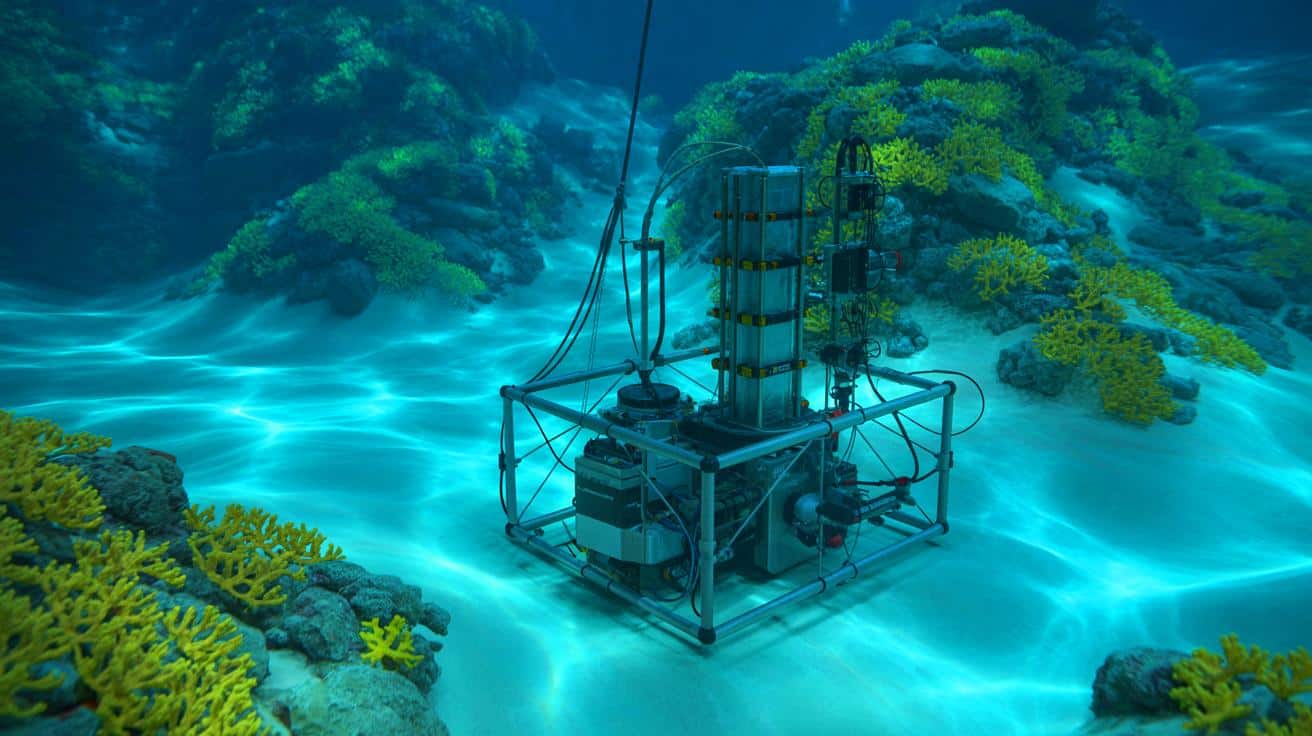
The successful test of the Spider deployment device is a vital component in constructing the Trident neutrino telescope. This planned observatory in the South China Sea hopes to capture neutrinos from cosmic and atmospheric origins. The Spider’s ability to descend and position itself above the ocean floor, deploying sensors with precision, is a testament to the ingenuity driving this research. Such advancements could revolutionize our knowledge of cosmic rays and celestial phenomena, offering insights into the universe’s origins and evolution.
Secret Supersonic Plane Discovered on Google Earth: Traveling at Six Times the Speed of Sound
The Sea Trial: A Pioneering Step
In preparation for the Trident telescope, the Spider device underwent a full-scale trial, descending to just above the ocean floor. During the trial, it executed a flawless 10-minute rotation while uncoiling a 2,300-foot string of sensors and buoyancy blocks. These sensors are strategically positioned at a depth of approximately 5,577 feet to detect neutrinos. The precision of this setup is crucial for the successful operation of the future Trident observatory, which will require exact alignment to capture neutrino interactions.
The Spider’s deployment and sensor placement were preceded by eight design iterations and numerous trials, underscoring the complexity and dedication involved in this endeavor. The success of this trial represents a pivotal moment in China’s journey to establish a deep-sea neutrino observatory, which will serve as a beacon of scientific exploration and innovation.
Building the Trident Observatory
The Trident telescope aims to leverage its massive scale to capture rare neutrino collisions. Positioned 11,480 feet below sea level, it will benefit from the calm and dark environment essential for detecting faint light signals emitted by neutrinos. This setting, free from sunlight, surface vibrations, and natural radiation, is ideal for such sensitive measurements.
Globally, several large-scale observatories have been constructed to study neutrinos. The IceCube Neutrino Observatory at the South Pole is perhaps the most renowned, utilizing thousands of sensors within a cubic kilometer of ice to detect neutrinos. Russia’s Baikal-GVD, the first large neutrino telescope in natural water, is another significant endeavor. China’s Trident and the planned High-energy Underwater Neutrino Telescope (Hunt) are poised to join these ranks, contributing to the global effort to understand the universe’s most elusive particles.
Global Implications and Future Prospects
China’s advancement in neutrino research exemplifies the growing international interest in these subatomic particles. With the successful development of observatories like Trident and Hunt, scientists hope to achieve breakthroughs in understanding cosmic rays and other astrophysical phenomena. These efforts not only enhance our knowledge of the universe but also pave the way for technological innovations in particle detection and data analysis.
As the world continues to invest in neutrino research, collaborations between countries and institutions will become increasingly important. The shared goal of unlocking the universe’s secrets through neutrino detection may lead to unprecedented scientific discoveries. How will these advancements shape our understanding of the cosmos and influence future scientific endeavors?