


Venezuela Buildup Sparks Regional Tensions as War Plans for Nigeria and China’s Third Carrier Unfold
 By
Adam Kovács
By
Adam Kovács
| IN A NUTSHELL |
|
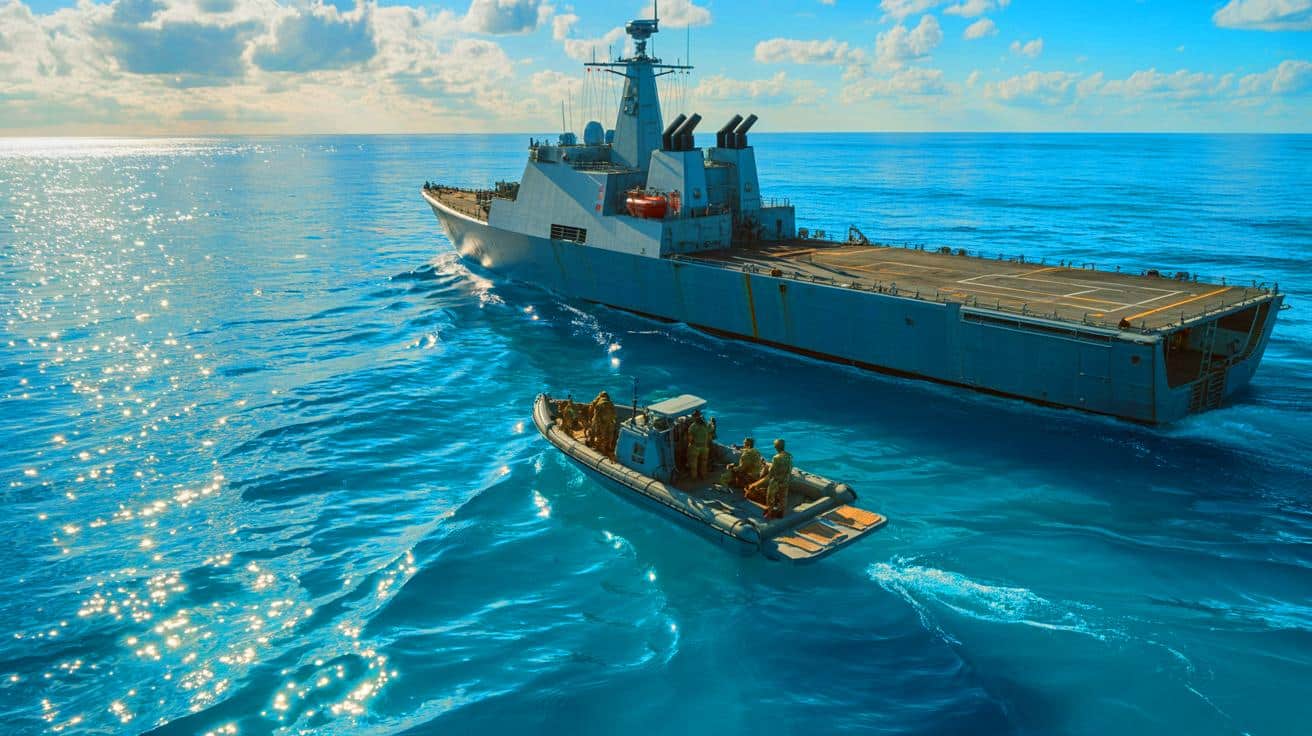
The United States military has been actively involved in a controversial anti-drug operation in the Caribbean, targeting vessels suspected of narcotics trafficking. The Pentagon recently announced the destruction of another alleged drug-trafficking boat, adding to a series of strikes that have resulted in significant casualties. The operation, however, has sparked debate over the legality and morality of these actions, with critics labeling them as “extrajudicial killings.” This raises critical questions about due process and the broader implications of such military interventions in international waters.
Controversial Strikes in the Caribbean
The United States military has launched at least 17 strikes since early September, reportedly resulting in over 60 deaths. These operations are conducted under the banner of combating narcotics trafficking in the Caribbean. However, the lack of transparency and evidence supporting claims of drug trafficking has led to widespread criticism. Legal experts question the legitimacy of these actions, citing the absence of due process and the potential violation of international law.
Reports from various sources suggest that not all individuals targeted were involved in drug trafficking. Investigations revealed that some of the deceased were civilians with no criminal background, adding to the controversy. Critics argue that such military actions set a dangerous precedent, undermining international legal standards and human rights.
Military Expansion in Latin America
In a move reflecting its strategic interests, the U.S. military has expanded its operations in Latin America. Recent reports indicate the deployment of an AC-130J Ghostrider attack plane from El Salvador, alongside other military assets such as a Navy P-8A Poseidon reconnaissance plane. These deployments are part of a broader strategy to enhance U.S. military presence in the region, ostensibly to combat drug trafficking and other criminal activities.
This military buildup has raised concerns among regional leaders and international observers. Critics argue that such actions could escalate tensions and destabilize the region further. The presence of sophisticated military equipment in Latin America also signals a shift in U.S. foreign policy, emphasizing military solutions over diplomatic engagement.
Legal and Political Ramifications
The legality of the U.S. military’s actions in the Caribbean has become a point of contention. The White House has yet to provide a clear legal justification for these strikes, raising questions about the executive’s authority to conduct such operations without congressional approval. This legal ambiguity has prompted debates within the U.S. government, with some lawmakers advocating for stricter oversight of military interventions.
Senate Republicans recently blocked legislation that would have limited military actions in Venezuela, reflecting the political divide on this issue. Some Republicans expressed concerns about the current strategy, while Democrats emphasized the need for congressional approval before engaging in military actions. This ongoing debate highlights the complexities of balancing national security interests with legal and ethical considerations.
Broader Geopolitical Implications
The situation in the Caribbean is part of a larger geopolitical narrative involving U.S. interests in Latin America. The Trump administration’s focus on countering foreign influence in the region, particularly from countries like China and Russia, has shaped its approach to Latin American policy. Venezuela, in particular, has been a focal point, given its strategic importance and political alignment with U.S. adversaries.
The United States’ actions in the region are viewed as efforts to assert dominance and prevent the spread of influence by rival powers. However, this strategy is not without risks. Military interventions could lead to unintended consequences, such as regional instability and strained diplomatic relations. As the U.S. continues to navigate its role in Latin America, the challenge remains to balance strategic interests with responsible and ethical foreign policy.
As the U.S. military continues to engage in operations in the Caribbean and beyond, the debate over the legality and morality of such actions persists. The implications of these operations extend beyond immediate security concerns, touching on broader issues of international law, human rights, and geopolitical strategy. How will the U.S. reconcile its national security objectives with the need for accountability and transparency on the global stage?
Continue reading