


Aviation Industry Shaken After “Steel Giants Rolled Out Relentlessly” as New Jet Fuselages Begin Arriving Every 30 Hours to Redefine Flight’s Future
 By
Adam Kovács
By
Adam Kovács
| IN A NUTSHELL |
|
In a significant leap forward for aerospace technology, Northrop Grumman has announced a breakthrough in the production of the F-35 Lightning II fighter jets. With the aid of cutting-edge manufacturing technologies and a highly sophisticated assembly line, the central fuselages of these jets can now be produced in a mere 30 hours per unit. This remarkable advancement not only highlights Northrop Grumman’s role as a pivotal player in the global defense industry but also underscores a substantial enhancement in meeting both national and international defense demands.
The Crucial Role of the Central Fuselage
The central fuselage serves as a critical structure for all three variants of the F-35, incorporating a complex intake system and forming an integral part of the aircraft’s internal weapon bays and fuel reservoirs. Northrop Grumman is responsible for the precise manufacturing of the fuselage’s air-operable doors, including the weapon bay doors and their actuation systems. The precision in edge alignment and the application of specialized coatings significantly contribute to the distinctive capabilities of the F-35. To date, Northrop Grumman has delivered over 1,400 central fuselages for the F-35 program, illustrating the success and efficiency of their production processes.
The delivery of these components is crucial not only for the performance of the fighter jets but also for maintaining a consistent supply chain that supports military readiness. The central fuselage’s design and its seamless integration with other aircraft systems are testaments to advanced engineering and the importance of precision in aviation manufacturing.
Advanced Automated Technologies
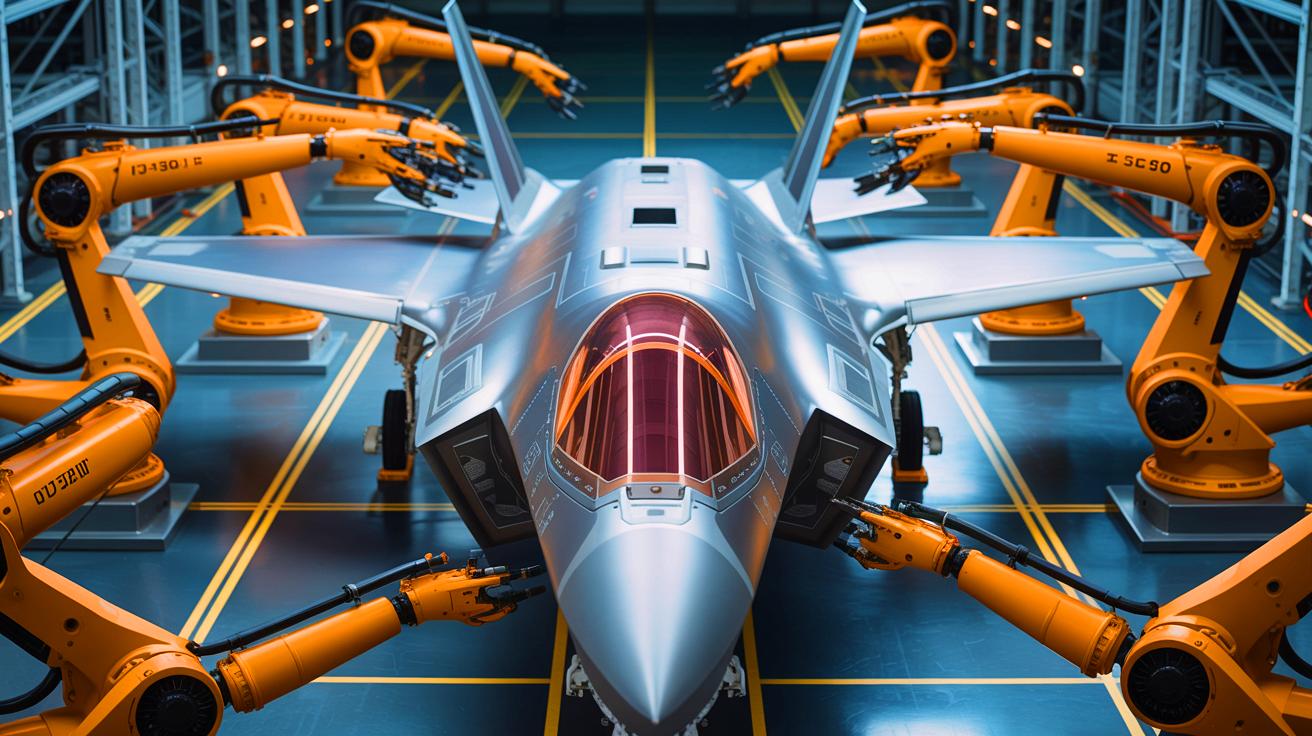
Northrop Grumman’s Integrated Assembly Line (IAL) exemplifies the pinnacle of automation and robotics in modern manufacturing. This sophisticated technology enhances capacity and efficiency, enabling the production of high rates that are challenging to achieve manually. The facility accommodates all three F-35 variants within the same line, along with production flight articles, unique development test articles, and country-specific production configurations.
Among the automated technologies used are Automated Guided Vehicles (AGVs), robotic drilling of intake ducts, molded coatings, and automated drilling systems. These technologies significantly improve quality control, reducing production time and labor costs associated with manufacturing the F-35 central fuselage. Such advancements in automation not only streamline production but also ensure a higher standard of precision and consistency, critical factors in the aerospace industry.
One of the Most Advanced Manufacturing Facilities
Claiming the title of one of the most advanced manufacturing facilities ever assembled for military aircraft production, Northrop Grumman’s IAL is a testament to innovation. The facility combines the strengths of human and machine, producing the central fuselage for all three variants of the F-35. The IAL, which spans the size of a football field, consists of over 3,000 parts and up to 115 assembly positions. Annually, it assembles 10 million parts, with the production of a central fuselage traditionally taking eight months. Thanks to the facility’s efficiency, a fuselage is now completed every 30 hours, dramatically increasing production capacity.
This rapid production capability is transformative, allowing for quicker deployment and replenishment of defense resources. The scale and sophistication of the IAL highlight the importance of investing in technology that supports defense and security objectives. The facility’s ability to meet high demands efficiently sets a new standard in military aerospace manufacturing.
Strategic Partnership and Future Outlook
As a key partner in the F-35 Lightning II Industrial Consortium, Northrop Grumman is instrumental in the development, production, and support of this fifth-generation fighter jet. Beyond producing central fuselages, the company is also involved in developing the AN/APG-81 AESA radar, communication subsystems, and providing support for the Electro-Optical Distributed Aperture System (EODAS). Northrop Grumman leads the development of mission systems, mission planning software, and vehicle systems, in addition to overseeing pilot and maintenance training systems.
This comprehensive involvement in the F-35 program reinforces Northrop Grumman’s leadership position in the defense industry. As the company continues to innovate and expand its capabilities, questions arise about the broader implications of these advancements. How will accelerated production rates influence global defense strategies, and what new technological innovations might emerge in the coming years to further revolutionize the field of aerospace?
Continue reading