


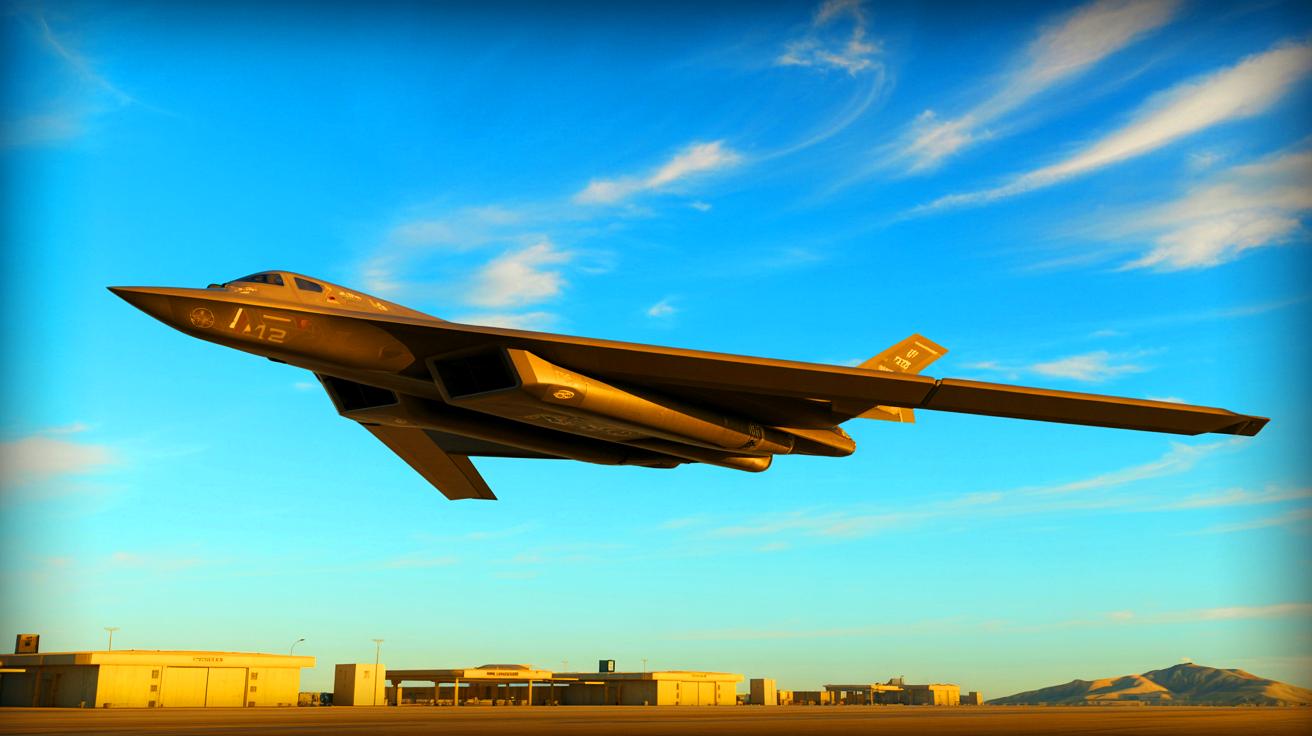
“Pentagon Unveils 30,000-Pound Nuclear Bomber”: Second B-21 Raider Lands at Edwards Air Force Testing Sixth-Generation Combat Systems
 By
Adam Kovács
By
Adam Kovács
| IN A NUTSHELL |
|
The arrival of the second B-21 Raider test aircraft at Edwards Air Force Base marks a significant milestone in the U.S. Air Force’s pursuit of next-generation airpower capabilities. As the military continues to advance its strategic deterrence initiatives, the integration of this state-of-the-art bomber into the fleet promises to reshape the future of aerial combat. With a payload capacity of approximately 30,000 pounds of munitions and cutting-edge technology, the B-21 Raider is poised to become a cornerstone in the Air Force’s modernization efforts.
The Arrival of the B-21 Raider
The United States Air Force has recently welcomed its second B-21 Raider test aircraft to Edwards Air Force Base in California. This arrival marks a pivotal step forward in the aircraft’s flight test campaign, moving beyond basic flight performance checks and into more advanced mission-systems and weapons-integration phases. The presence of a second test aircraft allows for an expedited evaluation process, crucial for the bomber’s operational debut.
Air Force Secretary Troy Meink emphasized the importance of this development, stating, “With the arrival of the second B-21 Raider, our flight test campaign gains substantial momentum.” This momentum is vital as the Air Force aims to maintain its strategic deterrence capabilities and combat effectiveness. The addition of the second aircraft not only accelerates testing but also reinforces the Air Force’s commitment to modernizing its fleet with cutting-edge technology.
As the B-21 Raider progresses through its testing phases, the Air Force is steadfast in its mission to deliver unmatched capabilities to deter and defeat threats worldwide.
Infrastructure and Modernization Push
The introduction of multiple B-21 test aircraft at Edwards Air Force Base provides a unique opportunity for maintainers to gain hands-on experience with simultaneous sustainment operations. This experience is invaluable as the Air Force evaluates maintenance tools, technical data, and logistics processes that will support future operational squadrons. General David Allvin, Air Force Chief of Staff, highlighted the urgency of modernization, stating, “By having more assets in the test environment, we bring this capability to our warfighters faster.”
In tandem with the expanded flight-test effort, the Air Force is planning extensive military construction projects at all three designated B-21 main operating bases in fiscal 2026. Ellsworth Air Force Base in South Dakota, the first base set to receive operational Raiders, is already advancing new hangars, training facilities, and support infrastructure to ensure readiness. These concerted efforts underscore the Air Force’s commitment to strategic nuclear modernization and the delivery of unmatched capabilities well into the future.
First Sixth-Generation Aircraft
The B-21 Raider, developed by Northrop Grumman under the Air Force Rapid Capabilities Office, is acclaimed as the world’s first “sixth-generation” aircraft. With a payload capacity of approximately 30,000 pounds, it is designed to deliver both conventional and nuclear payloads in high-threat environments. The B-21 Combined Test Force at Edwards has reported that the jet is performing as expected, closely matching simulator predictions. This success demonstrates the precision of the program’s digital design, which is crucial for its transition into low-rate initial production.
Northrop Grumman has employed agile software development, digital engineering, and advanced manufacturing techniques throughout the aircraft’s life cycle. These practices are intended to reduce risk, ease supplier integration, and support long-term sustainment efficiency. Moreover, the B-21’s open-systems architecture will facilitate the integration of new sensors and weapons as threats evolve, ensuring its adaptability in future combat scenarios.
The B-21 Raider Story
The B-21 Raider program began in 2015 when Northrop Grumman was awarded the engineering and manufacturing development contract. The program has since involved key partners, such as Pratt & Whitney, Janicki Industries, Collins Aerospace, GKN Aerospace, BAE Systems, and Spirit AeroSystems. In 2019, the Air Force designated Ellsworth, Whiteman Air Force Base in Missouri, and Dyess Air Force Base in Texas as the main operating locations for the B-21.
The name “Raider” pays homage to the Doolittle Raiders, a group of U.S. Army Air Forces personnel who executed a surprise attack on Japan in 1942. This historical reference underscores the aircraft’s potential to serve as a penetrating strike option against advanced adversaries. With initial operational capability targeted for the mid-2020s, the B-21 Raider is set to ensure America’s long-term airpower advantage.
As the B-21 Raider continues to progress through its testing and development phases, its role in the future of U.S. airpower becomes increasingly significant. With the potential to redefine aerial combat, the question remains: How will the B-21 Raider shape the strategic landscape of global military aviation in the years to come?