


“I’m Quitting My Job Tomorrow”: Factory Worker Reveals Fighter Jets Being Built Every Thirty Hours While Military Denies Production Numbers
 By
Adam Kovács
By
Adam Kovács
| IN A NUTSHELL |
|
In a remarkable development within the defense industry, Northrop Grumman has streamlined the manufacturing process for the world’s most advanced fighter jet, the F-35 Lightning II. This American defense company has revolutionized its production methods, allowing for the delivery of center fuselages at an unprecedented rate of one every 30 hours. This achievement not only highlights the technological advancements in defense manufacturing but also underscores the strategic importance of efficiency and precision in meeting both domestic and international demands.
The Significance of the Center Fuselage
The center fuselage is a critical component of the F-35 Lightning II, a versatile fighter jet available in three distinct variants. This fuselage integrates a bifurcated inlet system and constitutes a large part of the aircraft’s internal weapons bay and fuel reservoirs. These features are pivotal to the F-35’s stealth capabilities and operational effectiveness. The center fuselage is responsible for housing the inflight operating doors, including the weapons bay doors and their drive systems, all meticulously produced by Northrop Grumman.
Moreover, the edge alignment and coatings of the center fuselage are integral to the aircraft’s unique capabilities, ensuring that the F-35 maintains its competitive edge in modern aerial warfare. To date, Northrop Grumman has successfully delivered over 1,400 center fuselages, a testament to their commitment and expertise in the aerospace sector. The ability to produce such crucial components efficiently enhances the F-35’s role as a cornerstone of modern military strategy.
Revolutionary Integrated Automated Technology
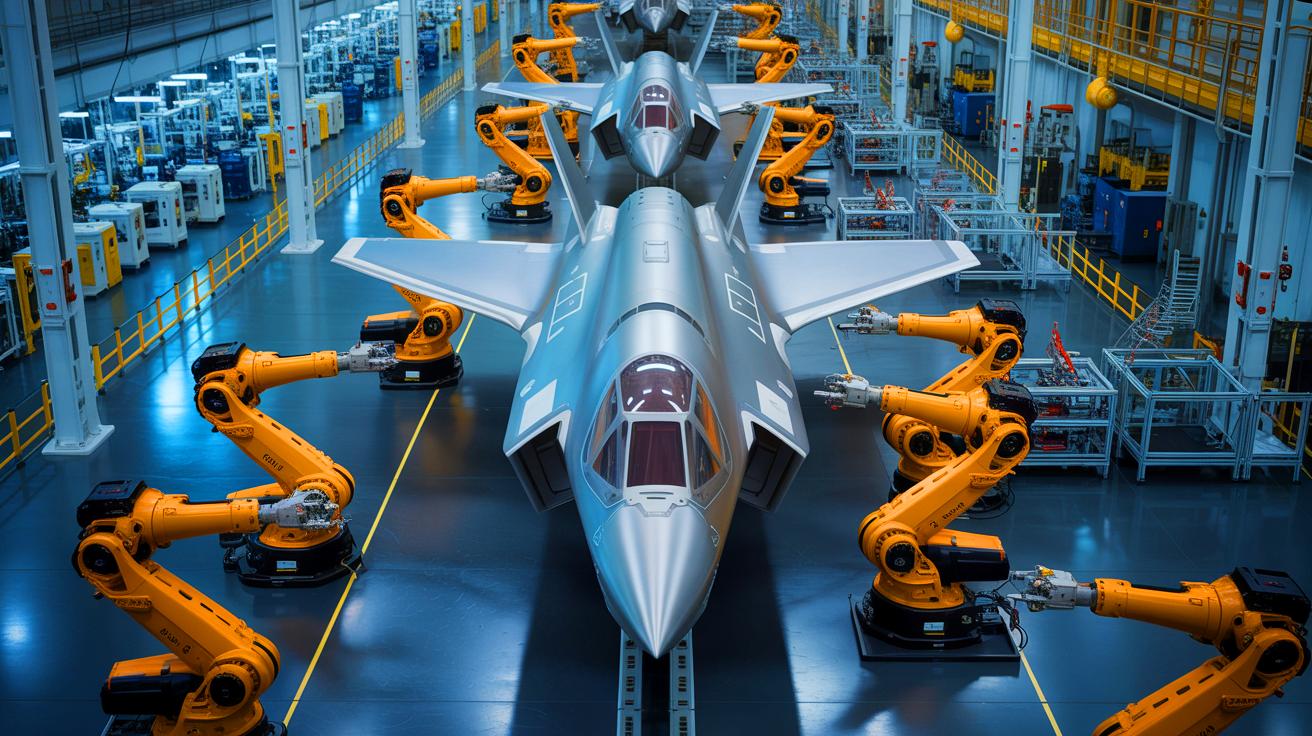
At the heart of this manufacturing marvel is the Integrated Assembly Line (IAL), which maximizes the use of robotics and automation. This cutting-edge facility allows Northrop Grumman to maintain high production rates while adhering to the stringent engineering tolerances essential for the F-35. By accommodating all three variants of the F-35 on the same production line, the IAL exemplifies flexibility and efficiency.
The technology employed at the IAL includes automated guided vehicles, robotic drilling, and mold-in-place coatings that enhance precision. These advancements, coupled with data-driven analytics, significantly improve quality control, reducing both time and labor. Beyond the center fuselage, Northrop Grumman also contributes to the F-35’s radar systems, communications subsystems, and sustainment support, demonstrating their comprehensive involvement in the aircraft’s lifecycle. Such integration of advanced technology underscores the importance of innovation in maintaining global military dominance.
Advanced Manufacturing: A Blend of Human and Machine
Northrop Grumman’s IAL is heralded as one of the most advanced manufacturing facilities ever conceived for military aircraft production. The facility, which spans the size of a football field, utilizes sophisticated automated technology that synergizes human ingenuity with machine precision. This collaborative approach is essential for the production of the center fuselage across all F-35 variants.
With over 3,000 parts and up to 115 assembly positions, the IAL assembles approximately 10 million parts annually. This impressive feat is accomplished in just eight months, allowing the team to complete one center fuselage every 30 hours. Northrop Grumman’s role as a principal partner on the F-35 Lightning II industry team further emphasizes their pivotal position in advancing fifth-generation fighter aircraft technology. The combination of human skills and high-tech machinery creates a production environment that is unparalleled in the field of defense manufacturing.
The Future of Defense Manufacturing
As Northrop Grumman continues to lead in defense manufacturing, the implications of their innovations extend beyond mere production efficiency. The ability to rapidly produce components for the F-35 enhances the strategic capabilities of the United States and its allies, assuring them of reliable support and sustained technological superiority. The integration of advanced manufacturing techniques not only optimizes current processes but also sets the stage for future advancements in aerospace technology.
With the global security landscape continually evolving, Northrop Grumman’s advancements in manufacturing technology ensure that the F-35 remains a formidable force in aerial combat. As they continue to refine their processes, one can only wonder: How will further innovations in manufacturing technology shape the future of defense and global security?
Continue reading