



CERN Unleashes the Coldest Science Experiment: These 20-Ton Magnets Frozen at -456°F to Boost Particle Collisions by 10 Times
 By
Adam Kovács
By
Adam Kovács
| IN A NUTSHELL |
|
The pursuit of understanding the universe has always driven scientific advancement, and CERN’s High-Luminosity Large Hadron Collider (HL-LHC) project is no exception. Nestled at the forefront of particle physics, this ambitious upgrade to the world’s most powerful particle accelerator is set to break new ground. By developing a test facility that operates at the extreme temperature of -456°F, engineers are laying the groundwork for exploring the fundamental forces of nature. As we delve into the intricate details of this project, we’ll explore how these developments promise to unlock mysteries such as dark matter and enhance our understanding of the cosmos.
Boosting Delivery Potential with Advanced Magnets
The HL-LHC project is designed to dramatically increase the luminosity of the existing collider. Luminosity, in this context, refers to the number of particle collisions occurring within the accelerator. By increasing this number tenfold, scientists can gather exponentially more data, allowing for more precise studies of known particles like the Higgs boson and a more intense search for new phenomena in physics. Such advancements could potentially shed light on elusive subjects such as dark matter.
The success of this endeavor hinges on the introduction of new superconducting quadrupole magnets, crafted from an innovative niobium-tin alloy. These magnets are capable of generating magnetic fields of 11.3 tesla, surpassing the capabilities of the current 8.3-tesla magnets. The increase in magnetic field strength is crucial for densely squeezing beams together before they collide, thereby increasing the likelihood of productive collisions. Achieving superconductivity necessitates cooling these 20-ton magnets with superfluid helium to a frigid 1.9 Kelvin (-456°F), a temperature even colder than the vastness of deep space.
Strategic Testing and Training
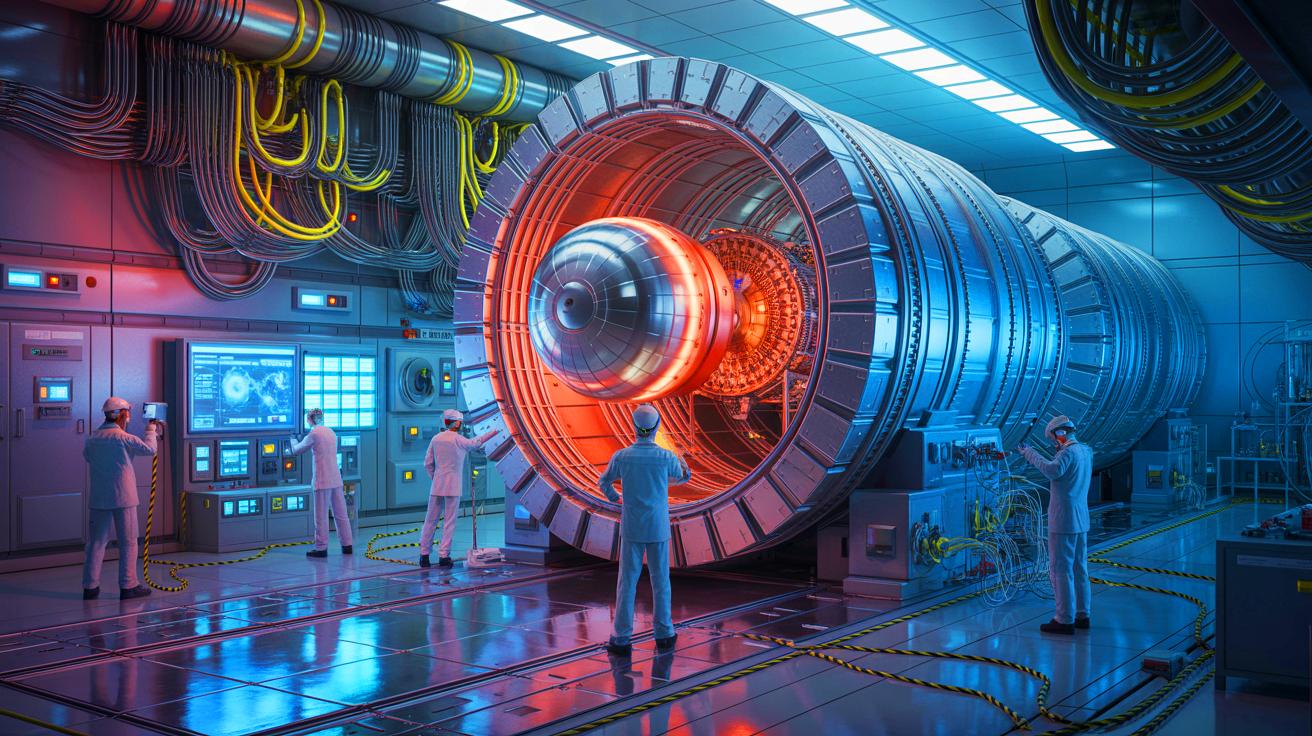
The construction of the HL-LHC test stand, known as the “IT String,” marks a significant milestone. Its purpose is to simulate the real-world conditions that the circuits will face, ensuring that all components function harmoniously under extreme conditions before their final installation in the main LHC tunnel. As Marta Bajko, head of the IT String project, explains, “The aim of the test stand is to check how the circuits behave collectively in real conditions.” This preparatory phase is critical for refining the installation and commissioning processes.
The technical challenges are immense, involving the management of a power supply line carrying over 100,000 amperes and the execution of approximately 70 precise interconnections. These connections require specialized brazing techniques to maintain the continuity of the superconducting circuits. This test also serves as a training ground, allowing teams to gain valuable experience and hone their skills in a controlled environment before transitioning to the LHC tunnel. The installation and validation work on the test stand is expected to advance through autumn, with the cooling and initial powering of the magnets anticipated by year-end.
The Role of Precision Engineering
The engineering marvel of the HL-LHC test stand is a testament to human ingenuity and precision. The 312-feet-long replica, meticulously constructed to match the segments destined for the LHC’s core, embodies the intersection of advanced materials and cutting-edge technology. With components weighing between 11 and 20 tons, their precise positioning required an arsenal of handling equipment, embodying the delicate balance of strength and finesse that characterizes modern engineering.
This test facility not only exemplifies the meticulous planning required to execute large-scale scientific projects but also highlights the collaborative efforts of international teams. The complexity of the assembly, coupled with the innovative power supply systems, underscores the project’s status as a cornerstone in the future of particle physics.
The Future of Particle Physics
As the HL-LHC project progresses, it stands poised to redefine the frontiers of particle physics. The success of the current testing phase is paramount, laying the foundation for future discoveries that could revolutionize our understanding of the universe. The enhanced capabilities of the upgraded collider promise to push the boundaries of what is scientifically possible, opening new avenues for exploration and discovery.
With each successful milestone, CERN edges closer to unveiling the mysteries that lie at the heart of matter and energy. The completion of these tests not only symbolizes a step forward in scientific achievement but also poses a broader question: How will these advancements shape our understanding of the universe and our place within it?
Continue reading