




| IN A NUTSHELL |
|
The world of energy storage has witnessed a groundbreaking achievement with Hithium’s successful completion of the first all-open-door large-scale fire test on its Infinity Block 5MWh battery energy storage system (BESS). This test represents a significant leap forward in safety testing, setting a new benchmark for the industry. As safety concerns surrounding thermal runaway incidents continue to rise, the need for rigorous and standardized safety testing becomes more critical. Hithium’s open-door fire test not only addresses these concerns but also establishes a high-stakes technical model for future product safety standards.
World’s First Open-Door Fire Test: A New Benchmark
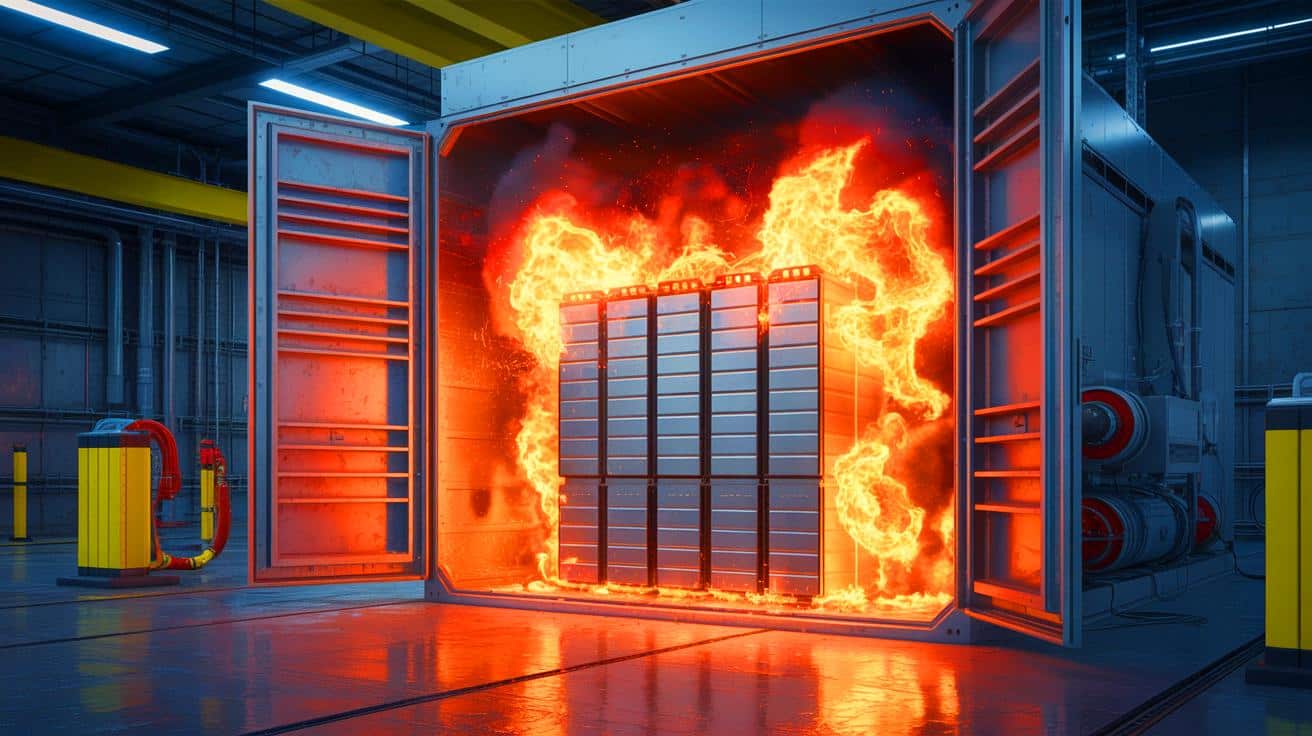
Hithium’s achievement in conducting the world’s first all-open-door large-scale fire test on a BESS marks a pivotal moment in energy storage technology. This test was designed to push the limits of safety testing by creating an unrestrained combustion environment. The open-door scenario allowed intensified oxygen flow, making the test more severe than traditional closed-door scenarios. The BESS was exposed to dual 6-inch extreme spacing conditions, where units were placed side by side with minimal spacing. Despite enduring flames exceeding 2,372°F, the system effectively prevented thermal propagation, showcasing its robust isolation capabilities.
The test adhered to stringent safety standards, including UL 9540A and NFPA 855, and was conducted by UL Solutions, a globally recognized safety certification authority. Witnessed by certified U.S. fire protection engineers, the test provided valuable insights into the capabilities of Hithium’s multi-layered passive safety architecture. This achievement emphasizes the importance of meeting rigorous safety standards to enhance the credibility and reliability of energy storage solutions.
Unyielding System Structure Amidst Intense Fire
One of the most remarkable outcomes of Hithium’s fire test was the system’s ability to maintain its structural integrity despite 15 hours of full combustion. The BESS’s structure remained intact, and no fire propagation occurred to any of the three adjacent containers. This outcome underscores the system’s exceptional thermal isolation capabilities and validates Hithium’s commitment to developing a robust passive safety architecture.
The open-door nature of the test created an intensified combustion environment, significantly increasing the difficulty of maintaining system integrity. The success of this test demonstrates Hithium’s innovative approach to building resilient energy storage solutions capable of withstanding extreme conditions. By proving the efficacy of its passive safety measures, Hithium establishes itself as a leader in advancing safety performance in the energy storage industry.
Passive Fire Protection: A Testament to Reliability
Hithium’s fire test also evaluated the efficacy of passive fire protection measures by deactivating all fire suppression systems. The system relied solely on its inherent fire resistance capabilities to withstand prolonged exposure to intense fire. This aspect of the test highlighted the autonomous reliability and stability of the BESS under the harshest conditions. Operating at full capacity, the system maximized thermal energy release, further validating its resilience.
The success of this aspect of the test reinforces Hithium’s commitment to innovation and quality. By prioritizing passive fire protection, the company provides valuable insights for future safety standards in the industry. This achievement is seen as a qualitative leap in energy storage fire safety testing, offering a replicable framework for establishing practical, real-world safety benchmarks.
Implications and Future Prospects
The implications of Hithium’s successful fire test extend beyond immediate safety validation. Industry experts have hailed the trial as a transformative step in energy storage safety testing, enhancing the credibility of safety claims. The results offer a replicable framework for establishing more practical safety benchmarks, driving the industry toward safer and more reliable energy storage solutions.
As the energy storage sector continues to evolve, rigorous safety testing becomes paramount. Hithium’s achievement sets a new standard for addressing safety concerns and underscores the importance of advancing safety performance through technology leadership and global collaboration. The company’s dedication to innovation and quality positions it as a key player in shaping the future of energy storage safety standards.
With such significant advancements in energy storage safety, the industry is poised for further innovation and growth. How will these developments influence future standards, and what new challenges will arise as the industry continues to evolve?