


“U.S. Aircraft Carriers Face Off Against China”: Tensions Skyrocket in Pacific as Experts Warn of Escalating Danger
 By
Adam Kovács
By
Adam Kovács
| IN A NUTSHELL |
|
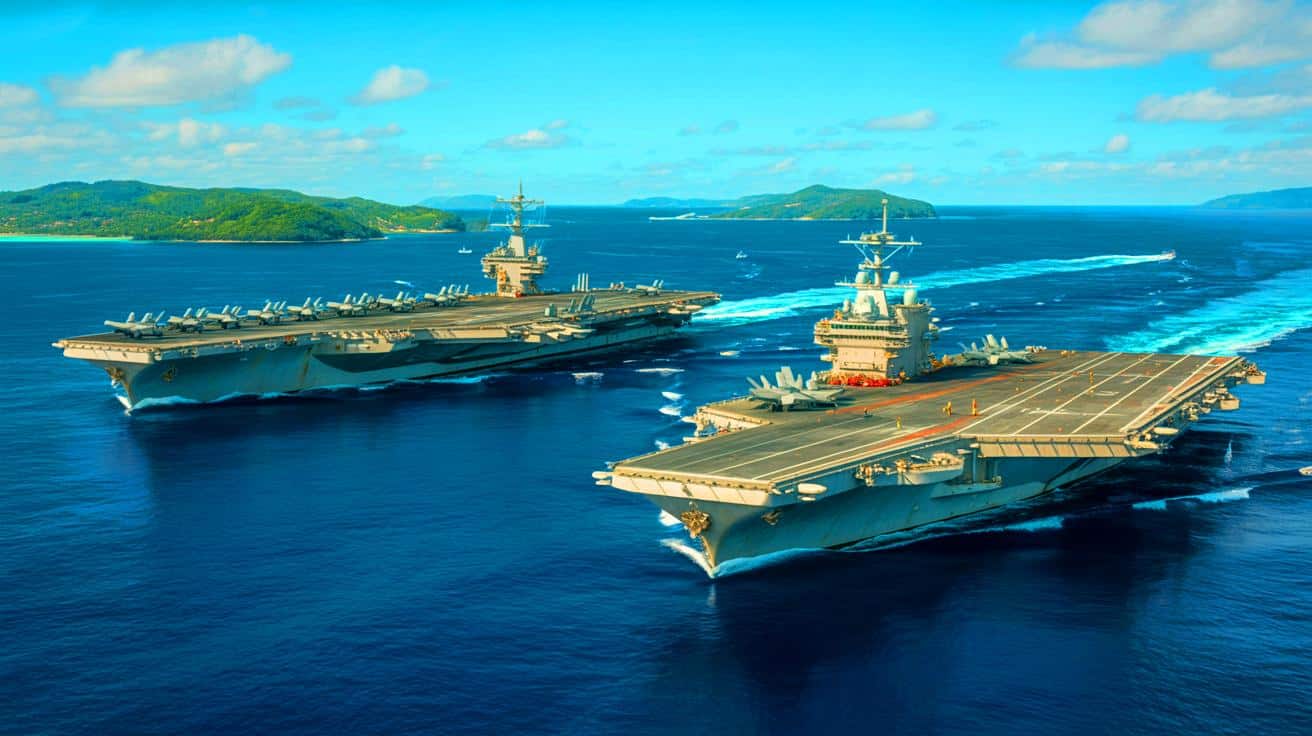
The escalating military tensions in the Pacific, especially around the South China Sea, have thrust the international community into a significant security dilemma. The deployment of U.S. aircraft carriers USS Nimitz and USS George Washington is a strategic move by the United States to reaffirm its naval power in response to China’s military expansion. As nations navigate these turbulent waters, the global implications are profound, requiring careful consideration and strategic diplomacy.
Strengthened American Presence
The continued presence of the USS Nimitz, alongside the USS George Washington, underscores a strategic commitment by the United States to maintain freedom of navigation and protect its interests in a region rife with conflicting territorial claims. This show of force is coupled with a renewed American military diplomacy aimed at stabilizing the situation while containing China’s growing influence. The enhanced presence of these aircraft carriers is a direct response to China’s actions, which persist in extending its hold over contested territories. The U.S. aims to deter further Chinese expansion and reassure its Asian allies of its unwavering commitment to regional security.
The Implications of Chinese Territorial Claims
For several years, China has intensified its military presence in the region, transforming islands and reefs into military bases. These actions have heightened tensions with neighboring countries, particularly the Philippines and Vietnam, which also lay claim to several of these territories. The deployment of the USS Nimitz near disputed areas marks a critical phase for regional diplomacy. By asserting its presence, the United States seeks not only to deter China but also to reassure its Asian allies of its commitment to regional security. The South China Sea remains a pivotal point of contention, with each maneuver by the involved nations carrying potential for significant geopolitical shifts.
International Reactions and Future Maneuvers
The deployment has elicited swift reactions. ASEAN member countries, while cautious not to overtly oppose China, have cautiously supported the American initiative. Defense experts interpret this deployment as a clear signal from the American administration aiming to reaffirm its role as a security leader in the Asia-Pacific region. The impact of these deployments on Sino-American relations could redefine the future power dynamics in the region. As tensions mount, the global community watches closely, aware that the outcomes could reverberate far beyond the immediate region, affecting international alliances and economic stability.
A Double-Edged Strategy
While the United States’ increased military presence in the Pacific aims to prevent armed conflict, it risks escalating tensions further. China views these movements as provocations, potentially leading to a military response or an acceleration of its expansion plans. The South China Sea is a vital commercial route, with about one-third of global maritime trade passing through it. The stability of this region is crucial not only for neighboring countries but for the global economy as a whole. A conflict in this area could have devastating consequences for international trade and the worldwide distribution of resources. The strategic calculations of both the U.S. and China will significantly impact the economic and security landscape of the region.
Future Perspectives and Challenges
The coming months will be crucial in understanding the evolution of the situation in the Pacific. American and Chinese decision-makers find themselves at a strategic crossroads, where every move is scrutinized and can influence the global balance in the region. The stakes are clear: maintaining peace and stability while navigating the complex waters of modern geopolitics. The response of the United States and China during this period of heightened tensions will determine the future of security in the Asia-Pacific and beyond. How will the international community adapt to this shifting landscape?
Continue reading