


“They Won’t Make It Alone”: US Calls on These Key Allies to Rebuild Its War Fleet Against Rising Chinese Power
 By
Adam Kovács
By
Adam Kovács

| IN A NUTSHELL |
|
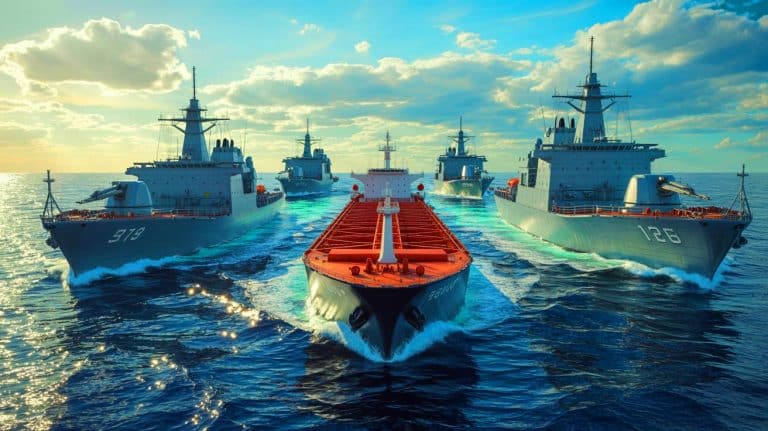
The decline of American naval power is a pressing concern as the U.S. grapples with maintaining its maritime dominance. Despite possessing a formidable fleet of aircraft carriers and nuclear submarines, the U.S. Navy’s supremacy is challenged by China’s rising naval capabilities. Over the past three decades, the American fleet has shrunk from 471 to 295 ships, prompting a strategic pivot. The U.S. plans to expand its fleet to 390 ships by 2054, a monumental task requiring substantial investments of $40 billion annually. This raises critical questions about the feasibility of such a strategy amidst significant industrial and financial hurdles.
The Urgency of a Swift Response to China
China’s burgeoning naval power presents a formidable strategic challenge to the United States. In 2024, China reportedly secured around 1,700 shipbuilding orders, starkly contrasted with a mere five for American shipyards. This disparity underscores the urgent need for Washington to respond decisively. Former President Trump, recognizing the gravity of the situation, set a 210-day deadline to rejuvenate American civil shipbuilding through the “Make Shipbuilding Great Again” executive order. This initiative aims to revitalize U.S. shipyards, a sector pivotal for restoring the balance of power.
In tandem, the U.S. is seeking international partnerships to bridge technological and industrial gaps. South Korean, Japanese, and Australian companies have expressed interest in aiding the modernization and expansion of the American fleet. This international collaboration could serve as a temporary fix, yet it also highlights the United States’ growing reliance on allies to maintain its naval supremacy.
The Root Causes of the Loss of Supremacy
The erosion of American naval supremacy can be traced back to the economic policies of the 1980s. The Reagan administration’s push for economic liberalization led to a gradual withdrawal of state support, leaving American shipyards vulnerable to fierce international competition. Foreign competitors, bolstered by significant government subsidies, gradually eclipsed the American industry. This dynamic resulted in a marked decline in American competitiveness on the global stage.
Moreover, budgetary priorities often favored other military branches or non-defense projects, limiting resources allocated to the U.S. Navy. This has led to chronic underfunding, adversely affecting the maintenance and modernization of the existing fleet. Reclaiming naval supremacy will require a comprehensive overhaul of these economic and budgetary policies.
The Strategy for Modernization and Expansion
To achieve the ambitious goal of 390 ships by 2054, the U.S. Navy must implement a robust strategy for modernization and expansion. This strategy entails not only substantial financial investments but also an innovative approach to shipbuilding. The integration of cutting-edge technologies and enhancement of production processes are crucial for increasing efficiency and reducing costs.
Partnerships with foreign companies can provide valuable expertise and expedite the modernization process. However, it is essential for the U.S. to simultaneously develop its internal capabilities to avoid long-term dependency. Emphasizing training and skill development is paramount to ensuring that American shipyards can compete globally. The path to reclaiming naval supremacy involves significant industrial and technological transformation.
An Uncertain Future for American Naval Power
The challenge of restoring American naval power is immense and multifaceted. Efforts to expand the fleet to 390 ships face numerous obstacles, particularly financial and industrial. The critical question is whether the United States can overcome these challenges and reassert its maritime dominance. Success in this endeavor will hinge on the ability to mobilize necessary resources, establish effective strategic partnerships, and reform economic and industrial policies.
As the U.S. strives to make up for lost ground, the global naval power balance remains uncertain. How will the U.S. Navy adapt to these rapid changes and maintain its position against an increasingly powerful China?
Continue reading