



“US Military Unleashes Game-Changer”: This 9-Foot Wingman Elevates Spy Drone with Astonishing 750-Mile Strike Range Boost to Unprecedented Heights
 By
Adam Kovács
By
Adam Kovács
| IN A NUTSHELL |
|
In the realm of modern warfare, technological advancements are pivotal in defining the capabilities of armed forces. The introduction of the Precision Exportable Launched Effect (PELE) marks a significant leap in unmanned aerial technology. Developed by General Atomics Aeronautical Systems, Inc. (GA-ASI), PELE is designed to enhance the reach and operational flexibility of both manned and unmanned platforms. With a wingspan of 11 feet and powered by a 16-horsepower engine, this small, attrition-tolerant, propeller-driven aircraft aims to revolutionize combat strategies by expanding into contested airspace. As militaries around the world seek to bolster their aerial capabilities, PELE emerges as a promising tool in the global aerospace and defense market.
The 9-foot Wingman Drone
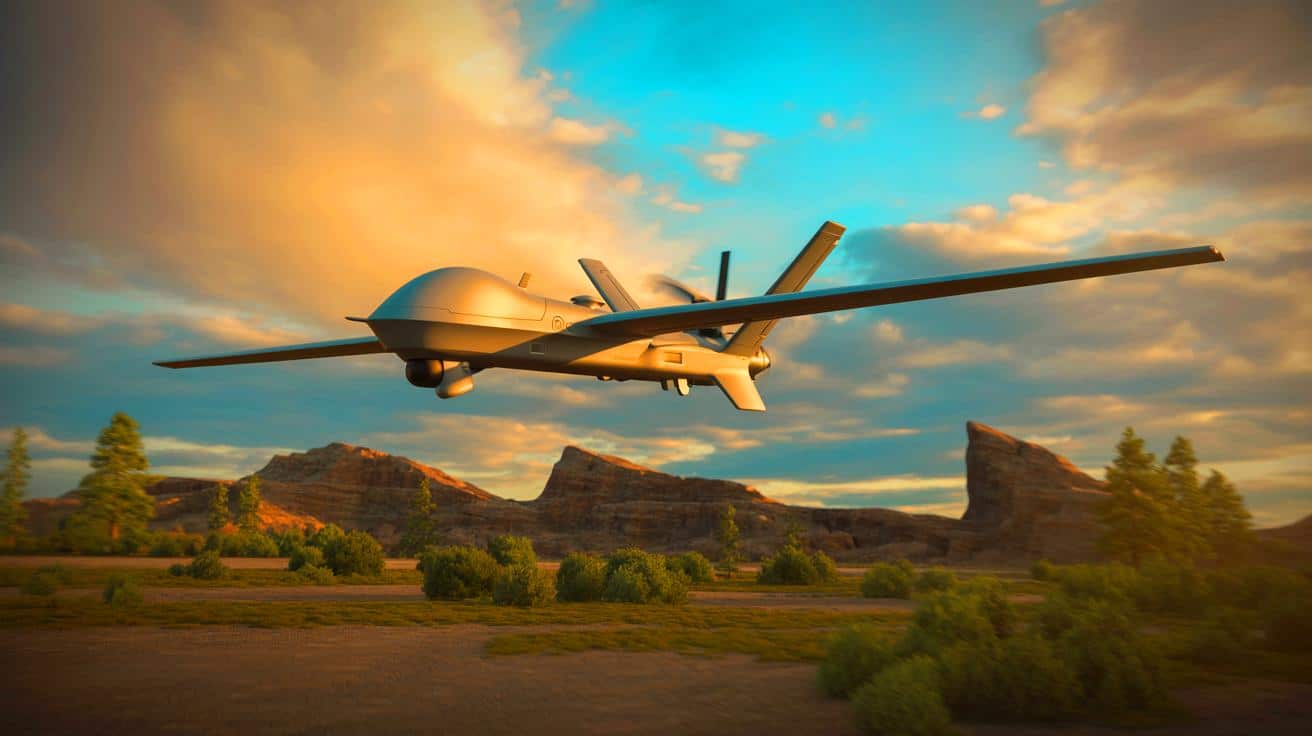
Inspired by the Hawaiian goddess of fire, Pele, the PELE drone embodies a formidable combination of endurance and adaptability. This semi-autonomous, propeller-driven vehicle is equipped to handle multi-mission tasks, making it a versatile asset in military arsenals. With a wingspan of 11 feet, PELE is engineered to operate effectively in high-risk zones, ensuring the survivability of larger, more valuable aircraft. Its integration with the MQ-9B SkyGuardian enhances its utility, enabling the deployment of multiple PELE units in a single sortie.
PELE’s design allows it to be launched from both air and ground systems, providing unparalleled flexibility in force deployment. This capability is further enhanced by its ability to preserve the “mothership,” allowing air forces to conduct long-endurance intelligence, surveillance, and reconnaissance (ISR) patrols. As David R. Alexander, President of GA-ASI, stated, “PELE brings even more versatility to growing MQ-9B fleets around the world.” The potential for air forces to deploy PELE in high-risk roles underscores its strategic value, ensuring that high-value platforms remain protected while extending their operational reach.
750-Mile Range
PELE’s capabilities extend beyond its impressive design. Equipped with an electro-optical/infrared (EO/IR) full-motion video sensor and internal mission-specific payloads, PELE is primed for a range of tactical operations. With a length of 9 feet and a maximum gross takeoff weight of 250 pounds, PELE offers up to 7 hours of flight endurance. Its range, exceeding 570 miles, makes it a formidable tool for deep reconnaissance missions or cross-domain target acquisition when paired with platforms like the MQ-9B.
The development of PELE is part of a broader U.S. and Allied push towards Collaborative Combat Aircraft (CCA) and Manned-Unmanned Teaming (MUM-T) concepts. These systems are designed to operate in swarms, enabling saturation attacks and electronic warfare penetration without risking high-value crewed assets. By embracing these concepts, the U.S. and its allies aim to maintain a strategic advantage, ensuring operational success in contested environments. GA-ASI’s commitment to rapidly deploying disruptive technologies is exemplified by PELE, a testament to the evolving nature of aerial warfare.
Future Implications in Defense Strategies
PELE’s introduction is poised to reshape defense strategies, particularly in regions facing anti-access/area-denial (A2/AD) challenges. By offering a cost-effective, survivable, and modular sensor-to-shooter capability, PELE emerges as a key enabler in future joint all-domain operations. Its potential impact is especially significant in the Indo-Pacific and Eastern European theaters, where stand-off and risk-tolerant systems are crucial for maintaining strategic balance.
The adaptability and resilience of PELE highlight its potential to address the evolving needs of modern military operations. As the global landscape continues to shift, the ability to deploy versatile, unmanned systems will become increasingly vital. PELE’s modular design and operational flexibility position it as a cornerstone of future defense strategies, enabling forces to respond swiftly and effectively to emerging threats.
General Atomics’ Commitment to Innovation
General Atomics Aeronautical Systems, Inc. has long been at the forefront of aerospace innovation. With the introduction of PELE, GA-ASI continues its tradition of pioneering technologies that redefine military capabilities. The company’s commitment to research and development is evident in PELE’s cutting-edge design and its ability to integrate seamlessly with existing aerial platforms.
As global defense strategies evolve, the role of unmanned systems like PELE will become increasingly prominent. GA-ASI’s dedication to innovation ensures that its products remain at the cutting edge, meeting the demands of modern warfare. The introduction of PELE not only enhances the capabilities of existing platforms but also sets the stage for future advancements in unmanned aerial technology. How will the ongoing evolution of unmanned systems shape the future of global defense strategies?
Continue reading