


“They’re Launching Satellites Like Bullets Now”: Auriga’s Hypersonic Accelerator Shatters Old Models and Experts Call It “Orbital Disruption”
 By
Adam Kovács
By
Adam Kovács
| IN A NUTSHELL |
|
In the rapidly evolving field of space exploration, innovation is the key to unlocking new frontiers. Auriga Space, a vibrant startup based in California, is making headlines with its groundbreaking approach to satellite launches. By harnessing the power of electromagnetic technology, the company aims to revolutionize how we send small rockets into space. With $6 million secured from investments and government contracts, Auriga is poised to develop a hypersonic accelerator capable of propelling rockets to astonishing speeds, promising a future where space missions are more efficient and cost-effective.
The Vision Behind Auriga Space
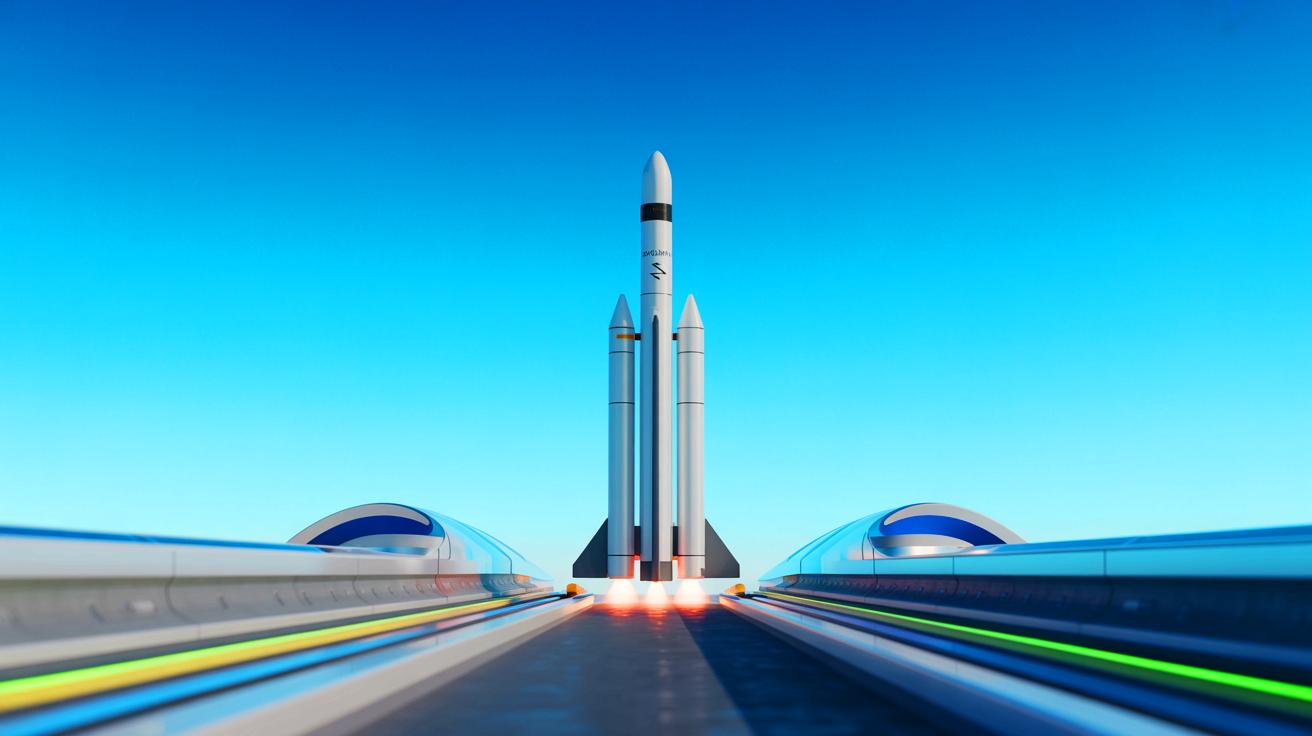
Auriga Space is not just another aerospace company; it is a trailblazer in developing cutting-edge technology to transform satellite launches. The company’s vision centers around an innovative electromagnetic “maglev ramp” that accelerates small rockets to Mach 6, approximately 4,570 mph. This incredible speed is achieved without relying on the traditional first-stage fuel, significantly reducing the mass and cost of launches. The concept involves using a reusable linear track equipped with powerful superconducting magnets, similar to those found in high-speed Maglev trains. By firing the carrier engine only for the final orbital maneuver, Auriga optimizes efficiency and sustainability.
The company’s ambitious plans extend beyond theory, with two smaller-scale installations in the works. The Prometheus laboratory track and the Thor field track are set for hypersonic testing by 2026. These projects will pave the way for the full-scale Zeus orbital complex, marking a significant leap forward in space technology. Unlike its competitors, Auriga’s design minimizes G-load impact, a crucial factor for protecting sensitive satellite electronics, ensuring the system’s viability and success.
Technological Marvel: The Maglev Ramp
The heart of Auriga Space’s innovation lies in its ingenious use of a maglev ramp. This system employs a linear track embedded with superconducting magnets, which generate a powerful electromagnetic field. As the rocket moves along the track, it accelerates rapidly, reaching hypersonic speeds with remarkable efficiency. The final section of the track is angled to form a ramp, allowing for a seamless transition into the atmosphere and minimizing aerodynamic drag.
This revolutionary approach has garnered significant attention and support from various sectors. Venture capital funds like OTB Ventures and Trucks VC, alongside government programs such as AFWERX and SpaceWERX, are backing Auriga’s vision. The potential for reduced fuel consumption and reusable infrastructure could dramatically cut costs, opening new avenues for scientific exploration and commercial use.
Implications for Scientific Missions
By reducing the cost and preparation time for launches, Auriga’s technology could have far-reaching implications for scientific missions. The ability to deploy telescopes quickly to observe ephemeral astronomical events, like gamma-ray bursts or novas, would enhance our understanding of the universe. Additionally, the rapid replenishment of microsatellite networks could support advanced fields like radio and gravitational astronomy.
Auriga’s approach also promises to expand the scope of experiments conducted on the International Space Station (ISS). With more affordable and frequent launches, researchers could conduct a greater number of experiments, yielding a higher scientific return from the orbital infrastructure. This could lead to groundbreaking discoveries and advancements in various scientific fields, further emphasizing the importance of Auriga’s innovations.
Challenges and Opportunities
While Auriga Space’s hypersonic accelerator presents numerous opportunities, it also faces significant challenges. The complex engineering involved in constructing a reliable maglev ramp and ensuring safety standards cannot be understated. However, the potential rewards are equally substantial, offering a chance to redefine the landscape of space exploration.
The key to overcoming these challenges lies in continued research and development, collaboration with industry partners, and the support of government initiatives. By addressing these hurdles, Auriga Space aims to set a new standard for satellite launches, driving progress and innovation in the space sector.
As Auriga Space pushes the boundaries of what is possible, the implications for the future of space exploration are profound. By leveraging advanced electromagnetic technology, the company is on the cusp of making space more accessible and affordable. As we look to the stars, one question remains: How will these technological advancements shape our understanding of the cosmos and our place within it?
Continue reading