

German Firm’s 500000-Pound Rocket Engine Test Sparks Global Alarm: “Will This Change Warfare Forever”
 By
Adam Kovács
By
Adam Kovács
| IN A NUTSHELL |
|
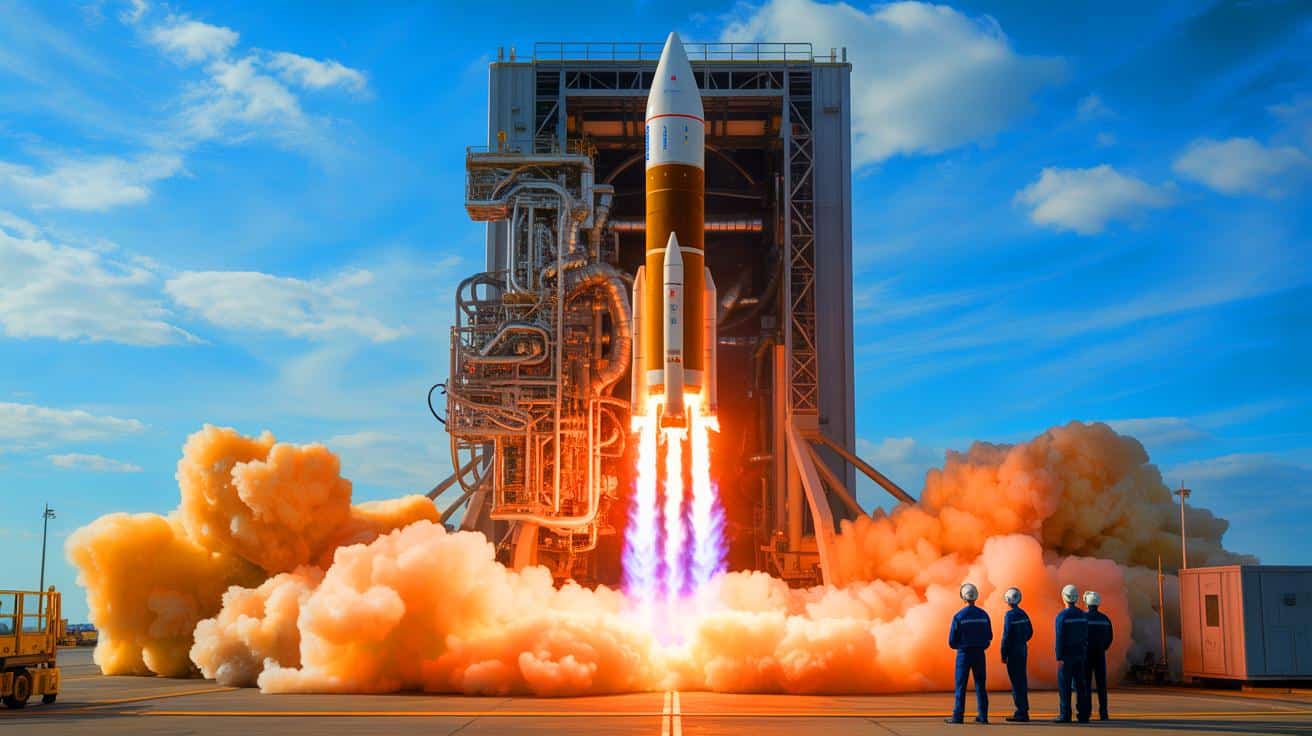
The recent successful testing of a German rocket engine has rekindled discussions on advancements in space propulsion technology. Over a six-week period, The Exploration Company conducted extensive tests on its Typhoon rocket engine at the German Aerospace Center (DLR) site in Lampoldshausen. This new development in rocket engineering showcases the potential for increased thrust capacity and enhanced engine stability. With co-financing from the French space agency CNES, the Typhoon engine aims to set new benchmarks in the aerospace industry. As the testing phase concludes, questions arise about the engine’s applications and its implications for future space missions.
Resolving Early Instabilities
The Typhoon rocket engine underwent 16 hot-fire tests across four different configurations. These tests were crucial in addressing and resolving early low-frequency instabilities. By the end of the campaign, the engine achieved stable combustion test firings lasting up to 85 seconds. This marked a significant improvement over previous test campaigns. The Exploration Company emphasized the importance of these tests, noting the engine’s ability to operate within a broad range of conditions.
The preburner, a critical component of the engine, powers the turbopumps that feed fuel and oxidizer into the combustion chamber. Successful stabilization of this component was a crucial breakthrough. The DLR Institute of Space Propulsion expressed satisfaction with the progress, highlighting their contribution to future space propulsion systems. The tests took place at the P8 research and development test bench, underscoring the collaborative efforts involved in this endeavor.
Comparing Thrust Capacity
The Typhoon engine’s thrust capacity is noteworthy, drawing comparisons to SpaceX’s Raptor engines. The Raptor family powers the Starship system and is known for its reusable methane-oxygen staged-combustion engine design. While the Typhoon engine’s thrust is comparable, it currently lacks a confirmed application. It is considered too powerful for The Exploration Company’s existing in-space logistics projects.
Despite this, the engine may play a role in future missions. The company has partnered with an industrial prime to submit a proposal for the European Space Agency’s European Launcher Challenge. Although the specifics are unconfirmed, the Typhoon engine is likely a significant component of the bid. This raises intriguing possibilities for its role in future European space initiatives.
Past Achievements and Future Prospects
The Exploration Company has a track record of notable achievements. Almost a month ago, it launched the Mission Possible capsule from Vandenberg Space Force Base. This mission marked the company’s second spacecraft to reach orbit in under four years. The spacecraft successfully powered its payloads, conducted attitude control maneuvers, and managed a controlled re-entry from an orbital altitude of 342 miles.
Such accomplishments demonstrate the company’s capability in space exploration. The successful testing of the Typhoon engine adds another layer of potential to their portfolio. As the aerospace industry continues to evolve, the question remains: how will The Exploration Company leverage this technology in the coming years?
International Collaboration and Investment
The Typhoon engine’s development has been a collaborative effort involving international partners. Co-financing from the French space agency CNES highlights the cross-border cooperation essential in advancing space technology. This partnership not only provides financial support but also facilitates the exchange of expertise and resources.
International collaborations in space exploration have become increasingly common. They allow for shared risks, costs, and benefits, ultimately accelerating technological advancements. As The Exploration Company looks to the future, its partnerships will likely play a crucial role in determining the trajectory of its projects. The global space community will be watching closely to see how these collaborations unfold.
The successful testing of the Typhoon rocket engine marks a significant milestone in space propulsion technology. As The Exploration Company continues to push boundaries, the implications of this development extend beyond its immediate applications. How will this advancement shape the future of space exploration, and what new possibilities will it unlock for international cooperation in the aerospace industry?
Continue reading