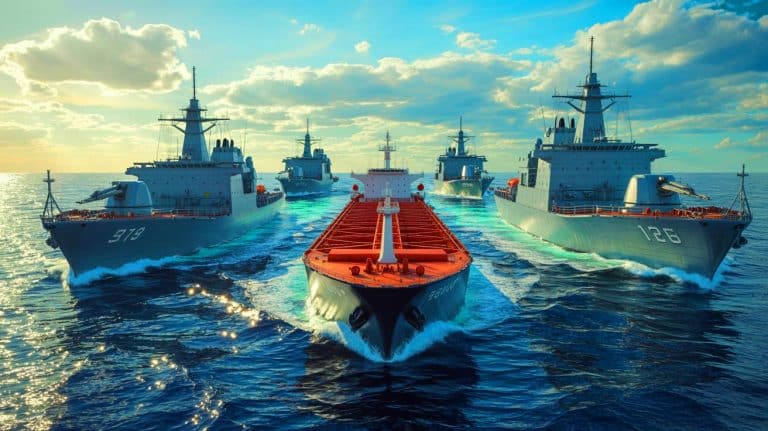



United States Warns World of China’s Expanding Maritime Threat and Demands Global Support to Confront Escalating Ocean Confrontations
 By
Adam Kovács
By
Adam Kovács
| IN A NUTSHELL |
|
The United States Navy faces a critical juncture as its maritime fleet has sharply declined from 471 to 295 ships over the past three decades. This reduction poses significant challenges to American naval supremacy, particularly in light of growing geopolitical tensions with China. With plans to expand the fleet to 390 ships by 2054, the U.S. is embarking on an ambitious journey requiring substantial investments and strategic alliances. This article delves into the underlying causes of this decline, the strategic efforts to rebuild the fleet, and the broader implications for U.S. naval power on the global stage.
The Urgency of Responding to China’s Maritime Ambitions
The rapid expansion of China’s navy has sparked a strategic alarm within the United States. As of 2024, China had approximately 1,700 shipbuilding orders, starkly contrasting with a mere five for American shipyards. This stark disparity underscores the urgent need for the U.S. to bolster its naval capabilities. In response, former President Trump issued the “Make Shipbuilding Great Again” executive order, aiming to rejuvenate American shipyards with a 210-day timeline for reviving civil ship construction.
To address these challenges, the U.S. is forging partnerships with nations such as South Korea, Japan, and Australia. These collaborations aim to bridge technological and industrial gaps. While these alliances provide temporary relief, they also highlight the increasing dependency of the U.S. on its allies to maintain naval dominance. As China continues to assert its maritime influence, the U.S. faces a pivotal moment in redefining its naval strategy to safeguard its interests and global standing.
The Underlying Causes of Naval Supremacy Decline
The erosion of American naval supremacy can be traced back to economic policies from the 1980s. During the Reagan administration, deregulation reduced government involvement, exposing American shipyards to intense international competition. Foreign competitors, often bolstered by state subsidies, gradually dominated the industry, further eroding U.S. competitiveness. This decline in competitiveness has had profound repercussions on the global market.
Moreover, budgetary priorities often favored other military sectors or non-defense projects, leading to chronic underfunding of the U.S. Navy. This financial shortfall has hindered fleet maintenance and modernization. To reclaim naval supremacy, a comprehensive overhaul of economic and budgetary policies is essential. The challenges of the past three decades serve as a stark reminder of the need for strategic foresight in preserving national security interests.
The Strategy for Modernization and Expansion
Achieving the goal of a 390-ship fleet by 2054 requires a rigorous strategy of modernization and expansion. This endeavor demands substantial financial investments and the integration of cutting-edge technologies. Enhancing production processes and technological innovation is crucial to improving efficiency and reducing costs.
International partnerships offer valuable expertise, but it is imperative to develop internal capabilities to avoid excessive reliance on external sources. Prioritizing skill development and training will ensure the competitiveness of American shipyards. The path to regaining naval supremacy necessitates a significant industrial and technological transformation. Balancing foreign collaboration with domestic development is key to achieving sustainable growth and maintaining naval dominance.
An Uncertain Future for American Naval Power
Rebuilding American naval power presents a complex challenge. The ambitious goal of expanding the fleet to 390 ships faces substantial financial and industrial hurdles. Success hinges on resource mobilization, strategic partnerships, and economic policy reform. As the U.S. endeavors to catch up, the future of global naval power dynamics remains uncertain. How will the U.S. Navy adapt to these rapidly evolving challenges to maintain its position against an increasingly influential China?
Continue reading