

“It Can Lift Ten Trucks”: ITER Central Solenoid Completes Assembly As 3000-Ton Superconducting Magnet Powers Humanity’s Greatest Energy Gamble
 By
Adam Kovács
By
Adam Kovács
| IN A NUTSHELL |
|
In the world of energy production, the quest for a sustainable and powerful source has long been a priority. At the forefront of this pursuit is ITER, a monumental international project nestled in the south of France. With backing from major global powers, including the United States, China, and the European Union, ITER aims to demonstrate the potential of nuclear fusion as a viable energy source. Central to this endeavor is the construction of a tokamak, a donut-shaped fusion reactor designed to confine plasma with powerful magnetic fields. The goal is to achieve a state where hydrogen nuclei fuse, releasing significant amounts of energy, a task that requires reaching temperatures exceeding 150 million degrees Celsius.
The Role of the Central Solenoid in ITER
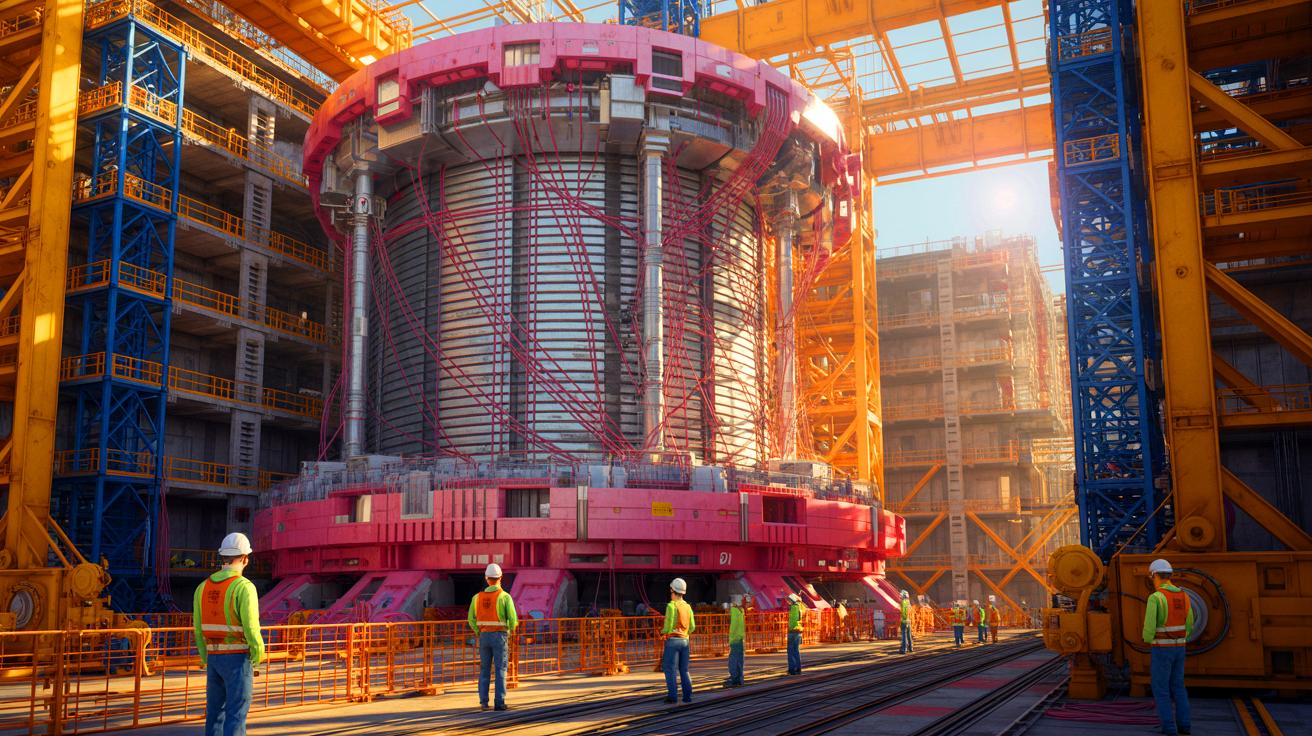
At the heart of the ITER project is the central solenoid, a critical component of the tokamak. This giant superconducting electromagnet has the essential role of generating and controlling the induced current within the plasma. Comprising six modules made from niobium-tin (Nb₃Sn), a superconducting material, the solenoid can carry massive electrical currents without energy loss. These modules, weighing approximately 3,000 tons in total, represent a significant engineering feat. Fabricated by the U.S. Department of Energy, they were shipped to France, where they now form a cornerstone of the ITER project.
The central solenoid is expected to produce an incredibly strong and variable magnetic field, crucial for initiating plasma formation and ensuring its confinement. The intensity of this magnetic field is so powerful that it could lift an object weighing 50,800 pounds, equivalent to ten large trucks. This capability underscores the advanced engineering and technological prowess involved in the ITER project.
Challenges and Milestones Ahead
Despite the advanced technologies employed, the path to achieving the first plasma production in ITER is laden with challenges. Engineers anticipate that the tokamak will eventually generate 500 megawatts of fusion power from just 50 megawatts of input heating energy. For comparison, a typical nuclear fission reactor produces around 1,000 megawatts from an input of 3,000 megawatts.
While ITER has faced numerous delays, the recent completion of the central solenoid marks a significant step toward the reactor’s anticipated results. However, much work remains, including integrating the infrastructure within the tokamak and finalizing the reactor’s components. This process is expected to be intricate and prolonged, with plasma production not projected to commence before 2033.
Aliens May Be 33,000 Light-Years Away: Scientists Warn of Possible Life Beyond Our Galaxy
Global Collaboration and Technological Innovation
ITER stands as a testament to global collaboration and technological innovation. Supported by a coalition of countries, this project reflects a shared vision of a future powered by clean and abundant energy. The commitment and resources pooled by the European Union, India, the United States, China, Russia, Japan, and South Korea demonstrate the international community’s dedication to overcoming technical obstacles for the greater good.
The development of the ITER tokamak and its components, like the central solenoid, showcases advances in engineering and materials science. Superconducting technologies, such as the Nb₃Sn used in the solenoid, highlight the cutting-edge research driving the fusion energy sector. These innovations not only promise to revolutionize energy production but also contribute to a growing body of knowledge in the field of superconductivity and magnetism.
The Future of Fusion Energy
The ITER project embodies the potential and promise of fusion energy as a sustainable solution to the world’s growing energy demands. Should ITER succeed in demonstrating the viability of fusion, it could pave the way for future reactors capable of providing clean, limitless energy. The success of this endeavor, however, hinges on continued international collaboration, technological advancements, and sustained investment.
As ITER progresses, the scientific community and policymakers eagerly await its outcomes. The project not only represents a leap forward in energy technology but also poses philosophical and ethical questions about how society will adapt to and manage new energy paradigms. What will be the implications of a successful transition to fusion energy, and are we prepared for the societal shifts that may follow?
Continue reading