
“Scientists Found Hell Under Siberia”: Massive Methane Bombs Create 538-Foot Craters While Russia Hides Underground Explosions Forever
 By
Adam Kovács
By
Adam Kovács
| IN A NUTSHELL |
|
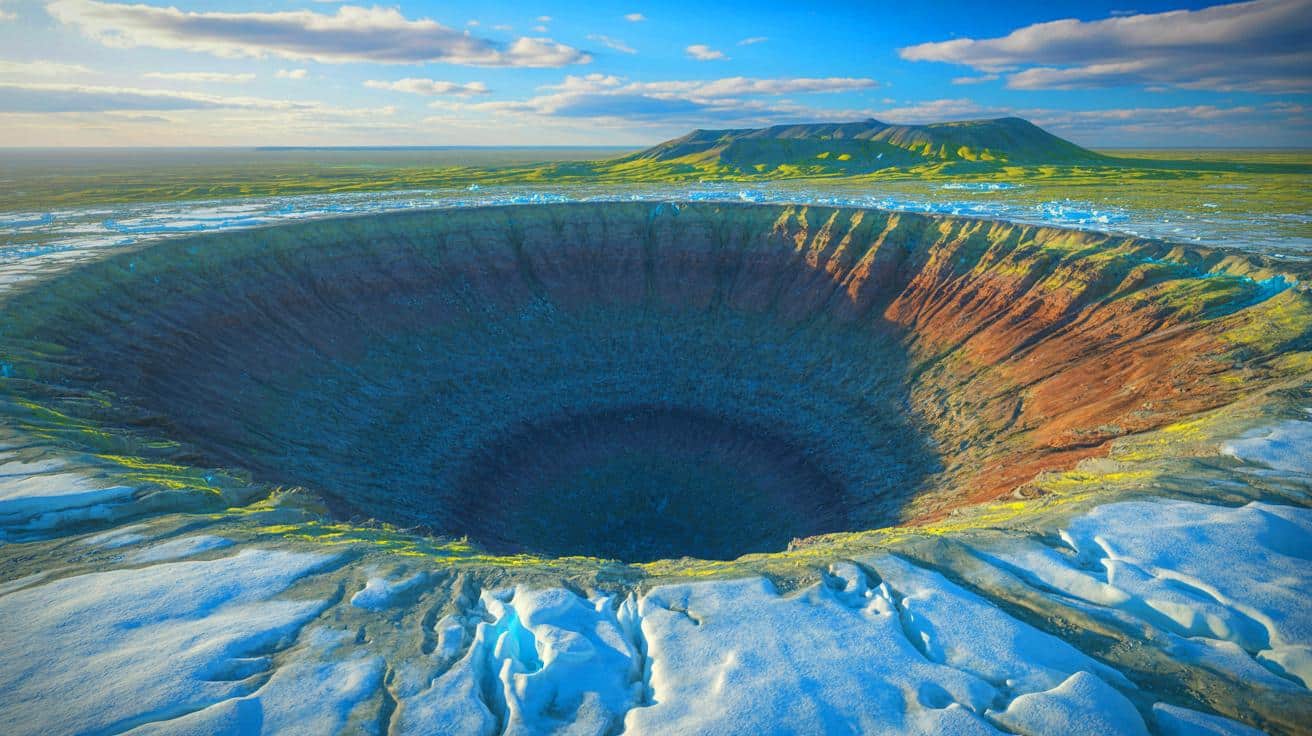
In the remote and stark landscapes of western Siberia, particularly on the Yamal and Gydan peninsulas, a geological mystery has intrigued scientists and locals alike. The emergence of massive craters, known as gas-emission craters (GECs), has led researchers on a quest to understand their origins. These craters, characterized by their steep, cylindrical formations reaching depths of up to 538 feet, have sparked significant scientific inquiry. Since the first discovery in 2014, only eight such craters have been documented, yet their dramatic appearance and potential implications for climate change have garnered significant attention. Recent studies have begun to unravel the forces behind these mysterious formations.
The Geological Enigma of Siberian Craters
The Siberian landscape has long been a subject of scientific curiosity due to its unique geological features. The craters’ sudden appearance initially led to various hypotheses regarding their formation. Early theories suggested that the melting of surface-level permafrost, influenced by climate change, was responsible for the explosions. This included the presence of cryopegs, liquid saltwater pockets that expand and create cavities. Additionally, the breakdown of methane hydrates, stable under cold and high-pressure conditions, was considered a potential cause. However, these theories failed to explain why such craters appeared exclusively in western Siberia, despite similar conditions across the Arctic.
Research from the University of Oslo and Russian collaborators has provided new insights. They suggest that while surface-level thawing contributes to the landscape’s vulnerability, the real power behind the craters lies much deeper. Methane gas and heat, originating from vast underground reserves, push upward with considerable force. Fault lines in the region facilitate the movement of gas and heat, intersecting with surface features like lakes and rivers, which act as weak points in the permafrost.
Understanding the Mechanics of Crater Formation
To delve deeper into the mechanics of crater formation, researchers employed physical modeling. They treated the permafrost as a “cork” in a pressurized bottle, simulating how gas might accumulate beneath it. By varying the thickness of this frozen layer and the size of the gas chamber, they calculated the pressure required to create such explosive forces. Their findings indicated that small, shallow cavities could not generate sufficient force, leading them to conclude that deeper gas accumulations were crucial.
The study highlighted the significance of fault lines, which act as conduits for methane and heat rising from below. These geological features, coupled with taliks, areas of unfrozen soil, create conditions ripe for sudden eruptions. When pressure builds to a critical point, the frozen surface gives way, resulting in the dramatic formation of craters. This process not only reshapes the landscape but also releases methane, a potent greenhouse gas, into the atmosphere.
Climate Change and Its Indirect Role
While the study shifts the primary focus away from climate change as the direct cause of crater formation, it underscores its indirect role. Warming temperatures contribute to the creation of thawed zones and weakened permafrost along fault lines. This environment facilitates the upward movement of gas, setting the stage for explosive events. The release of methane from these craters adds to the greenhouse gases in the atmosphere, creating a feedback loop that accelerates climate change.
The research indicates that while surface-level processes like thawing permafrost and methane hydrates can generate some pressure, they are insufficient to account for the forces observed in crater formation. Instead, the interaction between deep-seated geological processes and climate change plays a crucial role. This nuanced understanding highlights the complex interplay between natural geological activity and human-induced environmental change.
Potential for Craters Beyond Siberia
The insights gained from studying the Siberian craters suggest that similar formations could occur in other regions with analogous geological and environmental conditions. The presence of natural gas reserves, fault lines, and continuous permafrost are key factors. This raises important questions about the potential for similar phenomena in other parts of the world, particularly as climate change continues to alter environmental conditions.
Researchers emphasize that while the current focus remains on Siberia, the principles discovered could apply globally. Understanding these processes is crucial for anticipating future geological changes and their environmental impacts. As the planet continues to warm, the possibility of more gas-emission craters appearing in previously unaffected areas cannot be ruled out.
The discovery of the forces behind Siberia’s gas-emission craters marks a significant advancement in our understanding of geological processes in the Arctic. While climate change plays an indirect role, the primary drivers are deep-seated geological and gas dynamics. This research poses a compelling question: how might these findings inform our approach to mitigating the impacts of climate change and managing natural resources in vulnerable regions?