



“China’s Beetle-Inspired Sensor Beats US Tech By 20,000x”: Terrifying Infrared Breakthrough Could Cripple Missile Defenses And Shift Military Power
 By
Adam Kovács
By
Adam Kovács
| IN A NUTSHELL |
|
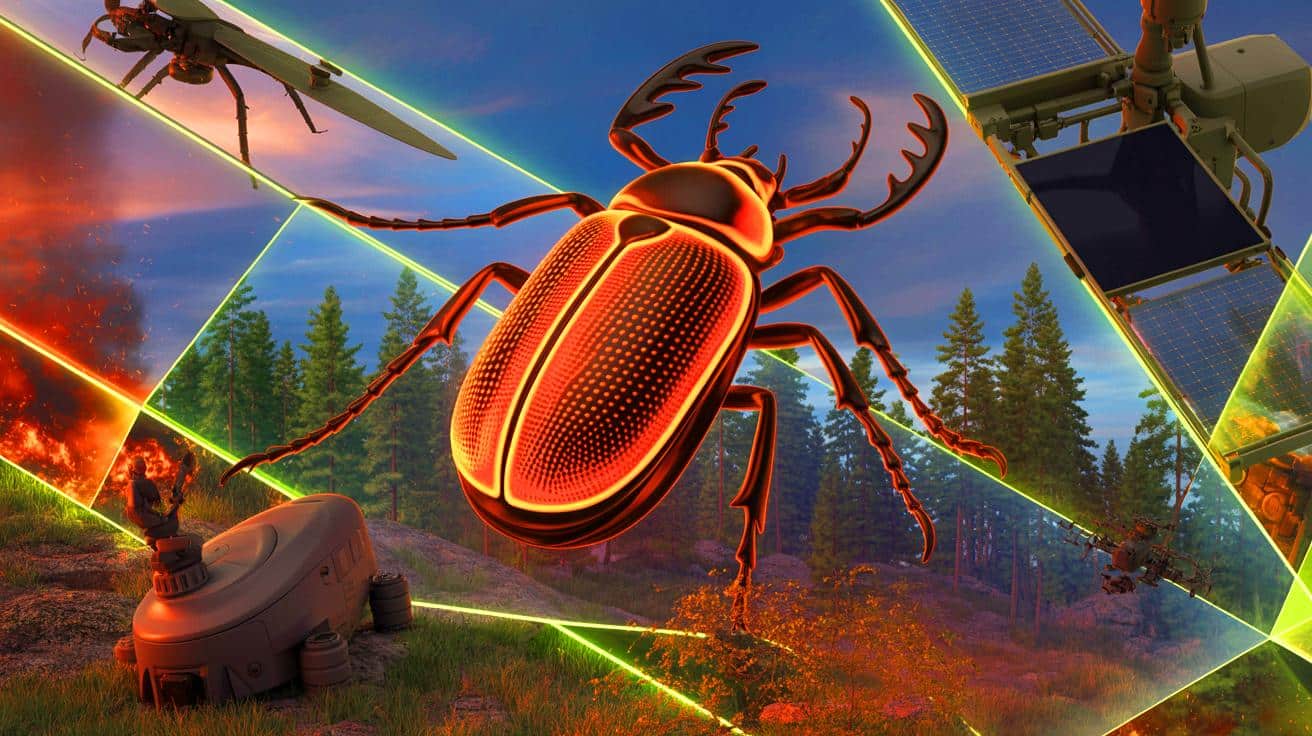
In the high-tech laboratories of Shanghai, a remarkable technological revolution is unfolding, drawing inspiration from an unlikely source: a humble fire beetle. Chinese scientists have reached a significant milestone in military surveillance by developing an unprecedentedly fast infrared sensor, inspired by the extraordinary capabilities of this insect. The development, spearheaded by researchers at the Shanghai Institute of Technical Physics in collaboration with Tongji University, could reshape the landscape of military defense technologies.
The Beetle That Detects Fires from Miles Away
The fire beetle possesses an almost science-fiction-like ability: it can detect forest fires from miles away. This biological marvel is not mere coincidence. The insect has evolved a specialized organ that is ultra-sensitive to heat, allowing it to locate recently burned areas. These environments are ideal for the reproduction and development of its larvae. Such a fascinating evolutionary strategy has captured the attention of Professors Hu Weida and Miao Jinshui.
At the Shanghai Institute of Technical Physics, their team has embarked on the ambitious task of artificially replicating this exceptional sensory capability. By closely studying the beetle’s natural heat-detecting prowess, the researchers have sought to create a sensor that mimics this biological marvel. Their work stands at the intersection of biology and technology, promising to push the boundaries of what is currently possible in infrared detection.
A Revolutionary Architecture Inspired by Nature
The technical challenge was formidable: how to reproduce in a lab a thermal sensitivity that nature took millions of years to perfect? The answer lies in the ingenious combination of two materials with complementary properties. The first component, palladium diselenide (PdSe₂), excels at absorbing infrared light. The second, pentacene, an organic semiconductor, faithfully replicates the beetle’s sensory system behavior.
This combination forms a biomimetic transistor capable of operating in the mid-infrared spectrum with remarkable sensitivity. The performance achieved exceeds all expectations. During tests simulating forest fires with temperatures reaching 1,700°F, the sensor demonstrated 95% accuracy in tracking flame movements and recording thermal patterns. Even more impressively, its processing speed outpaces current technologies by a factor of 20,000.
A Second Innovation for Ultra-Fast Memory
In parallel to this initial device, the Chinese team developed a variant using black phosphorus and indium selenide. This configuration achieves photonic memory speeds of just 0.5 microseconds, allowing for the storage of 17 precise data points on infrared targets, where traditional systems capture only blurry signals. This real-time processing capability opens up revolutionary prospects.
The fusion of detection, memory, and processing in a single electronic unit eliminates transmission delays, reduces energy consumption, and enables instantaneous operations in hostile environments. This capability is particularly crucial for military applications, where rapid decision-making can mean the difference between success and failure.
Military Applications and Geostrategic Stakes
The implications of this advancement extend far beyond the scientific realm. These sensors could equip a new generation of missile defense systems, autonomous drones, and surveillance satellites. Their ability to function effectively in extreme conditions, sandstorms, dense smoke, and thick fog, makes them strategic tools of the highest order.
The technology could notably enhance the performance of the Chinese HQ-17AE missile defense system, enabling it to intercept threats even in the most challenging environments.
Naval applications are also significant, with possibilities for integration into targeting systems on railgun-equipped warships. This advancement signals a potential shift in military capabilities and strategic balance, particularly in the context of global defense initiatives.
A Technological Challenge to the American “Golden Dome” Project
This breakthrough occurs amid a tense geopolitical context. Mere months after former President Donald Trump announced the “Golden Dome” project, a multi-billion-dollar space-based missile defense shield, China responds with a technology that could potentially disrupt the balance of power. The American project relies on traditional silicon-based infrared sensors integrated into a satellite constellation.
Chinese researchers claim that their biomimetic devices far surpass these conventional technologies in speed and precision. This development raises critical questions about the future of military technology and the global arms race. As nations strive to maintain a strategic edge, such innovations could redefine the parameters of modern warfare.
As these technologies advance, the potential for distributed infrared surveillance networks on land, at sea, and in space becomes increasingly feasible. Civil applications are not forgotten: firefighting, industrial safety, autonomous vehicles, and advanced computing will also benefit from these advancements. Drawing inspiration from a fire-loving insect, Chinese scientists may have opened the door to a new era in military detection, where nature continues to inspire humanity’s most advanced technologies. How will these innovations reshape the landscape of global security and technological development?
Continue reading