


“Unreal Speed Demon”: SR-72 Darkstar Mach 6 Shockwave Sends Ruthless Warning to Russia and Redefines Balance of Global Military Power
 By
Adam Kovács
By
Adam Kovács
| IN A NUTSHELL |
|
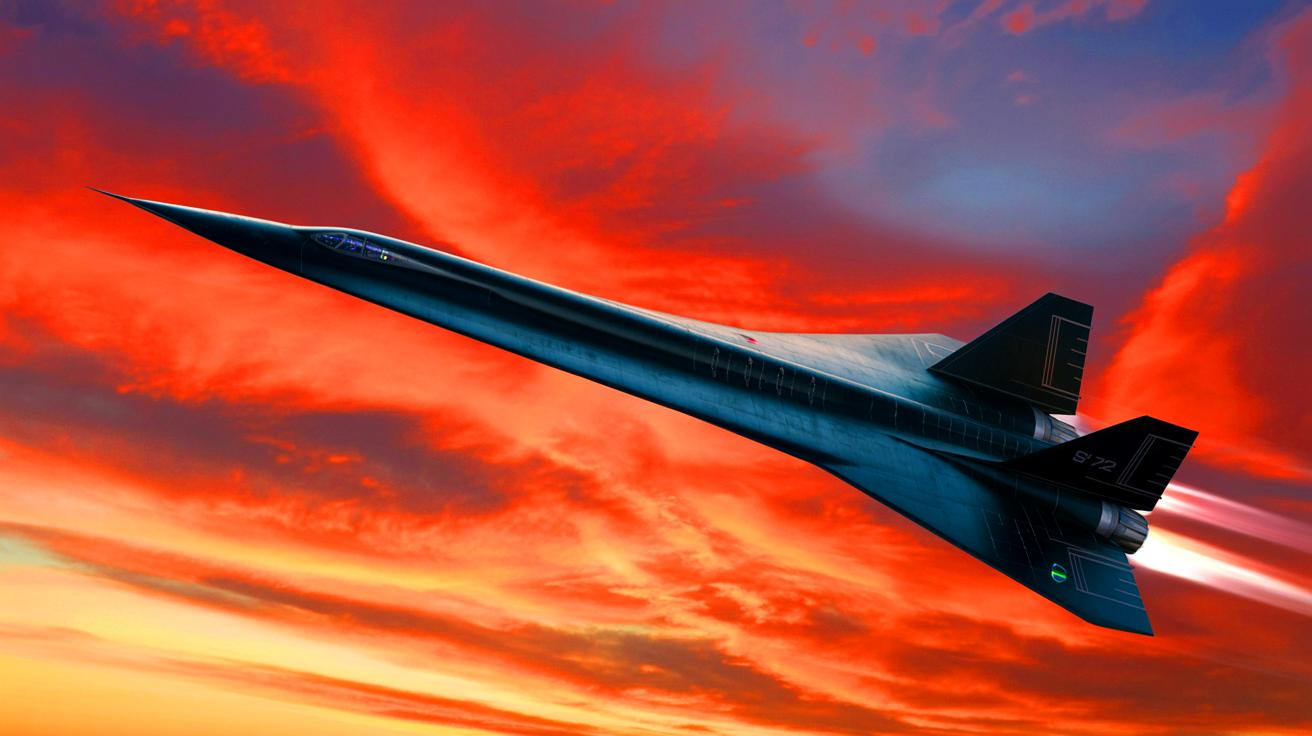
The development of the SR-72 “Darkstar” by Lockheed Martin marks a significant leap forward in aviation technology. As the successor to the legendary SR-71 “Blackbird,” this aircraft is poised to revolutionize military aviation with its hypersonic speeds and advanced stealth capabilities. Despite the veil of secrecy surrounding the project, the potential of the SR-72 is already creating considerable interest and anticipation. With the capability to reach Mach 6, this aircraft could redefine how air missions are conducted by pushing the boundaries of reconnaissance and precision in military strikes.
SR-72: Hypersonic Speeds as a Game Changer
The SR-72 is designed to reach speeds of Mach 6, approximately 4,000 miles per hour. This speed is double that of the SR-71 “Blackbird,” which could achieve Mach 3.2. The ability to travel at such high speeds allows the SR-72 to cover vast distances in a short amount of time, making it an invaluable asset for reconnaissance missions. While the SR-71 was once considered the fastest manned aircraft, the SR-72 surpasses it in many ways. Although satellite technology is advanced, it has the drawback of predictability. Military facilities can calculate satellite orbits and thus evade surveillance. In contrast, the SR-72 can move freely and unpredictably, without being detected by adversaries.
Advanced Propulsion System
Little is known about the propulsion system of the SR-72, but it is expected to use a Turbine-Based Combined Cycle (TBCC) system. This system integrates a turbine engine for lower speeds and a scramjet for higher speeds. The TBCC allows the aircraft to operate efficiently across a wide range of speeds, from subsonic to hypersonic. Scramjet technology is particularly crucial for achieving and maintaining hypersonic speeds, as it permits combustion at supersonic airflow speeds. This combination of propulsion technologies could redefine the boundaries of aviation technology.
Combination of Stealth and Speed
Unlike conventional stealth aircraft, which primarily rely on radar-evading technologies, the SR-72 combines speed with stealth. This combination makes it incredibly difficult to detect or target the aircraft, as it can simply outrun threats. The ability to penetrate heavily defended airspace and gather critical information without being detected is a significant advantage. The speed of the SR-72 makes it challenging for enemy radars to detect and track it. Hypersonic objects, such as missiles, are harder to detect due to their trajectories and speed, offering a tactical advantage.
Applications for Reconnaissance and Strike Missions
The SR-72 is designed to play a significant role in future military operations. Its hypersonic capabilities would allow for rapid response to emerging threats and provide decision-makers with real-time intelligence. Additionally, the SR-72 could be equipped with advanced sensors and communication systems to further enhance its reconnaissance capabilities. The speed and agility of the aircraft make it suitable for strike missions, where it can deliver precision munitions to high-value targets. The SR-72 is not only more technologically advanced than its predecessor but also capable of delivering lethal strikes against enemy targets, significantly increasing its versatility in the U.S. arsenal.
Development Since 2013
Lockheed Martin introduced the SR-72 concept in 2013, with plans to have a test vehicle available by 2025. The development of the SR-72 involves significant technological advancements, particularly in propulsion and material sciences. Engineers are exploring the use of high-performance composites such as carbon, ceramics, and metal alloys to withstand the extreme temperatures generated at hypersonic speeds. If successful, the SR-72 could be operational in the 2030s, providing the U.S. military with a cutting-edge reconnaissance platform. Despite rescheduling and delays, the SR-72 remains a symbol of the future of aviation technology.
The SR-72 “Darkstar” by Lockheed Martin is an ambitious project with the potential to fundamentally alter military aviation. With hypersonic speeds and advanced stealth technology, this aircraft is highly anticipated. As development progresses, one critical question remains: What new technologies and capabilities could be developed for the next generation of aircraft?
Continue reading