

How an indoor snow world keeps its snow intact all year round
An indoor snow world is a large refrigerated building that keeps snow and ice year-round, and its design choices explain what visitors find inside.
 By
Juliette Carrel
In brief
- An indoor snow world is a refrigerated building that keeps snow and ice in any season.
- Insulation, cooling and snow-making are the three systems that hold the setting together.
- Crowd flow, clothing and safety rules shape the visit as much as the attractions.
A snow world is a leisure complex that uses refrigeration to hold a winter setting inside a building, whatever the weather outside. The name Huafa is attached to one such project in China, but the principles described here apply to the whole category of indoor snow parks, and they are the part that stays valid over time.
What the building has to do
Keeping snow in a hall is first a problem of heat. Walls and roofs need heavy insulation, because sunlight, warm air and the bodies of visitors all push the temperature up. Cooling plants run continuously to pull that heat out, and the air is kept cold enough that snow neither melts nor turns to slush on the surface.
Doors are the weak point. Entrances are usually built as airlocks, with a buffer zone between the outside and the cold hall, so that warm, humid air does not rush in each time a group enters. Humidity matters because moisture that enters the hall freezes on surfaces, and it can form frost on ceilings and equipment.
Where the snow comes from
The snow itself is typically made by machines rather than collected. Such equipment sprays fine water droplets into cold air, where they freeze into crystals that settle on the floor. Operators then groom the surface with machinery, much as an outdoor ski area does, so that slopes stay even and safe.
Artificial snow behaves differently from natural snowfall. It tends to be denser and more granular, which suits sliding and play but feels different underfoot. Because the hall is closed, the operator can control the temperature and the texture of the snow far more closely than any outdoor resort could.
What visitors usually find inside
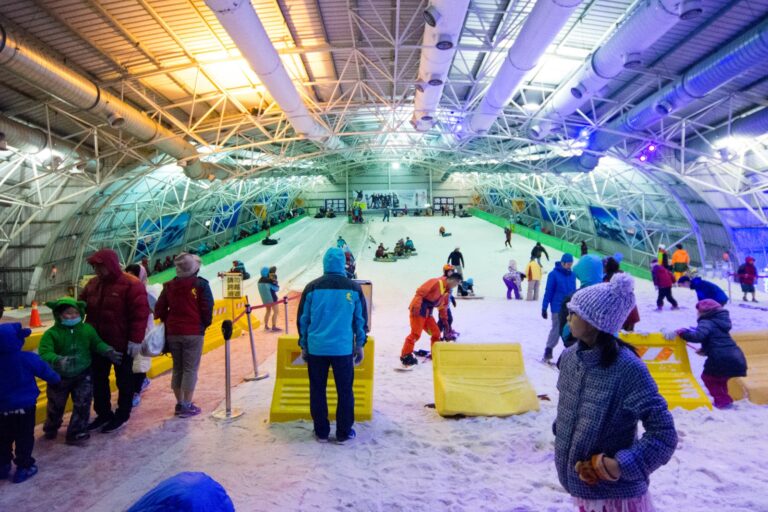
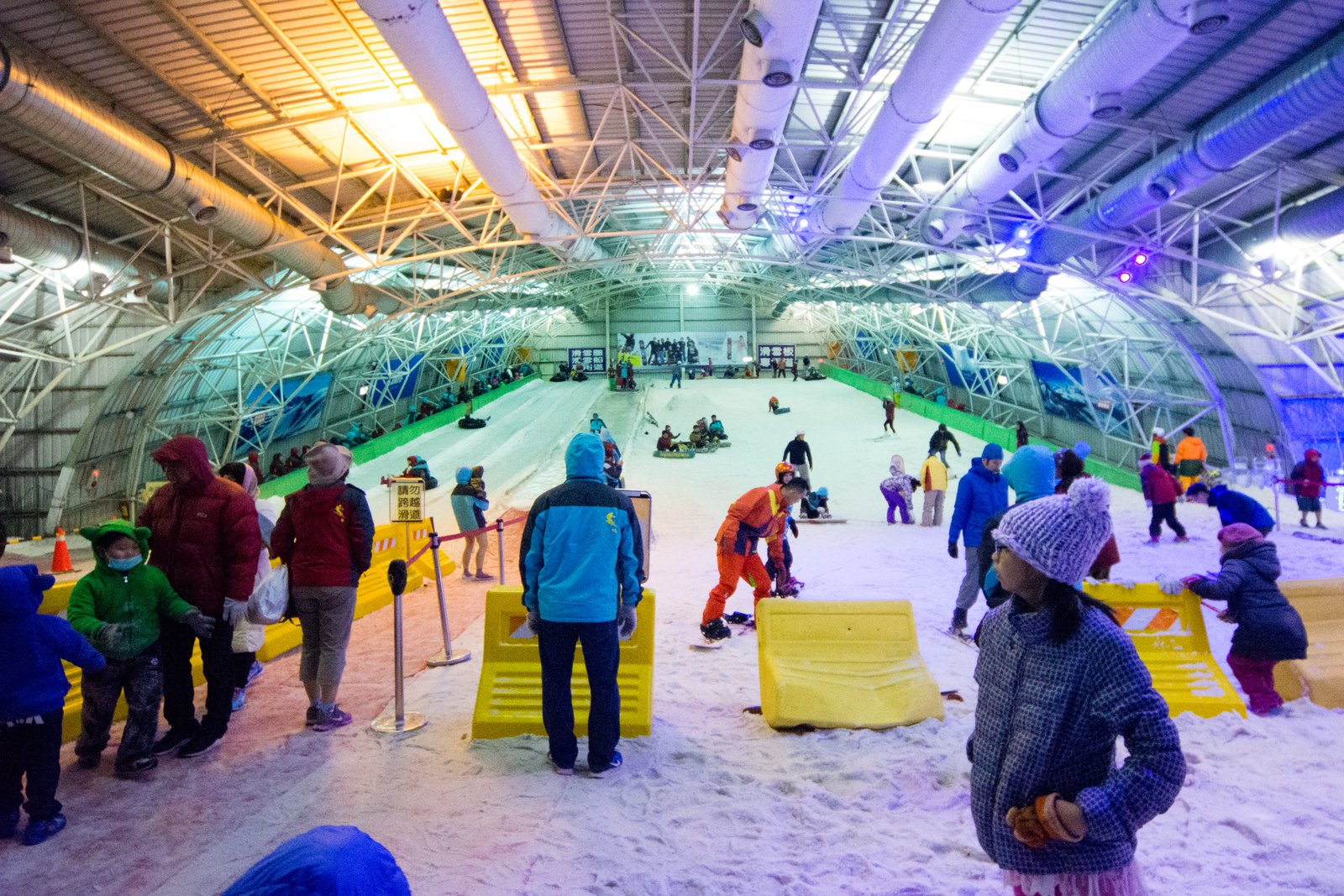
Indoor snow venues combine several kinds of activity under one roof. Many offer a ski or snowboard slope for beginners, along with areas for sledding, tubing, snowball play and sculpted ice features. Some add themed scenery, lighting and shows, so that the visit works for families and for people who have never seen snow.
Because these places target casual visitors, their slopes are generally short and gentle compared with mountain terrain. They are better understood as a controlled introduction to winter sport and winter play than as a replacement for a mountain resort.
Planning a visit
Practical matters shape the experience. Clothing is the first: the hall is cold, and warm layers, gloves and suitable footwear make the difference between a pleasant outing and a short one. Many venues rent jackets, boots and equipment, so it is worth checking what is provided before arriving.
Crowds are the second. Indoor halls have a fixed capacity, and busy periods such as school holidays and weekends can mean queues for slopes and rides. Visiting at quieter times usually gives more room on the snow. Ticket rules, session lengths and age or height limits differ from one operator to the next, so the venue’s own information is the reliable reference.
Safety is the third. Helmets are commonly required on slopes, and staff supervise the lifts and the sliding areas. Beginners are best served by lessons, since falls on hard-packed artificial snow can be more jarring than on soft powder.
Why these venues matter beyond leisure
Indoor snow parks are also an economic and urban story. They draw visitors in warm seasons, support winter sport in regions with little natural snow, and anchor larger entertainment developments. The trade-off is energy: keeping a building cold all year demands substantial power, which is why operators invest in insulation and efficient cooling. For readers following the broader World coverage, such projects show how tourism and engineering meet in places where winter cannot be taken for granted.
Photo: 曾成訓 / Wikimedia Commons, CC BY 2.0
Continue reading