



NASA Planetary Anomaly Warning Escalates As Mysterious Forces Under Earth’s Crust Spread Globally And Trigger Fears Of Uncontrollable Upheaval
 By
Adam Kovács
By
Adam Kovács
| IN A NUTSHELL |
|
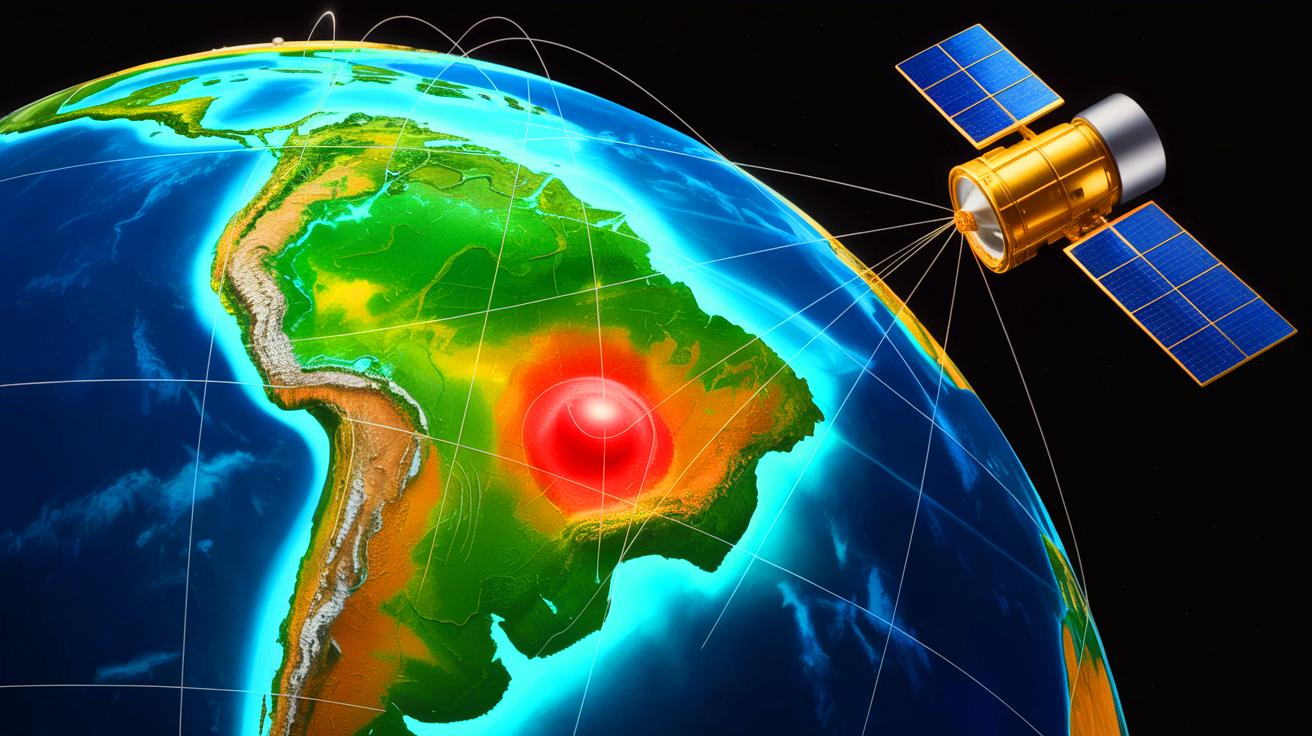
The South Atlantic Anomaly (SAA) has captured the attention of scientists and space agencies worldwide due to its unique characteristics and implications for space technology. Positioned over South America, this region exhibits a weakened magnetic field, posing challenges to the safety and operation of satellites and spacecraft. As the SAA continues to evolve, understanding its origins and potential impacts is crucial for future space missions. This article explores the anomaly’s origins, its effects on space technology, its dynamic nature, and the efforts to anticipate its future behavior.
Understanding the Origins of the Anomaly
The South Atlantic Anomaly represents a significant reduction in the Earth’s magnetic field intensity, allowing high-energy solar particles to penetrate closer to the surface. This geomagnetic phenomenon originates from the geodynamo process occurring in the Earth’s outer core. Here, the movement of molten iron and nickel generates the planet’s magnetic field, which is crucial for protecting Earth from cosmic radiation.
Two major factors contribute to the formation of the SAA. First, the tilt of Earth’s magnetic axis disrupts the normal intensity of the magnetic field in certain regions. Second, the presence of the African Large Low Shear Velocity Province, a dense structure approximately 1,800 miles beneath Africa, plays a significant role. This combination of factors results in a localized polarity reversal and a weakened magnetic field in the SAA region. Understanding these complex interactions is critical for comprehending the broader processes that shape Earth’s magnetic environment.
Impact on Space Technology
The South Atlantic Anomaly presents a substantial risk to space technology, particularly for satellites that pass through this region. High levels of energetic protons can lead to single event upsets (SEUs), causing temporary malfunctions, data corruption, or even permanent damage to spacecraft systems. To mitigate these risks, satellite operators often deactivate non-essential systems while traversing the anomaly.
The International Space Station (ISS), which also passes through the SAA, experiences challenges despite its protective shielding. While astronauts remain safe, external instruments can suffer from “glitches” and data loss. Missions like the Ionospheric Connection Explorer (ICON) play a crucial role in monitoring the SAA and adjusting operations to minimize disruptions. This ongoing impact on space exploration underscores the need for continued vigilance and adaptation.
Dynamic Evolution of the Anomaly
The South Atlantic Anomaly is not a static phenomenon; it is continually changing. Data from the ESA’s Swarm constellation and NASA’s historical SAMPEX mission highlight concerning trends. The anomaly is drifting northwest, expanding, and has recently split into two distinct lobes, creating dual centers of minimum magnetic intensity.
This bifurcation complicates efforts to develop predictive models for geomagnetic conditions, increasing the number of hazardous zones for spacecraft. Understanding the changing morphology of the SAA is essential for ensuring the safety of current and future satellites. Continuous monitoring and adaptation in satellite operations are necessary to counter potential disruptions, illustrating the ongoing challenges posed by the anomaly’s evolution.
Anticipating Future Changes
To better understand and predict the South Atlantic Anomaly, NASA relies on satellite data and simulations of Earth’s core dynamics. These inputs support global models like the International Geomagnetic Reference Field (IGRF), which track the evolution of Earth’s magnetic field. These models are critical for planning space missions and gaining insights into Earth’s internal structure, allowing scientists to estimate secular variation, gradual changes in the magnetic field over years and decades.
While the current evolution of the SAA is unprecedented in the space era, geological records suggest similar anomalies have occurred over long timescales. Importantly, scientists emphasize that the current SAA is not a precursor to a magnetic pole reversal, which occurs over hundreds of thousands of years. Studying the SAA remains vital for protecting orbiting technologies and deepening our understanding of the forces driving our planet.
As the South Atlantic Anomaly continues to evolve, the scientific community remains committed to understanding and mitigating its impact. With the potential to affect satellite operations and influence our understanding of Earth’s magnetic field, the SAA raises intriguing questions about the future of our planet’s magnetic dynamics. What new challenges and opportunities will arise as we continue to explore these unknown frontiers?
Continue reading