

Russia Unveils 180,000-Ton Nuclear Submarine Designed to Transport Gas Under Arctic Ice, Raising Fears of Geopolitical and Environmental Fallout
 By
Adam Kovács
By
Adam Kovács
| IN A NUTSHELL |
|
In an era marked by geopolitical tensions and evolving energy necessities, Russia is setting its sights on a groundbreaking initiative that could redefine global energy logistics. The development of nuclear-powered submarines for transporting liquefied natural gas (LNG) under Arctic ice is an ambitious project that promises increased safety and efficiency. By bypassing traditional surface routes, this innovative approach could overcome significant logistical challenges. In collaboration with Gazprom, the Kurchatov Institute is at the forefront of this endeavor, aiming to revolutionize the way energy is transported across the globe.
Revolutionary Nuclear Underwater Gas Carrier Design
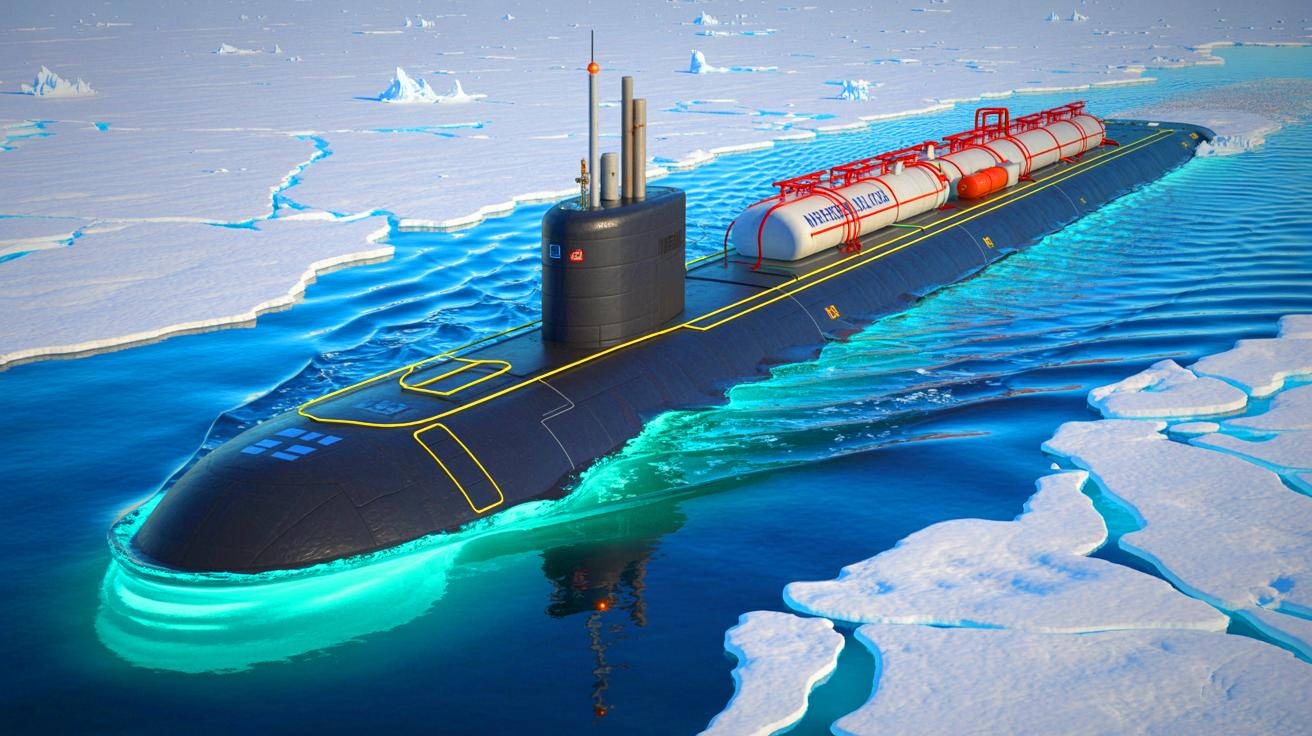
The concept of a nuclear underwater gas carrier represents a significant shift in energy transport methodologies. Recently unveiled by Mikhail Kovalchuk of the Kurchatov Institute, this vessel is equipped with advanced technological features, including three Rhythm-200 nuclear reactors. These reactors power electric motors capable of propelling the submarine at speeds of approximately 17 knots. Such speeds drastically cut down travel time along the Northern Sea Route, from 20 days to just 12 days.
The carrier’s design is both innovative and practical, integrating seamlessly with existing transport infrastructure. With a substantial cargo capacity and a design that minimizes ice contact, the vessel ensures safer and faster transit across treacherous Arctic waters. This approach not only speeds up energy logistics but also enhances safety, positioning it as a transformative solution in the field of global energy transportation.
Kurchatov Institute’s Collaboration with Gazprom
The Kurchatov Institute’s partnership with Gazprom stands as a cornerstone of this pioneering project. This collaboration aims to tackle the perennial challenge posed by Arctic ice, which has historically impeded LNG transport during several months of the year. Discussions about nuclear-powered gas carriers began in the early 2000s, but it is only now, with Gazprom’s involvement, that the project is gaining the momentum needed for realization.
Despite its promise, the project faces logistical challenges, particularly the shallow waters of the Ob Bay, which prevent submerged navigation. This necessitates the use of icebreakers to guide the submarines to deeper waters. Nevertheless, the potential for year-round LNG transport could significantly enhance gas export capabilities from Russia’s northern regions, offering a reliable alternative to traditional methods.
Enhanced Safety and Efficiency Over Surface Carriers
The enclosed nature of submarine transport provides a safer alternative to traditional LNG carriers and pipelines. By operating underwater, these carriers minimize the risk of environmental spills and disruptions caused by surface conditions. Additionally, the compact nature of these submarines allows them to transport gas volumes equivalent to subsea pipelines, offering an efficient solution to current logistic challenges.
This initiative emerges in response to the shortage of traditional LNG tankers, exacerbated by international sanctions. Russia’s principal LNG producer, Novatek, faced setbacks when plans to expand its fleet were thwarted by geopolitical tensions. Consequently, the development of the Northern Sea Route experienced delays, with cargo transport projections falling significantly short of expectations.
Challenges and Implications for Global Energy Transport
Despite its potential, the project is not without challenges. Technological difficulties at the Rosneft-controlled Zvezda shipyard have hindered domestic production timelines, and international contract terminations have further complicated progress. Nevertheless, the potential benefits of nuclear-powered LNG transport remain promising, offering a pathway to reduced reliance on traditional energy routes.
Russia’s pursuit of this technology positions it as a frontrunner in innovative energy transport solutions. If successful, it could signal a new era of logistics, with significant implications for global energy markets and environmental considerations. As the world grapples with shifting energy demands, this bold initiative raises a critical question: Will this pioneering approach set a precedent for future advancements in energy transport?
Continue reading