

“Unlimited Power Within Reach”: Scientists Successfully Harness Star-Level Temperatures In Revolutionary Breakthrough That Transforms Energy Forever
 By
Adam Kovács
By
Adam Kovács
| IN A NUTSHELL |
|
In the south of France, a monumental step has been taken in the pursuit of nuclear fusion at the ITER project site in Cadarache. Westinghouse, a major American player in the nuclear industry, has secured a contract worth 168 million euros to undertake the final assembly of the reactor’s core. This core, known as the “toroid,” is a critical component in the quest to replicate the power of the stars on Earth. The assembly of this massive structure marks a pivotal moment in the ongoing effort to harness fusion energy, a potential game-changer in the global energy landscape.
Westinghouse Takes on Reactor Core Assembly
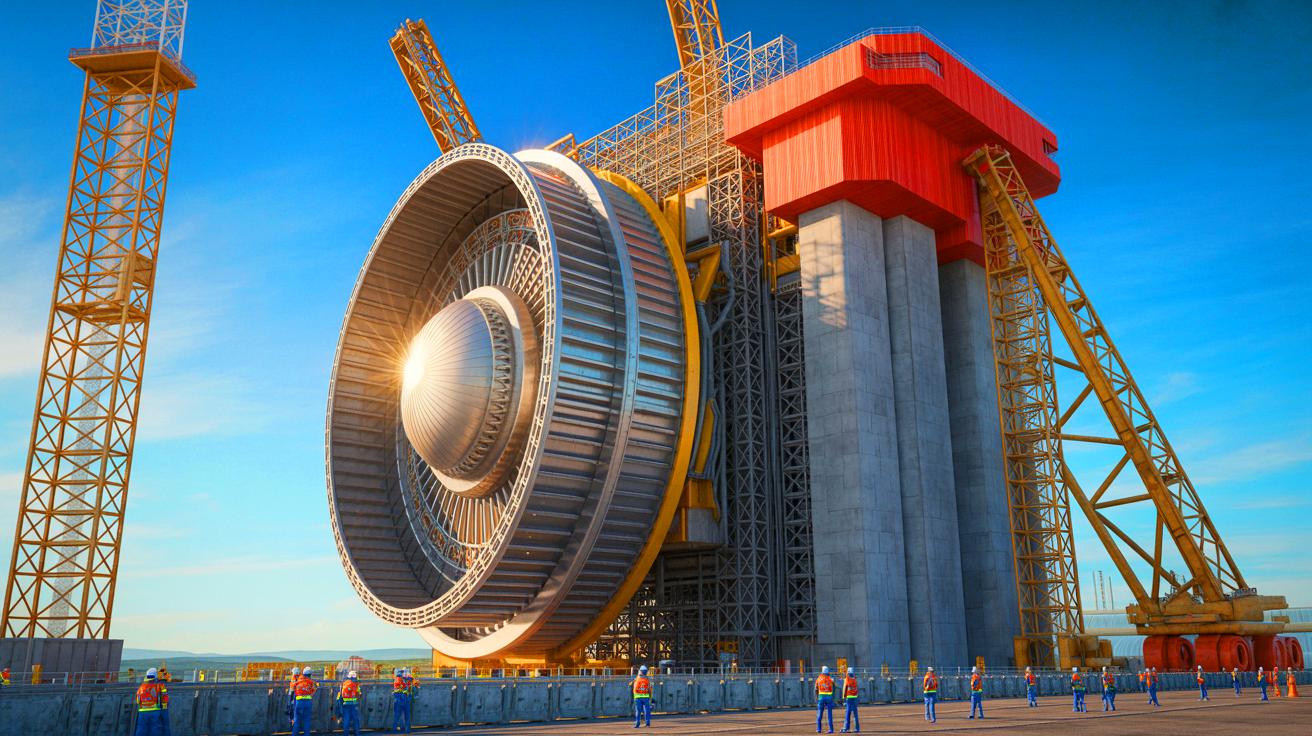
The heart of ITER’s mission lies in the toroid, a doughnut-shaped chamber at the center of the tokamak. This device is designed to recreate the conditions found in the core of a star, where nuclear fusion occurs. To achieve this, the tokamak will heat plasma to temperatures exceeding 270 million degrees Fahrenheit, causing hydrogen nuclei to fuse and release vast amounts of energy.
Containing this superheated plasma requires an engineering marvel of a container. The toroid itself is constructed from nine massive steel sectors, each weighing over 400 tons. These sections must be meticulously welded together in a giant pit at the Cadarache site. The aim is to create a perfectly sealed, circular chamber where no atoms of air can enter or escape.
The complexity of this task is akin to assembling a 5,000-ton puzzle while suspended over a void, all without room for error. The precision required is unparalleled, as even the slightest flaw could compromise the integrity of the reactor.
A Decade of Preparation Leads to Assembly
Westinghouse’s involvement in ITER is not a recent development. For over a decade, the company has been a key player in the project, collaborating with Italian firms Ansaldo Nucleare and Walter Tosto as part of the AMW consortium. Together, they have already manufactured five of the nine toroid sectors.
Now, the focus shifts from fabrication to assembly. This phase presents new challenges, including welding the massive components while managing thermal constraints, metal deformations, and vibrations. Ultrasonic testing will ensure the integrity of each weld, as the reactor must withstand extreme conditions once operational.
The goal is to create a stable environment where the plasma can circulate at incredible speeds without touching the reactor walls. This delicate balance is essential to achieving the desired fusion reactions.
ITER: A Global Collaboration
While ITER is located in France, it is far from a French-only endeavor. The project represents a collaboration among 35 countries, including the United States, China, Russia, Japan, India, South Korea, and all European Union nations. This global partnership seeks to demonstrate the feasibility of hydrogen fusion as a clean, abundant, and nearly limitless energy source.
The reactor aims to produce 500 megawatts of fusion power with an energy input of just 50 megawatts. Although ITER will not generate electricity, it serves as a prototype for future fusion reactors that could one day supply power to the grid.
The next step in this journey is DEMO, the successor to ITER, which will take the lessons learned and apply them to a fully operational fusion power plant.
The Long Road to Fusion Energy
ITER’s journey began in 2010 with the ambitious goal of producing its first plasma in 2018. However, technical challenges, design changes, and the sheer complexity of the undertaking have delayed the timeline. The current target for the first deuterium-tritium fusion experiments is 2035.
Before reaching that milestone, the assembly of the reactor must be completed, including the integration of superconducting magnets, cryogenic systems, and advanced control mechanisms. The toroid is only the beginning, but it represents a significant step forward in the long quest for fusion energy.
As Winston Churchill once said, “This is not the end. It is not even the beginning of the end. But it is, perhaps, the end of the beginning.”
ITER by the Numbers
| Element | Value |
|---|---|
| Total Estimated Cost | Approximately $24 billion |
| Number of Partners | 35 countries |
| Fusion Power Target | 500 MW for 400 seconds |
| Power Injected into Plasma | 50 MW |
| Number of Toroid Sectors | 9 |
| Diameter of Toroid | 62 feet |
| Total Chamber Weight | 5,000 tons |
| First Fusion Experiments | 2035 (target) |
As the ITER project progresses, it stands as a testament to human ingenuity and international cooperation. The challenges are immense, but the potential rewards are equally significant. By advancing our understanding of fusion energy, we move closer to a future where clean and abundant power is a reality. How will the lessons learned from ITER shape the future of global energy policies and international collaboration in scientific endeavors?
Continue reading