

“They Build F-35s In 30 Hours”: Northrop Grumman’s Robot Factory Produces Fighter Jets While China Cannot Match This Speed
 By
Adam Kovács
By
Adam Kovács
| IN A NUTSHELL |
|
The accelerated production of F-35 Lightning II fighter jets signifies a transformative moment in the defense industry. Northrop Grumman, a key player in this sector, has implemented advanced technologies to significantly reduce the production time of crucial components for these sophisticated aircraft. In just 30 hours, a central fuselage is now manufactured, showcasing the impact of technological innovation on military production. This development raises numerous questions about the strategic and operational implications of such advancements.
The Central Fuselage: Core Component of the F-35
The central fuselage is a vital component in the architecture of the F-35 aircraft. It integrates complex intake systems, an internal weapons bay, and fuel tanks. These elements are essential for maintaining the aircraft’s performance and efficiency. Northrop Grumman, as the manufacturer, also produces the weapon bay doors and door drive systems. The precision of alignments and specific coatings applied to the central fuselage contribute to the F-35’s unique capabilities. Over 1,400 central fuselages have been delivered to date, demonstrating the effectiveness and success of this process.
The central fuselage’s design allows for the integration of various systems that enhance the aircraft’s stealth and combat capabilities. This includes housing advanced radar and communication systems, which are crucial for modern warfare. The production of these components requires not only technical expertise but also an understanding of the strategic requirements of military operations.
Automated Integrated Technology
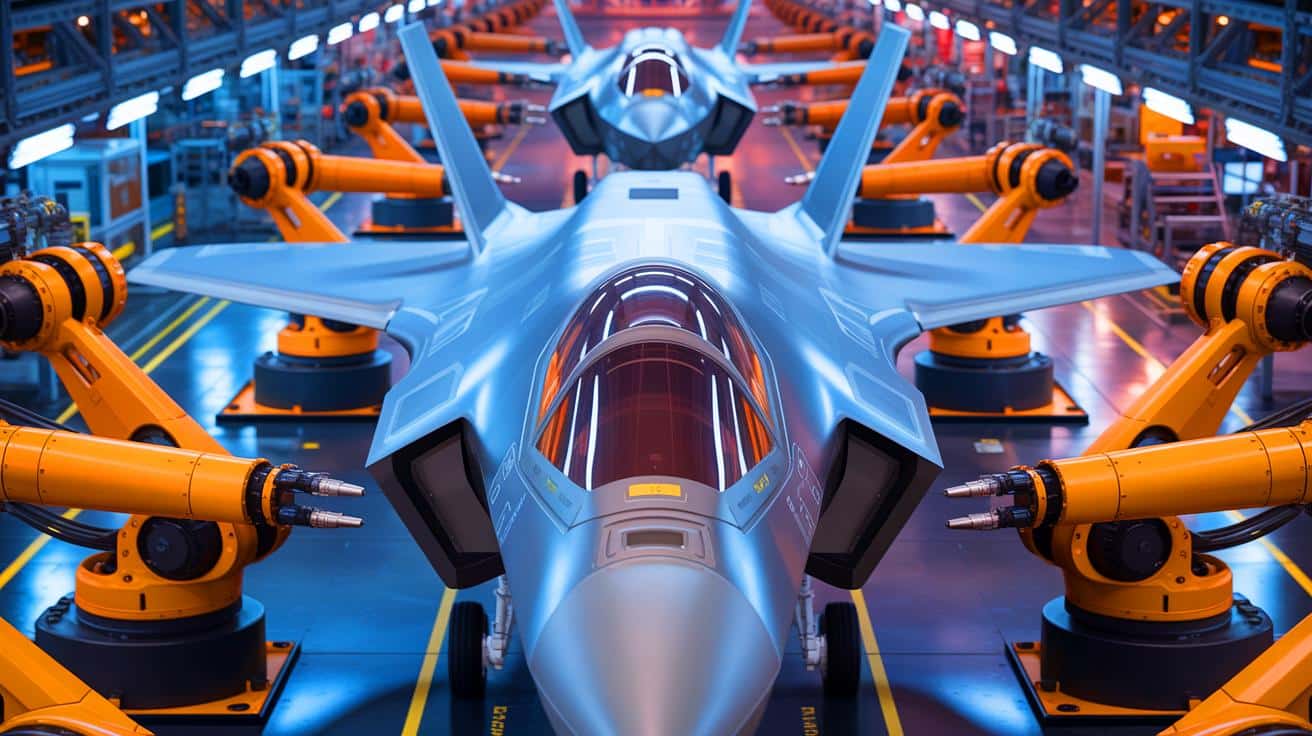
Northrop Grumman’s Integrated Assembly Line (IAL) represents the forefront of automation in military production. This system maximizes the use of robotics to enhance production capacity and ensure high production rates. Through this technology, it is possible to achieve engineering tolerances that are challenging to accomplish manually. The facility accommodates all variants of the F-35, offering impressive production flexibility.
Automated guided vehicles, robotic drilling, and molded coating systems are part of the integrated innovations. These technological advancements improve quality control and reduce the time and effort required for production. By utilizing such automation, Northrop Grumman not only increases efficiency but also sets a benchmark for future manufacturing processes in the defense sector.
The use of robotics and automation in the Integrated Assembly Line allows for unprecedented precision and speed in production.
One of the Most Advanced Manufacturing Facilities
Northrop Grumman claims that the IAL is among the most advanced military manufacturing facilities. By combining human and mechanical strengths, the facility produces central fuselages for all F-35 variants. Spanning the size of a football field, it contains over 3,000 parts and up to 115 assembly positions. With a processing capacity of 10 million parts annually, the facility completes a fuselage every 30 hours, significantly increasing production capacity.
This heightened efficiency represents a significant advancement in arms manufacturing. The integration of sophisticated machinery and skilled labor allows for rapid and precise production at a scale previously unattainable. Such capabilities not only enhance Northrop Grumman’s production output but also set a new standard for the defense industry.
Strategic Partnership and Future Prospects
Northrop Grumman is a key partner in the F-35 Lightning II industrial consortium. Besides producing central fuselages, the company develops advanced radar systems, communication subsystems, and provides support for the EODAS system. It also handles the development of mission systems, mission planning software, and pilot and maintenance training systems.
This involvement strengthens Northrop Grumman’s position as a leader in the defense industry and raises questions about the future impact of these innovations on the global market. How will accelerated production influence global defense strategies, and what technological innovations will emerge in the coming years?
As Northrop Grumman continues to push the boundaries of technology in defense manufacturing, the implications for the industry are profound. The integration of advanced automation and robotics not only enhances production efficiency but also sets a course for future innovations. How will these advancements shape the military capabilities of nations and influence the strategic landscape in the years to come?