


Here’s a Shocking New Threat: Metal-Cutting Drones From China Could Soon Be Flying Over Your Home
A groundbreaking development by a team of Chinese researchers has resulted in a lightweight drone system capable of reflecting high-powered laser beams, raising significant ethical and regulatory concerns as it promises to redefine military strategies worldwide.
 By
Adam Kovács
By
Adam Kovács
| IN A NUTSHELL |
|
A team of researchers in China has achieved a significant breakthrough in drone technology by developing a system capable of reflecting high-powered laser beams. Led by scientist Li Xiao, this innovative approach involves using a lightweight drone that does not carry its own laser source. Instead, it redirects a beam emitted from a ground station, allowing for precise targeting. This development promises to reshape military strategies while also raising important ethical and regulatory questions. As advancements in technology continue, the implications of such innovations will be crucial in the discussions surrounding global security and warfare.
Revolutionary Laser Technology In Drone Systems
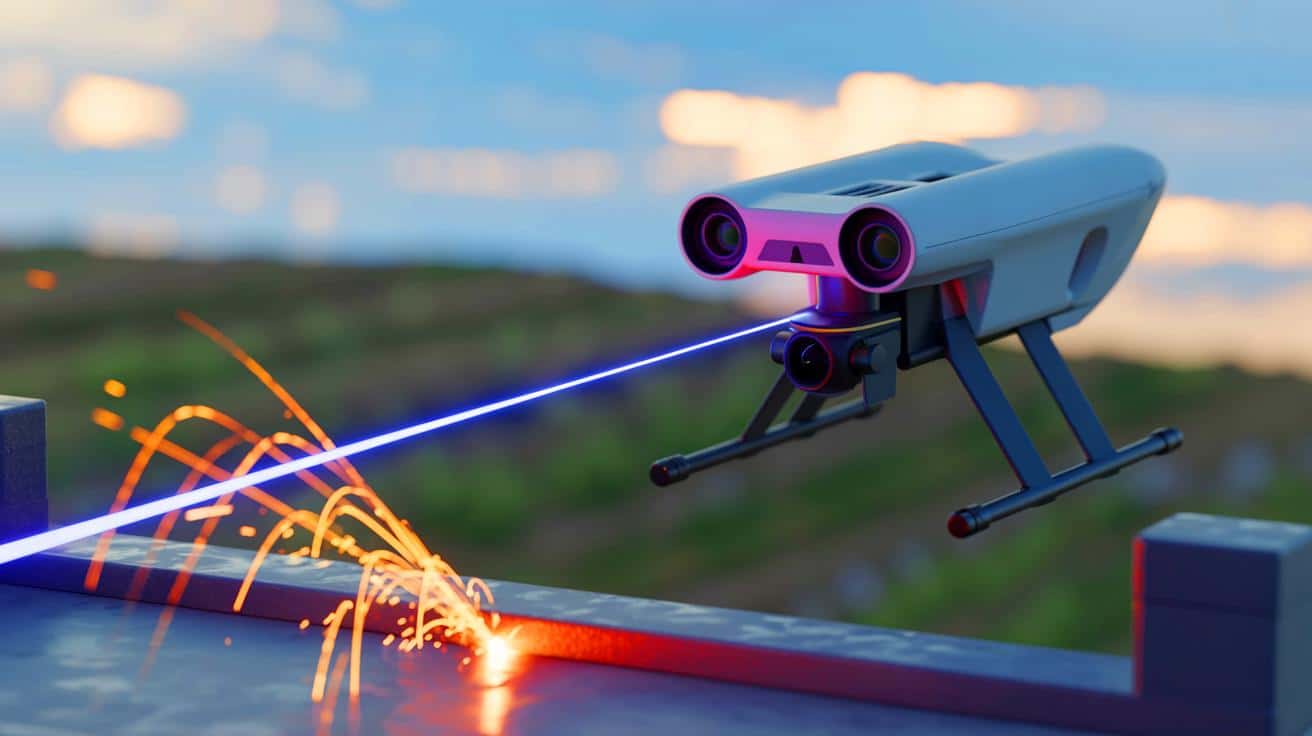
Under the guidance of Li Xiao, a team of Chinese researchers has engineered a drone system capable of reflecting powerful laser beams. This technology enables the drone to cut through metal with remarkable precision. A defining feature of this system is its compact design, which distinguishes it from traditional laser systems that typically require substantial equipment.
The drone does not carry the laser source itself, marking a significant shift from conventional methods. Instead, the laser is projected from a ground station and redirected by the drone. This innovative approach reduces the weight burden on the drone and allows it to utilize a laser power exceeding 30 kW. Such high power levels were previously unattainable without bulky equipment mounted on large vehicles.
Innovative Design And Functionality
The design of this laser system incorporates two telescope-like tubes. The first tube captures the laser beam from the ground, while the second directs it toward the target. The precision of this process is ensured through ultra-precise servomechanisms and high-performance reflective mirrors. These elements work together to maintain the stability of the laser beam even under challenging flight conditions.
One of the primary challenges encountered by the researchers was the vibrations produced during the drone’s flight. These vibrations posed a risk of dispersing the laser beam, which could compromise accuracy. To address this issue, the team developed advanced solutions for vibration isolation and optical stabilization. These innovations guarantee that the laser maintains a stable trajectory, enabling the drone to perform with exceptional precision.
Potential Military Applications And Strategic Implications
The potential military applications of these laser-equipped drones are extensive. The research team envisions scenarios where drones operate in swarms, detecting targets and coordinating laser strikes in conjunction with ground-based support. Their ability to navigate around obstacles and accurately target vulnerable points makes them a formidable asset in modern warfare.
These technological advancements stem from recent progress in laser telecommunications and precise synchronization between mobile devices. China’s successful launch of a quantum satellite in 2016 laid the groundwork for these unprecedented applications. Integrating such advanced technologies into military strategies could redefine warfare, providing new tactical advantages that shift the balance of power.
Ethical Concerns And Regulatory Challenges
While the technological achievements of laser-armed drones are impressive, they also raise significant ethical and regulatory concerns. The potential to alter military strategies globally is substantial, prompting necessary discussions about arms control and regulation. The international community closely monitors these developments, as their implications extend beyond scientific advancements.
The capacity to deploy precise and powerful laser strikes from drones introduces new dimensions to military ethics and international security. Balancing scientific innovation with responsible regulation presents a pressing challenge for global leaders. As these technologies evolve, the need for robust ethical guidelines becomes increasingly important to ensure their use aligns with international norms.
The integration of laser technology into drone systems carries profound implications for military strategy and global security. While these advancements enhance operational capabilities, they also demand careful consideration of ethical and regulatory frameworks. As nations navigate the balance between innovation and responsible governance, how will they address the challenges posed by laser-armed drones on the battlefield?
[diginov_stars rating=”4.4″ votes=”27″ lang=”en”]