



Refined Title: “The Stealth Bomber: A $80 Billion Defense Asset That Instills Fear in Adversaries”
The United States Air Force's B-21 Raider, a cutting-edge stealth bomber, has swiftly transitioned from prototype to pre-production at Edwards Air Force Base, underscoring its pivotal role in enhancing U.S. strategic air capabilities as it undergoes rigorous testing by the 412th Test Wing.
 By
Adam Kovács
By
Adam Kovács
| IN A NUTSHELL |
|
The B-21 Raider has recently made headlines with its successful test flights at Edwards Air Force Base. This advanced stealth bomber, developed by Northrop Grumman, is designed to enhance the United States’ strategic air capabilities. The rapid pace of its development and testing reflects a strong commitment to maintaining air superiority in an evolving global military landscape. As the first new bomber introduced in decades, the B-21 promises to redefine modern warfare with its innovative design and advanced technology.
The Role Of The 412th Test Wing
The 412th Test Wing plays a pivotal role in the development and testing of the B-21 Raider. This unit, part of the U.S. Air Force, is responsible for evaluating the aircraft’s performance under various conditions. Within this wing, the Global Power division focuses specifically on the Raider, ensuring rigorous testing protocols are followed. Recently, the 420th Flight Test Squadron was reassigned from Arizona to California to concentrate on this project.
This move highlights the strategic significance of the B-21 program. The testing phase includes four aircraft: one prototype and three pre-production models. Each flight is meticulously planned to gather data that will inform the Raider’s future capabilities. Collaboration between engineers and pilots is essential. Their combined expertise ensures that every test flight yields critical insights, pushing the program closer to achieving Initial Operational Capability (IOC).
Communication And Public Perception
The U.S. Air Force’s approach to communication regarding the B-21 Raider marks a notable change in strategy. Traditionally, military projects have been shrouded in secrecy, particularly during the initial development stages. However, the unveiling of the Raider has seen a shift toward greater transparency. The Air Force has released images and information that showcase the aircraft’s design, moving beyond the prototype phase.
This openness serves multiple purposes. It not only maintains public interest but also fosters support from taxpayers and the media. The recent images of the B-21 illustrate its sleek, stealthy design, which is crucial for its intended operations. By sharing updates, the Air Force aims to build trust and demonstrate the significance of the Raider in enhancing national security.
Design And Specifications
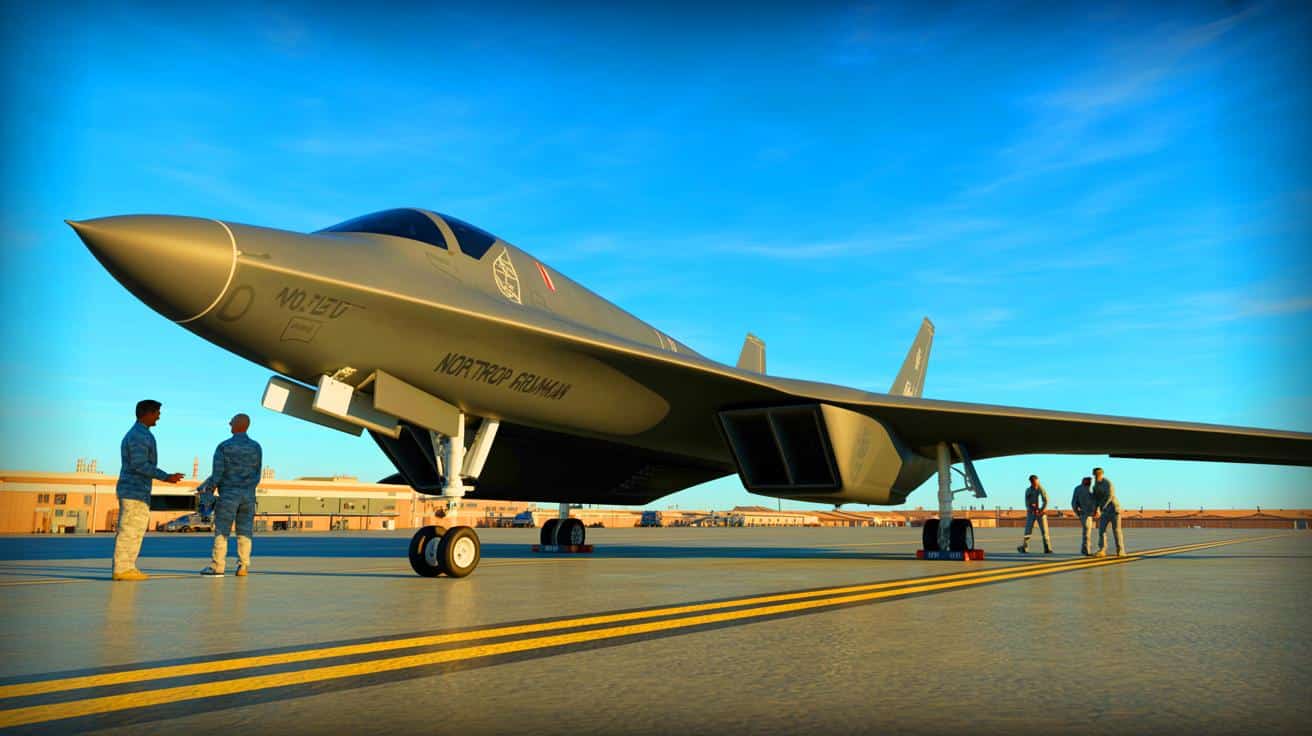
The design of the B-21 Raider is one of its most striking features. Ground photos taken at Edwards Air Force Base reveal the aircraft’s low ground clearance, which is even less than that of the B-2A Spirit. This design choice is critical for aerodynamic efficiency and stealth capabilities. The B-21 is slightly smaller than its predecessor, with a wingspan of approximately 131 feet and a length of about 52 feet.
These dimensions enhance the aircraft’s stealth profile, making it less detectable by enemy radar systems. The compact size does not compromise its operational effectiveness. The B-21 is engineered to deliver strategic payloads efficiently. Below is a comparison of the B-21 Raider and the B-2A Spirit:
| Feature | B-21 Raider | B-2A Spirit |
|---|---|---|
| Wingspan | 131 feet | 172 feet |
| Length | 52 feet | 69 feet |
Looking Ahead: Future Prospects
The future of the B-21 Raider holds significant promise as its test flights continue. With each flight, anticipation builds regarding its capabilities and the advancements it may introduce to military aviation. The transition from a controlled information environment to one that encourages openness reflects a broader trend within the military. This shift aims to engage the public and foster support for vital defense initiatives.
The Raider symbolizes not only technological innovation but also a strategic asset for the U.S. Air Force. As it moves closer to operational readiness, the B-21 will play a crucial role in shaping future military strategies. It represents an investment in air superiority that will influence U.S. defense policy for years to come. The question remains: How will the B-21 Raider impact global military dynamics, and what other innovations in stealth technology can we expect in the near future?
[diginov_stars rating=”4.6″ votes=”23″ lang=”en”]
Continue reading