


“This Could Be the Moment We Find Life”: Europe’s Mars Rover Will Drill Deeper Than Ever to Uncover What’s Hidden Beneath the Red Planet
 By
Adam Kovács
By
Adam Kovács
| IN A NUTSHELL |
|
The search for extraterrestrial life is set to reach unprecedented depths on Mars with the launch of the European Space Agency’s ExoMars Rosalind Franklin Rover in 2028. This mission represents a significant leap in the quest to uncover signs of life on the Red Planet. For the first time, a rover will drill up to two meters below the Martian surface, where it is believed that organic compounds and bio-markers might be preserved away from the harsh surface conditions. This groundbreaking mission is backed by cutting-edge technology, including the newly developed Enfys infrared spectrometer, which will be pivotal in analyzing the samples collected from beneath Mars’ surface.
ExoMars Rosalind Franklin Rover
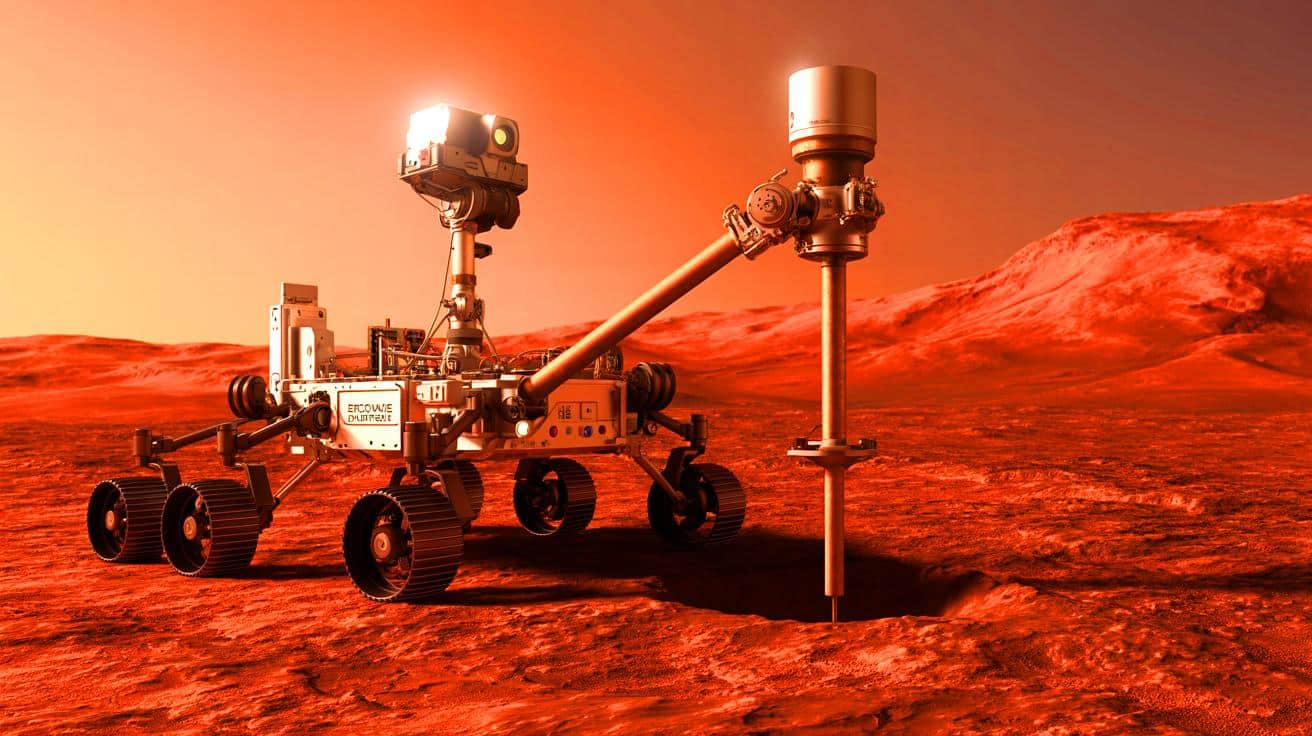
The ExoMars Rosalind Franklin Rover is a pioneering mission with a singular objective: to find evidence of life on Mars. This mission is unique in its design, as it targets the subsurface of the planet. The rationale behind this approach lies in the belief that organic materials, shielded from the planet’s harsh surface conditions, might still exist below ground. The rover’s ability to drill two meters deep is a calculated decision. This depth is considered sufficient to reach potentially preserved materials, offering a glimpse into Mars’ past when its conditions might have been similar to early Earth. The samples collected could date back nearly four billion years, providing invaluable information about the origins of life.
Harry Marsh, a postgraduate researcher involved in the project, explains that the chosen drilling depth balances scientific goals with the rover’s mechanical constraints. Deeper drilling would necessitate larger and more power-intensive equipment, which is impractical for a mobile rover. Thus, the two-meter depth is a strategic compromise, allowing the rover to remain efficient while maximizing its scientific potential.
The Enfys Infrared Spectrometer
A crucial component of the ExoMars mission is the Enfys infrared spectrometer, a state-of-the-art instrument designed to play a key role in the search for Martian life. This spectrometer works in conjunction with PanCam, another onboard instrument, to identify optimal drilling sites. The Enfys spectrometer analyzes the samples retrieved from beneath the surface, providing detailed data on their composition.
The surface of Mars is inhospitable to organic materials due to intense ionizing radiation, oxidants, and ultraviolet light. However, material located two meters below the surface is shielded from these destructive forces, providing a more favorable environment for the preservation of organic compounds. The ability to drill and retrieve such samples sets the ExoMars Rosalind Franklin Rover apart from previous missions, offering a novel opportunity to detect signs of past or present life.
Testing a Mars Rover
Before the Enfys spectrometer embarks on its journey to Mars, it undergoes rigorous testing on Earth. Researchers utilize a Ground Test Model, an Earth-based twin of the Rosalind Franklin Rover, within a Martian terrain simulator in Turin, Italy. This simulator recreates the challenging conditions of the Martian environment, allowing engineers to refine the rover’s systems and ensure its readiness for the mission.
Dr. Matt Gunn from Aberystwyth University highlights the significance of this testing phase, noting the pride it brings to the Welsh scientific community. The installation of Enfys on the Ground Test Model marks a critical milestone, enabling the team to conduct thorough evaluations and adjustments. This iterative process ensures that the rover is fully prepared to carry out its mission on Mars, pushing the boundaries of planetary exploration.
The Path Ahead
As the ExoMars Rosalind Franklin Rover prepares for its 2028 launch, the focus shifts to finalizing the Enfys spectrometer’s flight model. The engineering team at Aberystwyth University is dedicated to integrating test data and perfecting the system that will be installed on the rover. This meticulous preparation is essential to ensure the mission’s success and the potential discovery of life on Mars.
The upcoming years will be pivotal as researchers continue to refine their systems and strategies. If successful, the ExoMars mission could redefine our understanding of life beyond Earth. The potential findings from this mission hold the promise of answering fundamental questions about the existence of life on other planets and the conditions that might allow it to thrive.
The ExoMars Rosalind Franklin Rover’s mission is a testament to human ingenuity and curiosity, representing a bold step into the unknown. As scientists prepare to explore the depths of Mars, the possibility of discovering life on another planet becomes increasingly tangible. What new insights into the universe and our place in it could this mission uncover?
Continue reading