


“China Launches 100 Drone Death Swarm”: Jiu Tian Mothership Releases Kamikaze Robots While Pentagon Scrambles To Counter Attack
 By
Adam Kovács
By
Adam Kovács
| IN A NUTSHELL |
|
The development of China’s Jiu Tian drone mothership represents a significant advancement in military technology, with the potential to change the dynamics of modern warfare. Capable of deploying up to 100 small kamikaze drones, this system could achieve unprecedented battlefield coverage and efficiency. However, the technical challenges and strategic implications of such a system are substantial. As global powers closely monitor these developments, questions arise about the future of drone warfare and its impact on international security.
The Concept Behind Jiu Tian
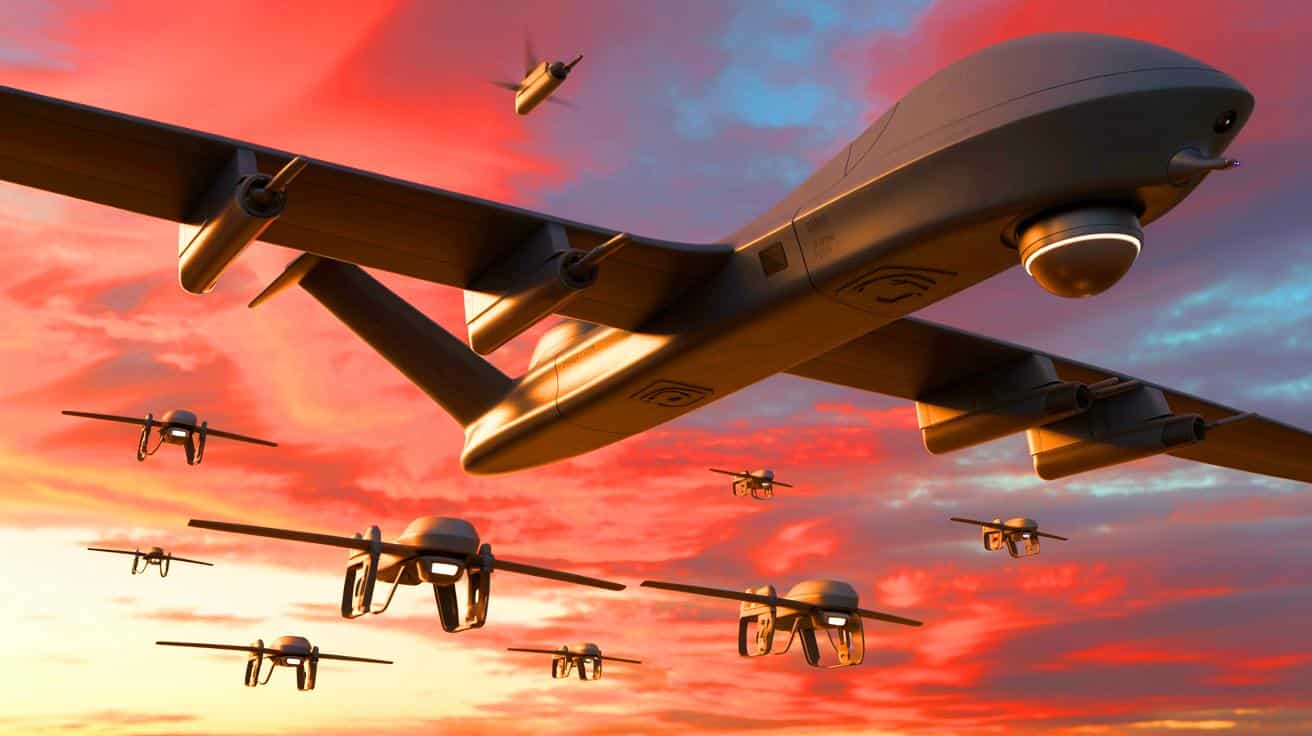
The Jiu Tian, or “Ninth Heaven,” is a massive drone mothership designed to release a swarm of small, kamikaze drones. This concept envisions a scenario where drones systematically scan and target battlefield elements, from armored vehicles to individual soldiers. Each drone, equipped with a lethal warhead and sensors, acts like a guided missile, small enough to infiltrate bunkers and other fortified positions. This approach could revolutionize military tactics by allowing rapid concentration of force over a large geographic area.
However, the execution of this concept faces significant challenges. Large, non-stealth aircraft like the Jiu Tian are vulnerable to modern air defenses. Additionally, controlling a swarm of drones presents technical difficulties, such as maintaining communication and ensuring precise targeting. Despite these hurdles, the Jiu Tian’s potential to perform reconnaissance or attack missions with high efficiency is noteworthy. Whether this system will achieve its intended capabilities remains to be seen, but it undoubtedly represents a bold step forward in drone warfare technology.
Technical Challenges and Strategic Implications
The Jiu Tian’s design raises questions about its operational viability. With a wingspan nearly equivalent to that of a Boeing 737 and a weight of 11 tons, this drone is built for high-altitude, long-duration missions. However, the thin air at high altitudes poses a challenge for the smaller drones it carries. These drones may struggle to generate the necessary lift and thrust, potentially compromising their effectiveness.
Moreover, the reliance on human operators for controlling the FPV (first-person view) kamikaze drones introduces further complications. The anticipated range and operational scope require an advanced communications infrastructure, likely involving satellite relays, to maintain connectivity between operators and drones. This dependency on human intervention underscores the need for advancements in drone autonomy. As military strategists consider the implications of such technologies, the balance between human control and autonomous operation remains a critical consideration.
Potential Applications and Limitations
Beyond its role as a drone mothership, the Jiu Tian has a variety of potential applications. It could serve as a platform for maritime surveillance, reconnaissance, and long-range strike missions. Its versatile payload bay and underwing pylons allow for the transport of cargo, additional fuel, or heavy weaponry, making it a multifunctional asset in military operations.
However, the limitations of the Jiu Tian should not be overlooked. Its vulnerability in contested airspace, coupled with the challenges of deploying small drones over vast distances, highlights the need for further technological advancements. The reliance on current drone autonomy technology, which is not yet fully developed, presents a significant obstacle. To realize the full potential of the Jiu Tian and similar systems, continuous innovation in autonomy and communication technologies is essential.
The Future of Drone Warfare
The Jiu Tian’s development reflects a broader trend in military strategy: the increasing reliance on drone technology for various operational roles. As nations seek to enhance their capabilities, the integration of drone swarms into military doctrine becomes a pressing focus. The potential for autonomous drone swarms to perform complex tasks with minimal human intervention is a tantalizing prospect for military planners.
Yet, the path to operationalizing such systems is fraught with challenges. The need for scalable, reliable, and autonomous drone swarms capable of executing lethal attacks is a complex endeavor that requires substantial investment and research. As military forces around the world explore these possibilities, the question remains: Can the technological hurdles be overcome to create effective and reliable autonomous drone systems?
As the Jiu Tian continues to undergo development and testing, its impact on the future of drone warfare is eagerly anticipated. This advancement prompts a fundamental question: How will the integration of advanced drone technologies reshape global military strategies and the nature of warfare in the coming decades?