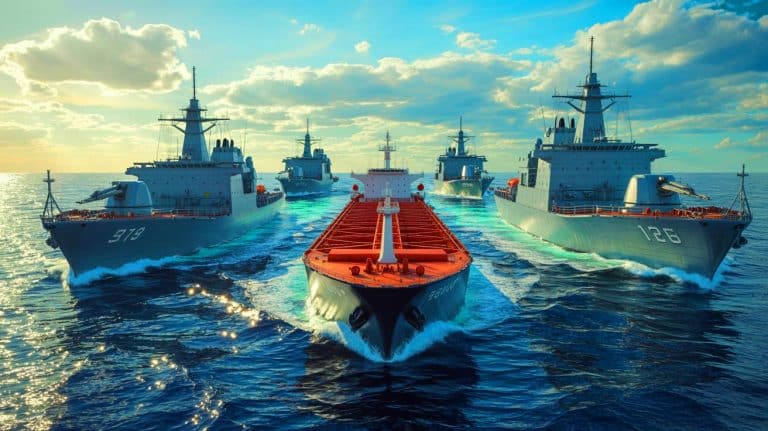



“The Navy Is Going Full Robot” as DARPA’s Uncrewed Battle Groups Ignite Explosive Debate Over Autonomous Warships and the End of Human Command at Sea
 By
Adam Kovács
By
Adam Kovács

| IN A NUTSHELL |
|
The concept of autonomous naval battle groups is rapidly gaining traction within the United States military. At the forefront of this innovation is the Defense Advanced Research Projects Agency (DARPA), which envisions a future where robotic assets play a pivotal role in naval operations. This shift towards automation is driven by a combination of technological advancements and the practical constraints of building and maintaining a traditional manned fleet. As the Navy explores these possibilities, significant experimentation is underway to assess how these uncrewed systems might integrate into existing military operations. The potential benefits are vast, but so are the challenges and risks involved.
The Vision for Autonomous Naval Battle Groups
Greg Avicola, a program manager at DARPA, has outlined a bold vision for the future of naval operations. He imagines a battle group comprised entirely of autonomous units, each varying in size, role, and capability. This concept suggests a departure from the traditional aircraft carrier-centric model to a more diverse and flexible fleet configuration. Avicola emphasized the need for extensive experimentation in the design and operation of these systems. He posed questions about logistics, refueling, and maintaining assured communications between platforms.
Despite Avicola’s enthusiasm, Navy leaders have expressed more caution. In 2020, for instance, acting Navy Secretary Thomas Modly suggested that autonomous capabilities might actually necessitate an increase in manned vessels. Nevertheless, the rapid pace of technological advancement and financial constraints on fleet expansion are influencing the Navy’s approach, making the integration of autonomous systems more appealing.
Prototyping and Operational Challenges
The development of prototypes is a critical step in realizing the vision of autonomous naval warfare. DARPA’s Tactical Technology Office, under Avicola’s guidance, has already completed a prototype 180-foot robotic ship known as the Defiant. This project falls under the No Manning Required Ship (NOMARS) program. However, the road to operational deployment is fraught with challenges. Among the most pressing concerns is ensuring that these robotic ships can operate independently, even in the event of damage or malfunction.
If a robotic ship breaks down and cannot return to port independently, the Navy may lose confidence in investing in further autonomous vessels.
https://visegradpost.com/en/2025/07/26/theyre-prepping-for-the-unthinkable-us-converts-cargo-containers-into-nuke-bunkers-fueling-explosive-fears-of-remote-war-escalation/
This highlights the practical barriers that must be overcome to gain the trust of military commanders and policymakers. Addressing these issues is crucial for the successful deployment of autonomous warships.
Risks and Strategic Considerations
The integration of autonomous vessels into naval operations is not without risks. Loading these ships with offensive capabilities could make them attractive targets for adversaries. Avicola pointed out that while intelligence and surveillance payloads might be relatively safe, arming these vessels with missiles presents significant strategic challenges. If such vessels were to be captured by enemy forces, the consequences could be severe.
To mitigate these risks, Avicola suggests deploying uncrewed vessels as part of a larger, mixed group that includes manned platforms. In this configuration, autonomous ships would take on auxiliary roles, such as serving as magazines, point defense outposts, or electronic warfare platforms. These vessels would operate under human command, providing support to the battle group while minimizing the risk of capture or misuse by adversaries.
Advancements in Undersea Autonomy
Undersea autonomous systems represent another frontier in the Navy’s exploration of robotic warfare. Rear Adm. Douglas Adams, program executive officer for undersea warfare systems, discussed the challenges of maintaining communication with these systems. Unlike aerial drones, undersea vehicles must remain in contact with other vessels in the battle group to maximize their effectiveness. This is complicated by the difficulty of underwater communication, which often requires vehicles to surface.
Despite these challenges, significant progress has been made in recent years. Techniques using the sea floor, water column, or air-water interface for communication are under development. Vice Adm. Robert Gaucher highlighted the Navy’s willingness to accept the risks associated with unmanned experimentation. He cited a successful, albeit challenging, effort to launch and recover an underwater drone from a submarine. This progress underscores the Navy’s commitment to embracing innovation, even in the face of potential setbacks.
The move towards autonomous naval operations marks a significant shift in military strategy, driven by technological advances and logistical constraints. As the Navy continues to explore this frontier, questions remain about the best ways to integrate these systems into existing frameworks. How will the balance between manned and unmanned vessels evolve in the coming years, and what impact will this have on global naval power dynamics? These are critical considerations as the military navigates the complexities of the future battlefield.
Continue reading