



“Congress Saves Navy’s Fighter Jet”: F/A-XX Program Gets $1.4 Billion While Boeing and Northrop Battle for That Next-Generation Contract
 By
Adam Kovács
By
Adam Kovács
| IN A NUTSHELL |
|
The competition to develop the next generation of carrier-based fighter jets for the U.S. Navy has taken an intriguing turn. With Boeing entering the fray with its vision for the F/A-XX fighter, the landscape of military aviation is poised for transformation. This development comes after a period of uncertainty, where the project seemed at risk of being shelved. However, recent financial boosts and increased interest from top military officials have revived hopes for this ambitious program. As the Navy evaluates competing designs from Boeing and Northrop Grumman, the stakes are high for both companies to secure a pivotal role in shaping the future of aerial combat.
The Evolution of the F/A-XX Program
The F/A-XX Next Generation Air Dominance (NGAD) program, once on the brink of cancellation, has received a significant boost in recent months. Initially struggling with minimal funding, the program’s future was uncertain until Congress intervened. The Senate Appropriations Committee approved an additional $1.4 billion, while the House allocated $972 million, providing the necessary financial lifeline. This influx of funds reflects a renewed commitment to advancing the Navy’s aerial capabilities.
With Lockheed Martin exiting the competition in March 2025, only Boeing and Northrop Grumman remain as viable contenders. The decision to continue investing in the F/A-XX program demonstrates the military’s recognition of the need for advanced technology to meet evolving threats. Vice Admiral Daniel Cheever’s comments about the program being “eagerly awaited” further underscore the Navy’s strategic interest in developing a cutting-edge fighter jet.
Boeing’s Vision for the Future
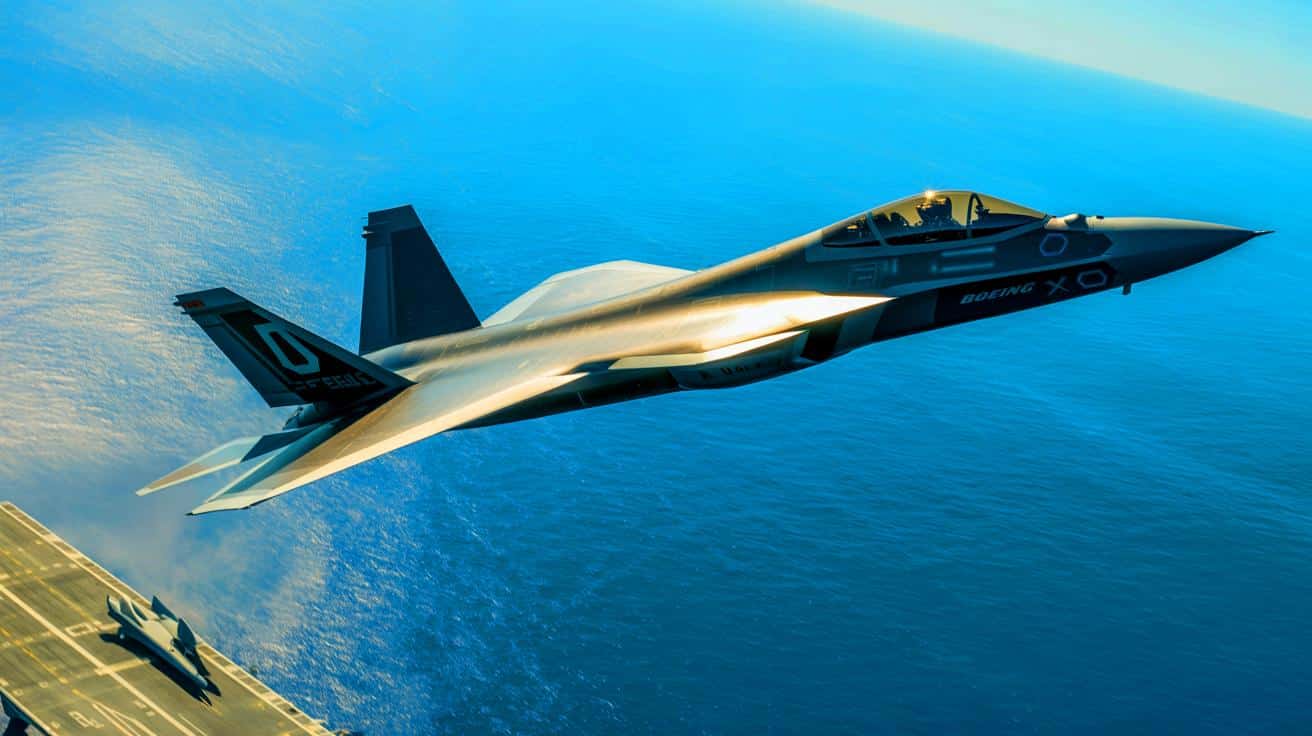
Boeing’s recent unveiling of its F/A-XX concept at the Tailhook Symposium showcases its commitment to innovation. The rendering, although sparse in detail, highlights key design elements that set it apart. The F/A-XX is tailless and twin-engined, emphasizing stealth and maneuverability. Notably, the presence of canards suggests a trade-off between stealth and agility, signaling Boeing’s focus on operational versatility.
“The F/A-XX is designed to excel in strike carrier operations, offering a multi-role capability that includes air combat, ground attack, and surface warfare.”
https://visegradpost.com/en/2025/09/01/they-build-f-35s-every-30-hours-northrop-grummans-robot-factory-completes-fighter-jet-fuselages-faster-than-cars-now/
As the successor to the aging F/A-18 Super Hornet, the F/A-XX aims to integrate seamlessly into carrier operations. Its advanced AI capabilities enable it to function as a command center for drone swarms, enhancing situational awareness and battlefield coordination. Additionally, the aircraft’s power plant is designed to extend its range by 25%, ensuring its effectiveness across the vast expanse of the Pacific theater.
Challenges and Opportunities Ahead
Despite the optimistic outlook, challenges remain in the path of the F/A-XX program. The ongoing budget negotiations between Congress and the White House could impact the program’s trajectory. Concerns about the ability of the U.S. defense industry to support two next-generation fighter programs also loom large. These factors underscore the importance of strategic decision-making in determining the program’s future.
Nevertheless, the Navy’s enthusiasm for the F/A-XX is palpable. The program’s emphasis on pilot-optional capabilities and integration with global networks positions it as a cornerstone of future military strategy. The ability to deploy hypersonic missiles and directed energy weapons further enhances its combat potential, making it a formidable asset in the Navy’s arsenal.
The Road to a Final Decision
As the competition intensifies, the Navy is poised to make a pivotal decision in the coming weeks. The choice between Boeing and Northrop Grumman will shape the future of carrier-based aviation for decades to come. Both companies are leveraging their expertise to meet the Navy’s stringent requirements, aiming to deliver a fighter jet that embodies technological advancement and operational excellence.
“The F/A-XX program represents a significant investment in the future of military aviation, with the potential to redefine aerial combat.”
The final decision will not only impact the defense industry’s landscape but also influence the strategic capabilities of the U.S. Navy. As stakeholders eagerly await the outcome, the F/A-XX program stands at a crossroads, with the potential to usher in a new era of air dominance.
In light of these developments, the future of the F/A-XX program remains uncertain yet promising. The ongoing deliberations and technological innovations underscore the complexity of modern military procurement. As the Navy prepares to make its decision, the question remains: which design will ultimately secure its place in the next generation of naval aviation?