


“China’s UFO Drone Looks Like Gimbal”: Elliptical VTOL Aircraft Doubles Lift Efficiency While That Ring-Wing Design Flies at Zhengzhou University
 By
Adam Kovács
By
Adam Kovács
| IN A NUTSHELL |
|
In recent years, the field of drone technology has seen remarkable advancements, with both civilian and military applications expanding rapidly. One of the latest developments comes from China, where researchers at Zhengzhou University of Aeronautics have successfully tested a vertical take-off and landing (VTOL) drone. This particular drone, with its unique design, bears an uncanny resemblance to the so-called “Gimbal” UFO, a mysterious object captured on video by a U.S. Navy pilot nearly a decade ago. The drone’s development raises intriguing questions about the convergence of aerospace design and the potential implications for future aviation technology.
UFO-Inspired VTOL Design
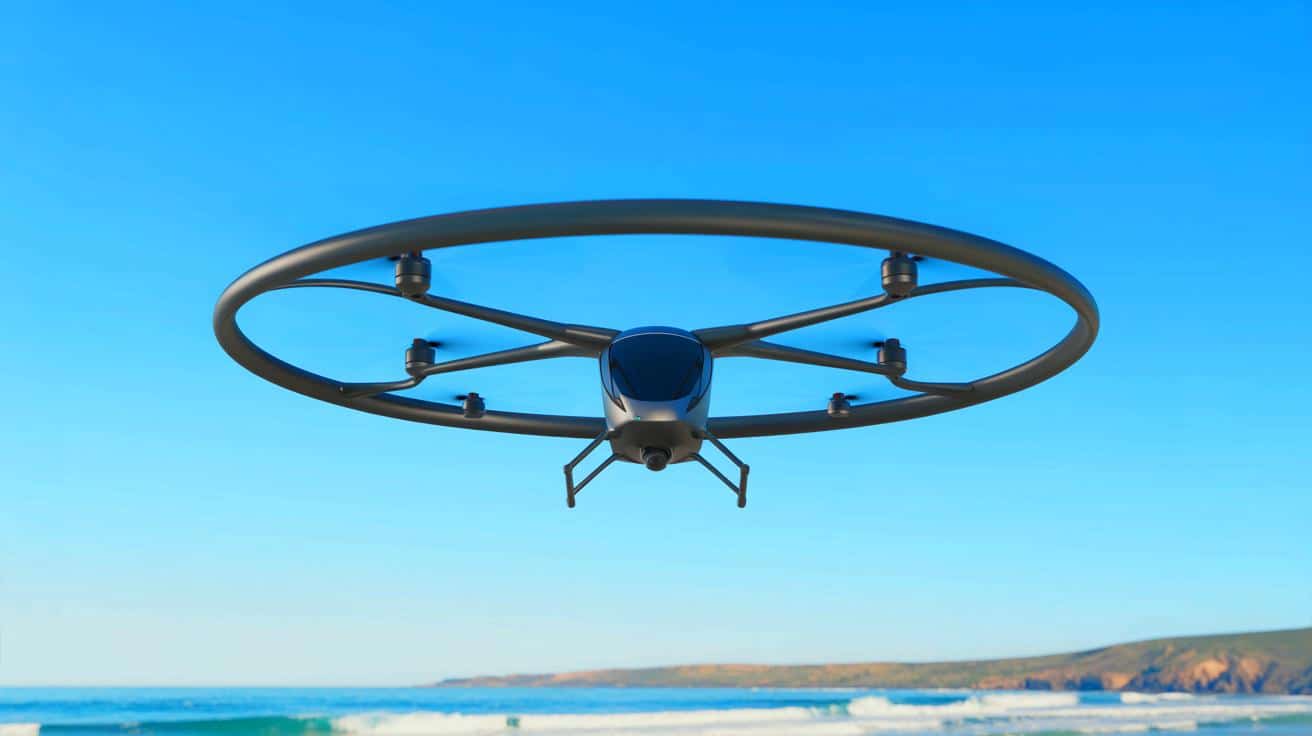
The recent unveiling of a VTOL drone by Chinese researchers has drawn considerable attention due to its striking resemblance to the “Gimbal” UFO, an unidentified flying object recorded by a U.S. Navy pilot in 2015. According to the South China Morning Post, the drone’s design departs from conventional quadcopter or fixed-wing forms, instead adopting an elliptical, closed-loop wing that integrates a straight central section with vertical stabilizers. This innovative design addresses a long-standing trade-off in aviation: the need for both vertical take-off capability and efficient forward flight.
Project leader Professor Liu Zhanhe explained that the drone combines the advantages of multirotor drones and fixed-wing aircraft. Traditional VTOL drones can hover and land in tight spaces but often sacrifice range and endurance. Conversely, fixed-wing drones offer greater efficiency in flight but require runways or catapult systems. Liu’s team argues that their elliptical wing design bridges this gap, with rotors providing steady lift during vertical take-off and landing.
Once airborne, the drone transitions into forward flight, with the hybrid wing generating substantial lift. This design leverages circulation control and enhanced pressure differentials to achieve significantly improved lift efficiency. Simulations and test flights have demonstrated that the drone’s lift curve slope is more than double that of conventional straight wings.
Civilian and Military Applications
The potential applications for the drone are vast, encompassing both civilian and military domains. The aircraft is designed to accommodate modular payloads, including sensors, supply pods, emergency equipment, and atmospheric samplers. According to the project team, the drone could be employed for battlefield surveillance, maritime reconnaissance, environmental monitoring, and emergency response.
Potential missions include water-quality sampling, rapid delivery of supplies to remote areas, and search-and-rescue operations in challenging coastal environments where traditional drones may struggle. The South China Morning Post noted that Chinese scientists are exploring more streamlined VTOL designs for naval deployment, including drones capable of launching from warships.
Despite the positive results achieved in initial tests, challenges remain. The unique shape of the ring wing introduces additional aerodynamic drag, prompting the team to refine the wing’s curve and shape. Moreover, control algorithms need optimization to prevent inefficient flight patterns that increase drag. While some critics suggest that spindle-shaped aircraft can be unstable, Liu’s team reported that their prototype maintained steady flight during test runs.
Implications for Future Aviation
For many observers, the drone’s silhouette recalls the unexplained Gimbal footage that captured international attention nearly a decade ago. While the U.S. Navy has not provided an explanation for the 2015 sighting, Chinese researchers assert that their aircraft demonstrates the practical aerodynamic advantages of unconventional forms. As Professor Liu and his colleagues noted in a peer-reviewed paper earlier this year, the drone offers “the best of both worlds from multi-rotor and fixed-wing aircraft.”
“The experimental aircraft departs from conventional forms, adopting an elliptical, closed-loop wing with vertical stabilizers.”
As technological advancements continue to blur the lines between science fiction and reality, the implications for future aviation are profound. The ability to innovate and develop aircraft that defy traditional design norms may unlock new possibilities for both military and civilian applications.
Challenges and Future Directions
While the drone’s development represents a significant step forward, it also underscores the complexities inherent in pioneering new aerospace technologies. The team at Zhengzhou University of Aeronautics continues to refine their design, seeking to overcome the challenges posed by aerodynamic drag and control efficiency. As they work to optimize the drone’s performance, the question remains: how will these advancements shape the future of aviation?
Looking ahead, the success of this VTOL drone could inspire further exploration of unconventional aircraft designs. The potential to enhance flight performance and adaptability holds promise for a range of applications. However, as with any technological innovation, careful consideration of ethical, environmental, and geopolitical implications is essential. How will the aviation industry balance innovation with responsibility as it navigates this uncharted territory?