


“We’re Building An Underwater Minefield That Thinks For Itself”: Chinese Scientists Create AI-Powered Submarine Traps Around Contested Paracel Islands
 By
Adam Kovács
By
Adam Kovács
| IN A NUTSHELL |
|
In a move that could potentially reshape naval strategies in the South China Sea, Chinese military scientists are pioneering a plan to transform the underwater landscape around the Paracel Islands into a formidable submarine trap. By leveraging advanced technologies and the region’s complex seafloor, China aims to establish a covert defensive network capable of evading detection while precisely targeting adversary submarines. This initiative underscores the strategic importance of the Paracels, as well as the evolving nature of maritime security and territorial claims in the region.
Submarine Hideouts in Sonar Shadow Zones
The Paracel Islands, a contested archipelago in the South China Sea, have been under Chinese control since 1974. Known as the Xisha Islands in China and the Hoang Sa Islands in Vietnam, this collection of reefs and atolls is situated about 300 nautical miles from the Chinese mainland. Despite China’s dominance, both Taipei and Hanoi continue to assert claims over the islands, making them a regional flashpoint.
The United States regularly conducts freedom of navigation operations in this area, deploying submarines and surface vessels to challenge China’s maritime claims and ensure open sea lanes. This ongoing presence underscores the strategic significance of the Paracels, which have become a hub for military operations.
Chinese researchers are now focusing on the region’s underwater topography to exploit sonar dead zones. These areas, characterized by complex terrain such as submerged mountain peaks, provide ideal hiding spots where sound waves scatter or disappear. Such zones could offer China a tactical advantage by concealing underwater assets from detection and challenging U.S. dominance in undersea operations.
Regional Claims Overlap in the Paracels
Despite heavy Chinese presence, the Paracel Islands remain a contentious region. Vietnam maintains outposts on nearby islands, and the Philippines, Malaysia, and other nations have overlapping claims. This geopolitical tension adds complexity to the strategic dynamics of the South China Sea.
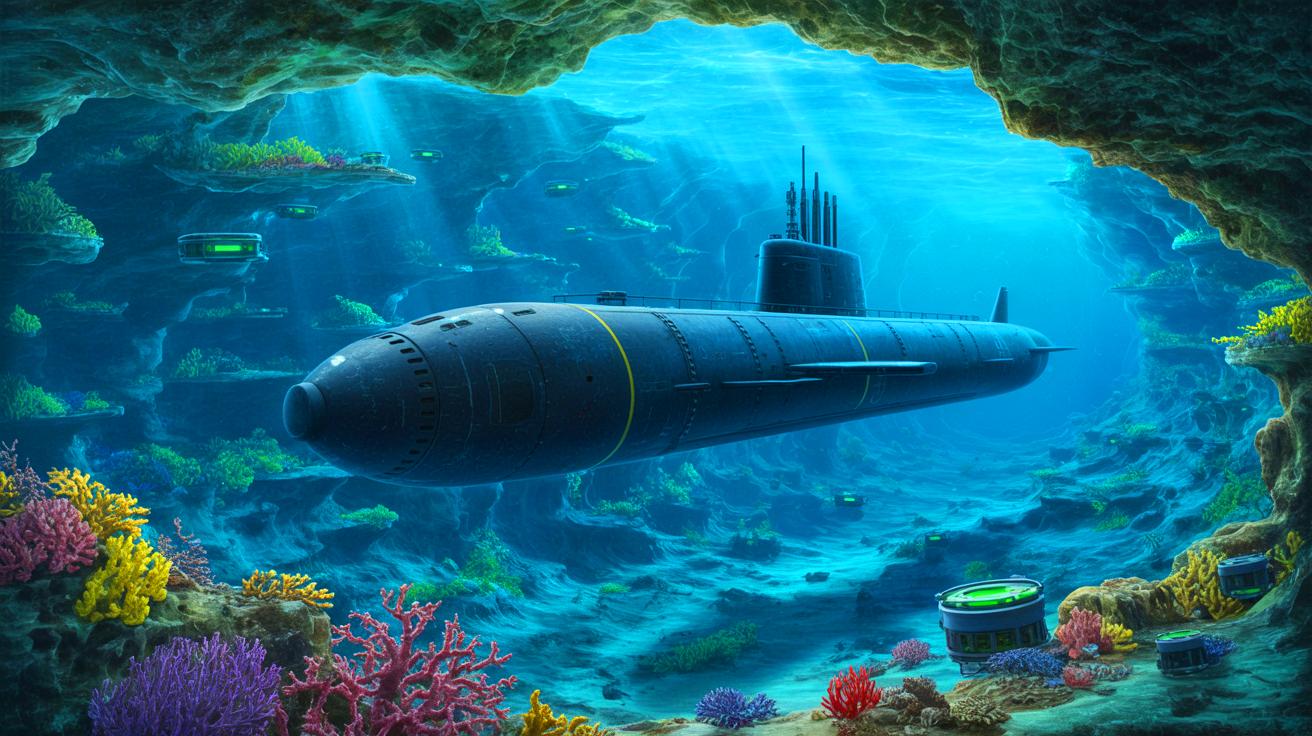
Chinese military scientists propose deploying AI-powered, long-endurance mines in the acoustic blind zones around seamounts. These mines, equipped with sophisticated sensors, can autonomously identify vessels by their unique signatures. They are designed to selectively target pre-approved adversaries, such as U.S. submarines or carrier strike groups, creating a highly effective underwater defense system.
The People’s Liberation Army (PLA) has utilized high-resolution bathymetric maps derived from deep-sea sonar surveys to develop detailed models of acoustic propagation. These models, combined with real-time oceanographic data, could enable China to deploy mines with precision, posing a challenge to U.S. undersea dominance maintained by its fleet of nuclear submarines.
Innovations in Underwater Defense Technology
The concept of using AI-powered mines represents a significant advancement in underwater defense technology. These intelligent mines can operate autonomously for extended periods, continuously monitoring and analyzing the underwater environment. Their ability to discern between friend and foe based on acoustic, magnetic, and optical signatures marks a leap forward in military technology.
By integrating AI with advanced sensor technology, these mines can adapt to changing conditions and respond swiftly to threats. This capability not only enhances China’s defensive posture but also exemplifies the growing role of artificial intelligence in modern warfare. The potential deployment of such technology in the South China Sea could significantly alter the balance of power in the region.
Researchers emphasize the strategic advantage of deploying these mines in acoustic shadow zones, where they are less likely to be detected by enemy forces. This approach could provide China with a covert yet effective means of securing its territorial claims and deterring foreign naval presence.
Implications for Regional Security
The deployment of AI-powered mines in the Paracel Islands poses significant implications for regional security. As China strengthens its maritime defenses, neighboring countries and global powers must reassess their strategic approaches to the South China Sea. The introduction of advanced underwater technologies could escalate tensions and provoke a military response from rival nations.
Moreover, the selective targeting of adversary vessels raises ethical and legal questions regarding the use of autonomous weapons. The international community may need to establish new norms and regulations to address the challenges posed by AI in military applications.
The South China Sea remains a critical theater for geopolitical competition. The development and deployment of innovative defense technologies will likely continue to shape the region’s security landscape. As nations vie for influence and control, the question remains: how will these technological advancements affect the future of maritime security and international relations?
As tensions persist in the South China Sea, the future of the Paracel Islands and their surrounding waters remains uncertain. The integration of AI-powered technologies in military strategies highlights the evolving nature of naval warfare. How will these developments influence the geopolitical balance in the region, and what measures can be taken to ensure stability and peace in this strategically vital area?