


“This French Company Builds Sun On Earth”: Thales Launches $20 Million Nuclear Fusion Project Using High Power Lasers That Could Replace All Fossil Fuels By Mid 2030s
 By
Adam Kovács
By
Adam Kovács
| IN A NUTSHELL |
|
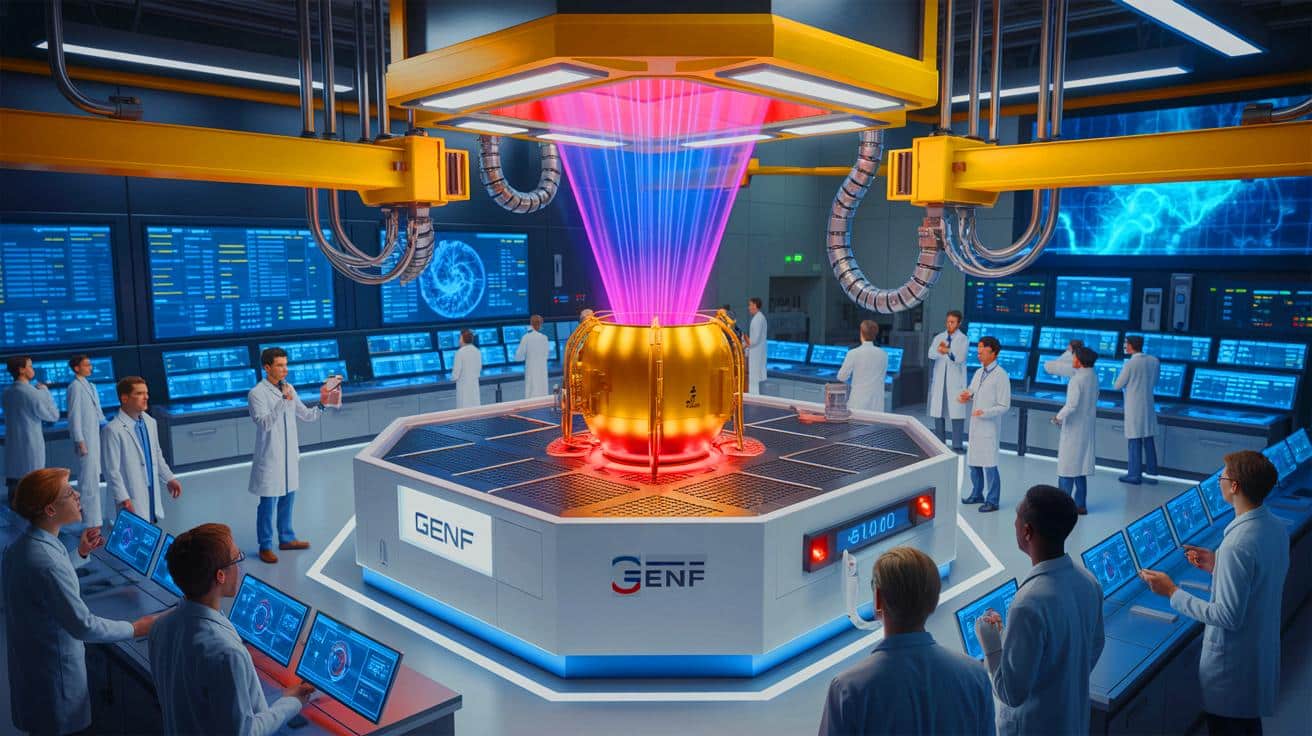
In recent years, the pursuit of nuclear fusion as a viable energy source has gained significant momentum. Unlike traditional nuclear fission, fusion promises a cleaner and more sustainable form of energy by replicating the sun’s power-generating process. This ambitious endeavor has seen a recent surge in investment, with significant contributions from the private sector. Notably, the French technology giant Thales has initiated a project to harness nuclear fusion through a company called GenF. This venture aims to develop a fusion reactor using inertial confinement, a method gaining traction for its potential to revolutionize energy production.
Harnessing the Power of High-Power Lasers
Thales has chosen inertial confinement by laser for its fusion reactor design, a decision driven by the company’s deep expertise in high-power laser technology. This method involves using powerful lasers to compress and heat atomic nuclei, facilitating their fusion into heavier elements and releasing energy. The collaboration for this project includes esteemed institutions such as the French Alternative Energies and Atomic Energy Commission (CEA), the École Polytechnique, and the National Center for Scientific Research (CNRS), alongside the regional support of Nouvelle-Aquitaine.
The project has been part of a government-backed initiative, selected in February 2024 following a call for proposals the previous year. With funding of €18.5 million (approximately $20 million), Thales is set to explore the first phase of development. This phase is critical, as it will lay the groundwork for the technological advancements needed to achieve practical and sustained fusion reactions.
Developing the First Inertial Confinement Fusion Reactor
Thales’s decision to pursue inertial confinement fusion leverages its extensive experience in high-power laser technology. Over the past four decades, Thales has contributed significantly to projects like the Laser Mégajoule, developed for the French Atomic Energy Commission. The company has also provided components for the ITER (International Thermonuclear Experimental Reactor), showcasing its capability and commitment to advancing fusion technology. GenF’s team, composed of engineers, scientists, and industry experts, is tasked with realizing this ambitious project.
The expertise and dedication of this team are pivotal, as they will navigate the complexities of laser technology and fusion mechanics. Their work will not only advance the development of the reactor but also contribute to the broader scientific understanding of nuclear fusion. The collaboration of diverse experts from various fields underscores the interdisciplinary nature of this innovative endeavor.
A Multi-Phase Project with Long-Term Goals
The development of GenF’s fusion reactor is structured into three distinct phases. The initial phase involves modeling, simulation, and experimental work at facilities like Thales’s Laser Mégajoule. Expected to conclude by 2027, this stage is essential for validating the theoretical and practical aspects of the reactor design. Following this, the second phase focuses on technological maturation, scheduled from 2027 to 2035.
This phase will address critical challenges, such as laser synchronization, the development of specialized materials for reactor walls, and the creation of cryogenic targets. These efforts are crucial for overcoming the technical hurdles that currently impede the realization of functional fusion reactors. The final phase, anticipated to begin in the mid-2030s, aims to produce an operational prototype, marking a significant milestone in the journey toward commercial fusion energy.
The Future of Fusion Energy
The promise of nuclear fusion lies in its potential to provide a nearly limitless and environmentally friendly energy source. By replicating processes found in the sun, fusion could significantly reduce our reliance on fossil fuels and mitigate the impact of climate change. The success of projects like GenF’s would not only transform energy production but also contribute to the global push for sustainable development.
As the world grapples with energy demands and environmental concerns, the development of fusion technology represents a beacon of hope. The challenges ahead are daunting, but the collaborative efforts of scientists, engineers, and policymakers offer a pathway to a cleaner energy future. As GenF and its partners embark on this ambitious journey, one must ponder: Could nuclear fusion be the key to unlocking a new era of sustainable energy?