

“No One Expected It to Fly”: The WindRunner Megajet Could Rescue U.S. Military Airlift Power (but it comes with a catch)
 By
Adam Kovács
By
Adam Kovács
| IN A NUTSHELL |
|
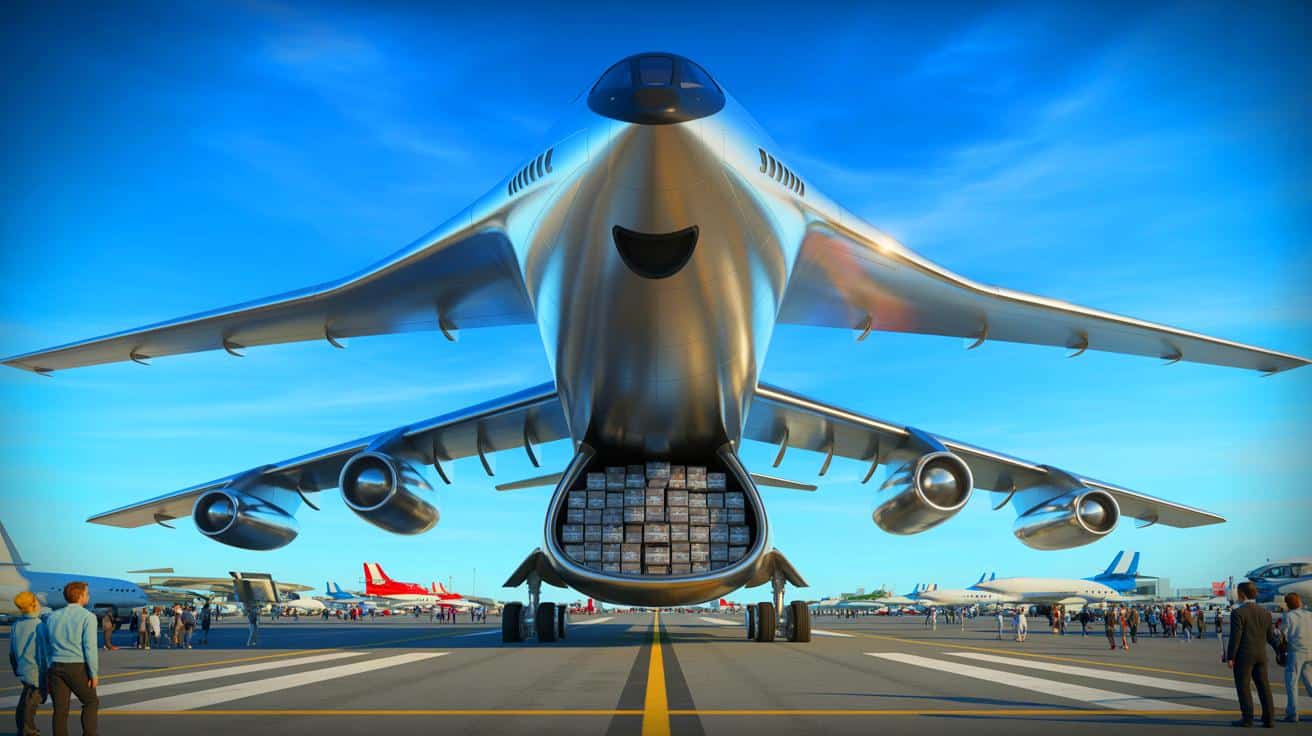
The Colorado-based company Radia recently showcased its WindRunner cargo jet concept at the Air & Space Force Association’s annual conference. This ambitious project comes at a time when the U.S. military is evaluating options to replace its aging fleet of C-5M Galaxy and C-17A Globemaster III transport aircraft. The WindRunner, initially designed for commercial purposes, aims to address the need for transporting large and outsized loads. Despite being in the early stages of development, the concept has attracted interest from various sectors, including defense, aerospace, and commercial cargo. The future of heavy lift capabilities remains uncertain, but Radia’s WindRunner presents an intriguing possibility.
WindRunner’s Origins and Potential
The WindRunner cargo jet, designed by Radia, originated as a solution for transporting large wind turbine blades. Its potential, however, extends beyond commercial applications. With its unprecedented volume, the WindRunner has captured the attention of defense and aerospace sectors. Radia claims that the aircraft could be suitable for moving tanks, helicopters, and other large military assets to remote locations. Furthermore, its design allows for the transportation of rocket boosters and other outsized cargo.
Grace O’Connor, a spokesperson for Radia, highlighted the WindRunner’s versatility: “As interest grew and development progressed, WindRunner’s unprecedented volume similarly appealed to the defense, aerospace, and commercial cargo sectors.” The aircraft’s design prioritizes volume over payload weight, addressing a common limitation in current military cargo planes. The WindRunner boasts a cargo space of approximately 270,000 cubic feet, significantly outpacing existing U.S. military transport aircraft.
Comparing WindRunner with Existing Aircraft
The U.S. Air Force's current heavy-lift aircraft, the C-17A and C-5M, have served for decades but are nearing the end of their operational lifespan. The C-17A, introduced in 1995, can carry up to 82 tons, while the larger C-5M can handle up to 140 tons. However, both planes are no longer in production, raising concerns about future replacements.
In contrast, the WindRunner, with a planned payload capacity of 72.6 tons, offers a different approach. Radia emphasizes that current military cargo planes often run out of space before reaching their weight limits. The WindRunner's spacious design aims to overcome this limitation. Its ability to transport six ready-to-fly Chinook C-47 helicopters underscores its potential utility for military operations. The aircraft's cockpit placement enhances vertical space, facilitating the loading of large items into its extensive cargo hold.
Technical Challenges and Potential Solutions
While the WindRunner promises substantial cargo volume, its range presents a challenge. The aircraft's loaded range is approximately 1,200 miles, significantly shorter than the C-17's 2,400 miles and the C-5's over 5,000 miles with aerial refueling. Radia acknowledges that aerial refueling capability will be crucial for military applications.
To address this limitation, the company is exploring potential solutions, including extending the aircraft's wingspan or incorporating auxiliary fuel tanks. While these modifications could enhance range, they also introduce additional complexities. Radia plans to include aerial refueling capabilities in military versions of the WindRunner, although commercial models may lack this feature initially.
The Future of Heavy Lift Capabilities
The U.S. Air Force is in the early stages of developing a Next Generation Airlift (NGAL) platform to replace the C-5s and C-17s. The new platform will prioritize speed, flexibility, and defense capabilities. However, budgetary and functional constraints pose significant challenges. A single aircraft replacing both the Galaxy and Globemaster is unlikely to match the Galaxy's cargo capacity.
Among the options under consideration is an aircraft with a blended wing body (BWB) configuration. This design could offer increased lift and internal volume, meeting some of the Air Force's requirements. JetZero, an aviation startup, has been selected to develop a BWB demonstrator for the Air Force. Despite these developments, the need for external solutions to transport the largest cargo remains.
Exploring Commercial Alternatives
With limited options for replacing the Galaxy's capabilities, the Air Force may need to rely on commercial alternatives. The An-124 Condor, a Soviet-designed aircraft, offers similar heavy lift capabilities but is available in limited numbers. The destruction of the An-225 Mriya, the world's largest operational cargo aircraft, further complicates the situation.
Radia's WindRunner could present a viable solution, albeit with challenges. The company aims to conduct the first flight of the WindRunner by 2030. To achieve this goal, Radia has raised over $150 million and is seeking additional funding from government, commercial, and private sources. The company has completed concept development and wind tunnel testing, with plans to proceed to system integration and manufacturing.
As the U.S. military continues to explore options for future heavy lift capabilities, Radia's WindRunner remains an intriguing prospect. While the aircraft is still in the conceptual phase, its potential to address the Air Force's needs cannot be overlooked. Will Radia's WindRunner ultimately bridge the gap in heavy lift capabilities, or will alternative solutions emerge to meet the military's requirements?