



“Aircraft Carrier Killers Ready”: China Unveils Upgraded Hypersonic Missiles That Can Strike US Bases Within Minutes During Victory Parade
 By
Adam Kovács
By
Adam Kovács
| IN A NUTSHELL |
|
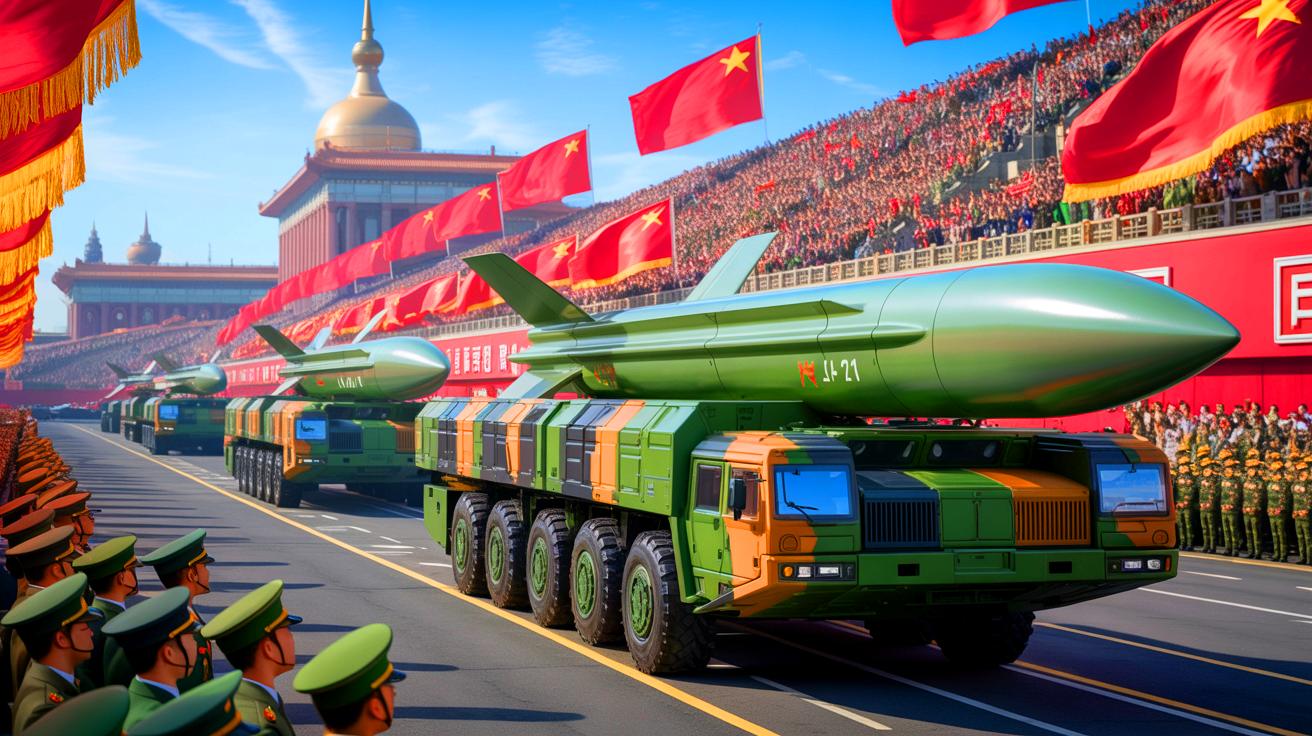
As China gears up for its Victory Day parade, the global spotlight is on the nation’s burgeoning military capabilities, particularly its advancements in hypersonic missile technology. These developments are not just a display of military might but also a statement of strategic intent. Among the highlights are upgraded versions of the YJ-21 and DF-17 missiles, which have been enhanced for greater penetration and interception evasion. This parade, marking the 80th anniversary of World War II’s end, serves a dual purpose: celebrating history and showcasing China’s growing influence in global military dynamics.
YJ-21: The Aircraft Carrier Killer
The YJ-21 missile, particularly its air-launched variant, has captured global attention for its potential to redefine naval warfare. Originally designed for sea launch, this version can be deployed from bombers, enabling strikes deep within enemy territories. Military analysts have dubbed it an “aircraft carrier killer” for its ability to target large naval vessels.
Military commentator Wei Dongxu notes that the YJ-21 can be launched from aircraft positioned outside enemy air defense zones. This capability allows it to penetrate interceptors, strike, and retreat swiftly. The missile’s adaptability across different platforms enhances its versatility, making it a formidable asset in varied combat scenarios.
First spotted in 2018, the YJ-21, also known as the KD-21, is believed to be carried by the H-6N strategic bomber. It potentially boasts a range of 1,860 miles and speeds ranging from Mach 4 to Mach 6. Its dual-use capacity allows it to be armed with either conventional or nuclear warheads. Recent satellite imagery indicates ongoing development, with suggestions that new variants may be unveiled at the upcoming parade.
DF-17: Advanced Glide Paths and Decoy Systems
The DF-17 missile, since its introduction in 2019, has been a focal point of international defense discussions. Its hypersonic glide capability allows it to travel in unpredictable trajectories, evading most existing missile defense systems. Wei Dongxu suggests that the missile could evolve with larger glide bodies and decoy warheads, complicating enemy detection and interception efforts.
The DF-17’s unique flight path, which mimics a skipping stone across the upper atmosphere, enhances its penetration capabilities and extends its operational range. This missile flies at altitudes between 12 and 62 miles, staying below the range of most midcourse defense systems, making it exceptionally challenging to intercept.
Future iterations of the DF-17 could incorporate maneuvering paths and multiple re-entry vehicles, further enhancing its strategic value. These advancements underscore China’s commitment to maintaining a competitive edge in hypersonic technology.
Mobility and Strategic Reach
China’s recent display of a DF-17 launching from a road-mobile vehicle underscores the missile’s strategic flexibility. This “unanchored launch” capability allows for rapid deployment without the need for fixed infrastructure, such as silos or stabilized platforms.
This mobility enables DF-17 units to blend into civilian traffic, dispersing across the road network and launching within minutes upon command. This strategic advantage is significant, especially when compared to other road-mobile systems that require extensive preparation.
With an operational range of up to 1,553 miles, the DF-17 can strike targets within the “first island chain” and beyond. This reach positions key American military bases in Japan, South Korea, and the Philippines within striking distance, challenging existing strategic balances in the Pacific.
The Global Hypersonic Arms Race
Hypersonic flight, defined as speeds exceeding Mach 5, is becoming a critical frontier in modern military technology. At these speeds, a journey from the Arctic to the Antarctic could be completed in less than three and a half hours. China’s advancements in this field are part of a broader global race, with the United States and Russia also investing heavily in hypersonic research.
Recent reports indicate that China possesses the world’s leading hypersonic missile arsenal. However, the United States faces challenges, with its hypersonic programs experiencing setbacks and delays. This technological race has significant implications for global military dynamics and the balance of power.
The upcoming Victory Day parade is poised to be more than a ceremonial event; it is a clear signal of China’s advancing military capabilities and its potential impact on global security architectures. As nations watch closely, questions arise about the future of strategic stability and the ongoing arms race.
As China continues to develop its hypersonic missile capabilities, the world watches with both intrigue and concern. The implications of these advancements extend beyond regional security, touching upon global strategic balances. With major powers vying for dominance in hypersonic technology, one must ask: How will these developments reshape international relations and defense strategies in the coming years?