


“Chinese Jets Simulated Kill”: Royal Navy Reports Harassment As Taiwan Strait Standoff Escalates Into Psychological Warfare And Growing Military Risks
 By
Adam Kovács
By
Adam Kovács
| IN A NUTSHELL |
|
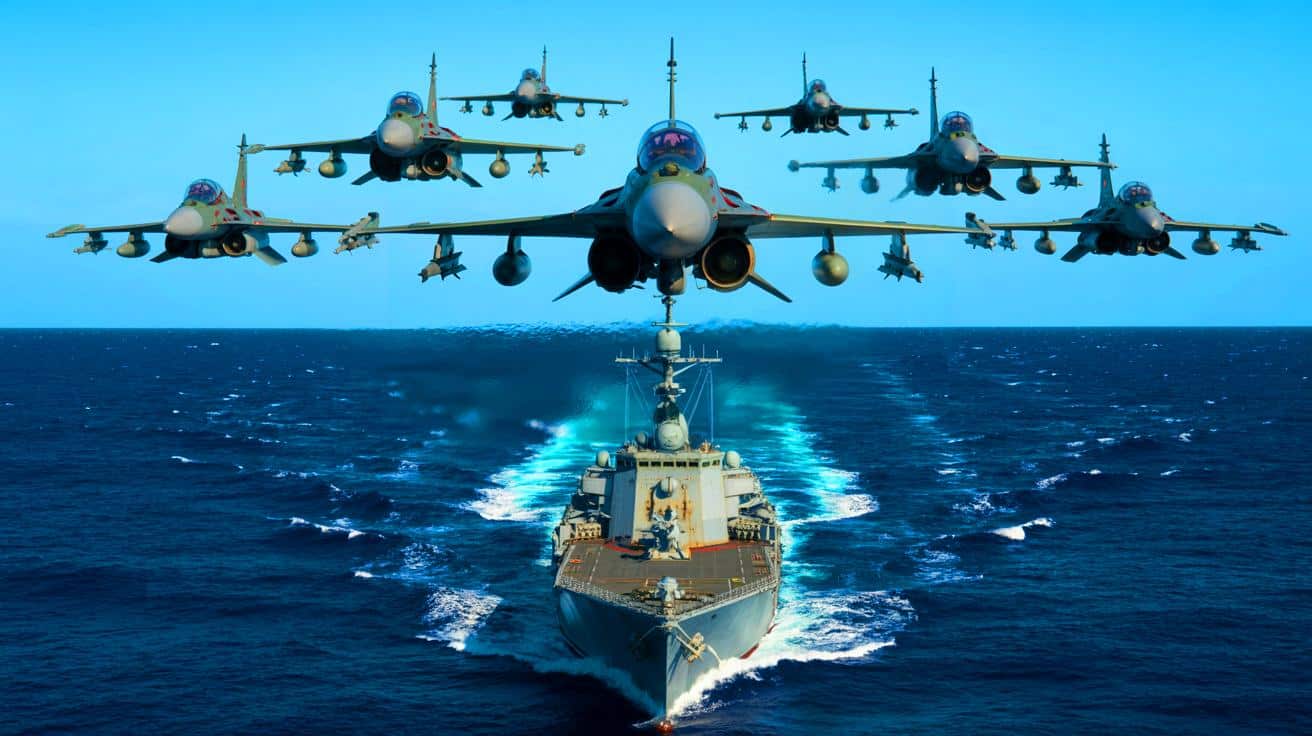
A recent encounter in the Taiwan Strait has reignited tensions between the West and China, highlighting the delicate nature of international waters in this contested region. The incident involved a British warship, HMS Richmond, and U.S. destroyer USS Higgins, which were targeted by Chinese jets performing a simulated missile strike. This provocative act has drawn attention to the ongoing geopolitical struggle over the Taiwan Strait, which China claims as its territorial waters, while Western nations maintain it is international territory. This event underscores the complexity of modern military engagements, where psychological tactics play as significant a role as physical confrontations.
Simulated Strikes: A New Form of Military Posturing
The incident involving the Royal Navy’s HMS Richmond and Chinese jets is being described as a “simulated kill.” This term refers to a maneuver where an attack is feigned but not executed, serving as a form of intimidation rather than direct aggression. According to Royal Navy officers, the Chinese pilots engaged in a mock missile launch without actually firing. This tactic was perceived by those aboard the warship as a psychological operation, aimed at demonstrating power and capability without crossing the threshold into open conflict.
Such actions are increasingly common in disputed areas like the Taiwan Strait, where military forces use simulated attacks to project strength and test the reactions of their adversaries. This approach allows nations to assert their presence and intentions while avoiding the international consequences of an actual military strike. The psychological impact of these tactics is profound, often leaving the targeted crews in a state of heightened alert and readiness.
The Chinese were trying to harass us, four or five of them trying to get close.
https://visegradpost.com/en/2025/09/24/russia-just-stole-europes-lithium-forever-putins-army-seizes-85000-per-ton-treasure-while-electric-car-industry-panics/
The strategic use of simulated strikes suggests a shift in modern military engagements, emphasizing the importance of perception and information warfare. As such, the Taiwan Strait remains a flashpoint for potential conflict, where military actions are as much about sending messages as they are about achieving tangible objectives.
The Geopolitical Implications of the Taiwan Strait
The Taiwan Strait is a narrow waterway that separates China from Taiwan, and it has long been a site of geopolitical tension. China views much of the strait as its territorial waters, a claim that is not recognized by many Western nations. The recent transit of the British frigate HMS Richmond and the U.S. destroyer USS Higgins was labeled as a “harassment and provocation” by Chinese officials, who argue that these maneuvers undermine regional peace and stability.
From the Western perspective, passages through the Taiwan Strait are seen as exercises of freedom of navigation, a principle upheld by international law. The U.S. Indo-Pacific Command emphasized that their ships conducted a routine transit, operating in waters beyond any coastal state’s territorial claim. This stance reflects a broader strategy to counter what is perceived as Chinese expansionism in the region.
As both sides assert their positions, the Taiwan Strait becomes more than just a geographical feature; it is a symbol of the broader struggle for influence and control in the Indo-Pacific. The stakes are high, with potential implications for global trade routes and regional security dynamics.
China’s Military Maneuvers and Regional Reactions
China’s military activities in the Taiwan Strait are part of a broader strategy to assert its sovereignty and deter perceived threats. The simulated attack on HMS Richmond is just one example of how China uses its military to send a message to both regional actors and the broader international community. Chinese officials maintain that such actions are defensive, aimed at safeguarding national sovereignty and ensuring regional stability.
However, these maneuvers have raised concerns among neighboring countries and military analysts, who fear they could be precursors to more aggressive actions. The specter of a potential invasion of Taiwan looms large, especially as Chinese President Xi Jinping has not ruled out the use of force to achieve unification.
Taiwan, for its part, continues to assert its status as an independent entity, with its own government and military. The island nation remains vigilant, aware that its position is central to the broader geopolitical contest between China and the West.
The Role of Information Warfare in Modern Conflicts
The events in the Taiwan Strait highlight how modern conflicts are increasingly fought in the realm of information and perception. The concept of a "constructive kill" is emblematic of this trend, where the threat of violence is used as a tool of psychological warfare. By simulating attacks, military forces can test their adversaries’ responses, gather intelligence, and influence public perception.
For the British forces involved in the recent incident, the encounter provided valuable insights into Chinese tactics and response protocols. Despite the tension, one officer described the experience as "mutually beneficial," suggesting that lessons were learned that could inform future engagements.
The integration of information warfare into military strategy reflects a broader shift in how nations project power and influence. As technology continues to evolve, the lines between physical and psychological warfare blur, raising new challenges for policymakers and military planners alike. How will nations adapt to these changes, and what role will information warfare play in shaping the future of global conflict?
As tensions continue to simmer in the Taiwan Strait, the international community watches closely. The stakes are high, and the potential for miscalculation or escalation is ever-present. In this volatile environment, how will nations balance the need for security with the imperative to avoid conflict, and what strategies will they employ to navigate the complex dynamics of the region?
Continue reading