


“It Slipped Right Past Us”: This Asteroid Flew Closer Than the Space Station Before Anyone Noticed (and It Could Happen Again)
 By
Adam Kovács
By
Adam Kovács
| IN A NUTSHELL |
|
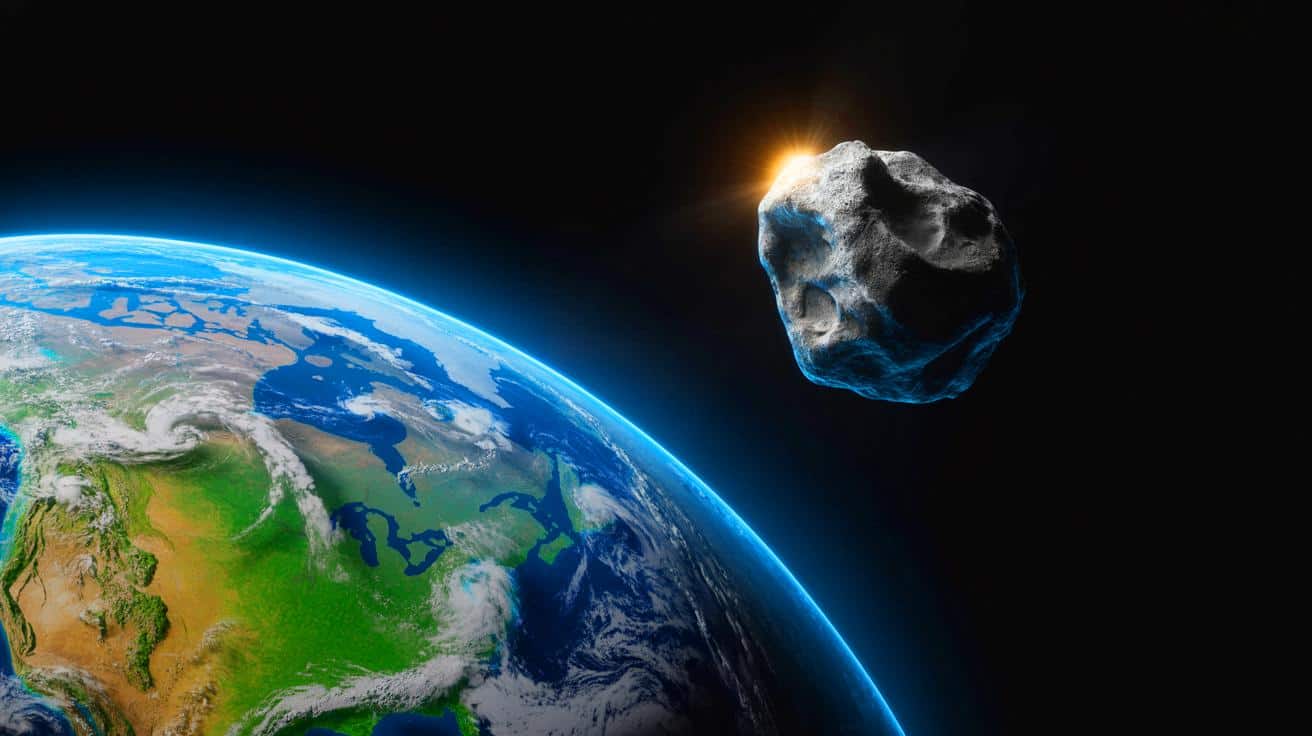
Last week, Earth experienced a close brush with an asteroid known as 2025 TF. The small space rock came within 266 miles of our planet, a distance comparable to the orbit of the International Space Station (ISS). This event marks the second-closest known flyby of an asteroid that did not impact Earth, highlighting both the potential risks and the advances in tracking near-Earth objects. While this particular asteroid posed no threat, its unexpected appearance underscores the importance of continued vigilance in monitoring space for potentially hazardous objects.
The Close Encounter: 2025 TF’s Near Miss
The asteroid 2025 TF made its closest approach to Earth on October 1, 2025, flying over Antarctica at an altitude of approximately 266 miles. This distance places it within the orbital range of the ISS, which typically orbits Earth between 230 and 286 miles above the surface. Despite its proximity, 2025 TF did not pose any danger to our planet due to its small size.
With a diameter between 3.3 and 9.9 feet, the asteroid was too small to cause significant damage even if it had entered Earth’s atmosphere. At most, it would have created a bright meteor and potentially left a small meteorite upon impact. Such events are relatively common, with small asteroids frequently burning up in Earth’s atmosphere without causing harm.
The record for the closest non-impacting flyby still belongs to asteroid 2020 VT4, which passed within 229 miles of Earth in November 2020. These near misses highlight the dynamic nature of our solar system and the constant movement of celestial bodies within it.
Discovery After the Fact: Tracking 2025 TF
The discovery of 2025 TF came after it had already made its close pass by Earth. The asteroid was first reported by the Kitt Peak-Bok Observatory in Arizona at 06:36 UTC, hours after its closest approach. However, data from the Catalina Sky Survey revealed that the asteroid had been observed just two hours post-flyby, indicating the challenges in detecting small, fast-moving objects in space.
Despite the delayed detection, the ability to track such objects is crucial for planetary defense. Astronomers use a variety of telescopes and surveys to monitor the skies for potentially hazardous asteroids. These efforts are vital for early warning and intervention strategies, should a larger, more dangerous object be detected on a collision course with Earth.
The surprise discovery of 2025 TF highlights the need for enhanced sky-monitoring systems and international collaboration in space observation.
https://visegradpost.com/en/2025/10/09/they-just-beamed-electricity-five-miles-through-the-air-darpa-breaks-record-with-laser-based-wireless-power-transmission/
As technology advances, astronomers are continually improving their methods for detecting and tracking asteroids, ensuring that even small objects like 2025 TF are cataloged and monitored.
Future Path: What Lies Ahead for 2025 TF
After its close encounter with Earth, 2025 TF is now traveling away from our planet into the depths of space. However, it is not gone forever. According to estimates from NASA’s Jet Propulsion Laboratory (JPL), the asteroid is expected to return to Earth’s vicinity in April 2087. Fortunately, during this future pass, it will be at a much safer distance.
In 2087, 2025 TF will come within about 5 million miles of Earth, more than 21 times the distance to the Moon. This significantly greater distance ensures that it will not pose any threat to our planet. The study of asteroids like 2025 TF provides valuable insights into the behavior and trajectories of near-Earth objects, helping scientists refine their models and predictions.
Understanding the orbital paths of asteroids is crucial for assessing potential risks and developing strategies to mitigate them. While 2025 TF is not a danger, its predictable return offers a valuable opportunity for continued observation and study.
The Bigger Picture: Implications for Earth
The close pass of 2025 TF, though benign, serves as a reminder of the potential threats posed by near-Earth objects. Larger asteroids have the capability to cause significant damage, as evidenced by historical events like the impact that led to the extinction of the dinosaurs. While astronomers have identified many of the largest asteroids, smaller ones remain elusive.
Efforts to catalog these smaller objects are ongoing, with initiatives like NASA’s Near-Earth Object Observations Program aiming to identify and track potentially hazardous asteroids. These programs are crucial for planetary defense, enabling scientists to predict and potentially avert future impacts.
Continued investment in asteroid detection and monitoring is essential for safeguarding our planet from future threats.
As technology advances, our ability to detect and respond to asteroid threats will improve, helping to ensure the safety of Earth and its inhabitants.
The recent flyby of 2025 TF offers a poignant reminder of Earth’s place in a dynamic and ever-changing cosmos. While this particular asteroid posed no threat, it underscores the importance of vigilance and preparedness. As we continue to explore and understand the universe around us, what new challenges and opportunities will arise in the realm of planetary defense?
Continue reading