

“WWII Bombs Still Haunt Germany”: New Simulation Tech Predicts Underground Shock Waves To Keep Cities Safe During Explosive Disposal Operations
 By
Adam Kovács
By
Adam Kovács
| IN A NUTSHELL |
|
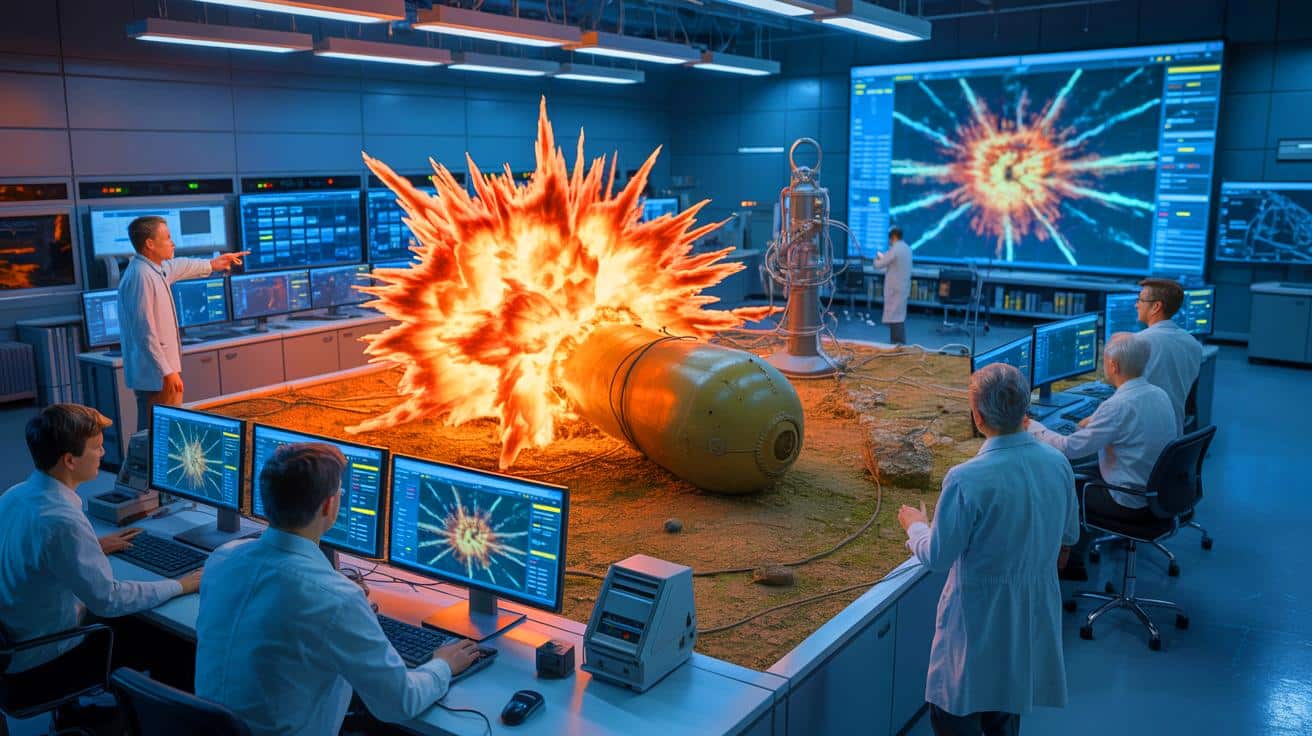
In Germany, the remnants of World War II continue to pose significant challenges, with hundreds of thousands of unexploded bombs still buried across the country. These relics continue to disrupt daily life, causing evacuations, district closures, and transport interruptions whenever they are discovered. To address this ongoing issue, German researchers have developed a new blast simulation software. This innovative technology aims to improve the safety and efficiency of bomb disposal operations, reducing the impact on communities and infrastructure. By simulating the effects of explosions both above and below ground, the software provides bomb disposal teams with crucial insights to manage these dangerous situations more effectively.
Revolutionizing Bomb Disposal With Advanced Simulations
The Fraunhofer Institute for High-Speed Dynamics, in collaboration with virtualcitysystems GmbH and the Ministry of the Interior of North Rhine-Westphalia, is at the forefront of this groundbreaking research. Their focus is on extending the capabilities of the VC BlastProtect software, initially developed to simulate aboveground blast waves. The enhanced version now includes the ability to model the underground transmission of shock waves. This advancement aims to reduce the evacuation zones required during bomb disposal and provide more accurate risk assessments for both people and infrastructure.
According to Dr. Christoph Grunwald of Fraunhofer EMI, the updated software allows explosive ordnance disposal services to evaluate different damping measures, such as covering bombs with sand or water. This capability enables a more precise assessment of how energy from a detonation is distributed, potentially shifting energy into the ground and affecting underground infrastructure like subway tunnels and basements.
The researchers highlight the importance of understanding these dynamics, as the spread of blast waves can significantly impact both surface and subterranean structures. By accurately modeling these effects, the team hopes to enhance safety measures and reduce the overall impact of bomb disposal operations on affected communities.
The Challenges of Simulating Soil Dynamics
One of the primary challenges faced by the researchers is accurately simulating the complex behavior of soil under explosive loads. Different soil types, such as gravel, clay, and sand, react in varied ways when subjected to sudden energy inputs. Additionally, the presence of water and air in the soil further complicates these dynamics. To address these challenges, the team conducts dynamic laboratory tests on generic soil samples, applying waves at different strain rates and amplitudes to build reliable models.
Dr. Grunwald explains that the behavior of soil as a three-phase mixture poses particular difficulties. The team ensures the accuracy of their models by comparing the results of their simulations with experimental data. Large-scale validation tests, such as those conducted at a former East German Army site, provide valuable data to refine their models further. These tests involve detonating buried bombs under various conditions and collecting data on the resulting blast and underground shock waves.
The results from these experiments are crucial for refining the numerical models used in the VC BlastProtect software. By achieving a better understanding of soil dynamics, the researchers aim to provide bomb disposal teams with more precise tools for managing explosive risks.
Real-World Applications and Validation
The practical application of this research is evident in the large-scale validation tests conducted by the team. At a site in Mecklenburg-Vorpommern, six buried bombs were detonated under different conditions to simulate real-world scenarios. These tests included various damping measures, such as sand and water coverings, as well as aluminum rings to support detonation pits.
One bomb was left uncovered to serve as a reference, allowing the researchers to compare the effectiveness of different damping measures. The data collected from these tests helps refine the numerical models and provides explosive ordnance disposal teams with better insights into the real-world effectiveness of different strategies.
The models initially predicted greater damage to nearby buildings, indicating that the current approach errs on the side of caution. As a result, future assessments can offer more precise risk evaluations, enabling disposal teams to plan targeted strategies to minimize damage.
https://visegradpost.com/en/2025/09/27/this-will-bankrupt-every-electric-company-engineer-discovers-fusion-plant-that-powers-entire-cities-using-just-one-teaspoon-of-fuel/
This research has significant implications for Germany, where buried wartime artillery continues to be a pressing concern. By improving the accuracy of risk assessments, the new modeling capability aims to reduce the disruption caused by bomb disposal operations and enhance the safety of both surface and underground infrastructure.
A Collaborative Effort for Enhanced Safety
The development of this advanced blast simulation software represents a collaborative effort between researchers, government agencies, and technology companies. By combining their expertise, the team has made significant strides in improving the safety and efficiency of bomb disposal operations. The new software not only enhances the ability to predict the impact of explosions but also provides valuable data for refining safety measures.
This collaboration highlights the importance of interdisciplinary research in addressing complex challenges. By bringing together experts from various fields, the team has developed a tool that can significantly reduce the risks associated with unexploded ordnance. As the software continues to evolve, it holds the potential to set new standards for bomb disposal practices worldwide.
The ultimate goal of this research is to enhance public safety and reduce the impact of unexploded bombs on communities. By providing more accurate assessments and targeted strategies, the software enables bomb disposal teams to operate more effectively and with greater confidence.
As Germany continues to grapple with the legacy of World War II, the development of advanced blast simulation software marks a significant step forward in ensuring public safety. By improving the accuracy of risk assessments and enhancing the effectiveness of bomb disposal operations, this technology has the potential to transform how unexploded ordnance is managed. As researchers continue to refine their models and expand the software's capabilities, what other innovative solutions could be developed to address the ongoing challenges posed by historical ordnance?
Continue reading