


“NASA Just Called Emergency Meeting”: Scientist Reveals Asteroid Will Smash Moon In Eight Years While Agency Considers Nuclear Strike
 By
Adam Kovács
By
Adam Kovács
| IN A NUTSHELL |
|
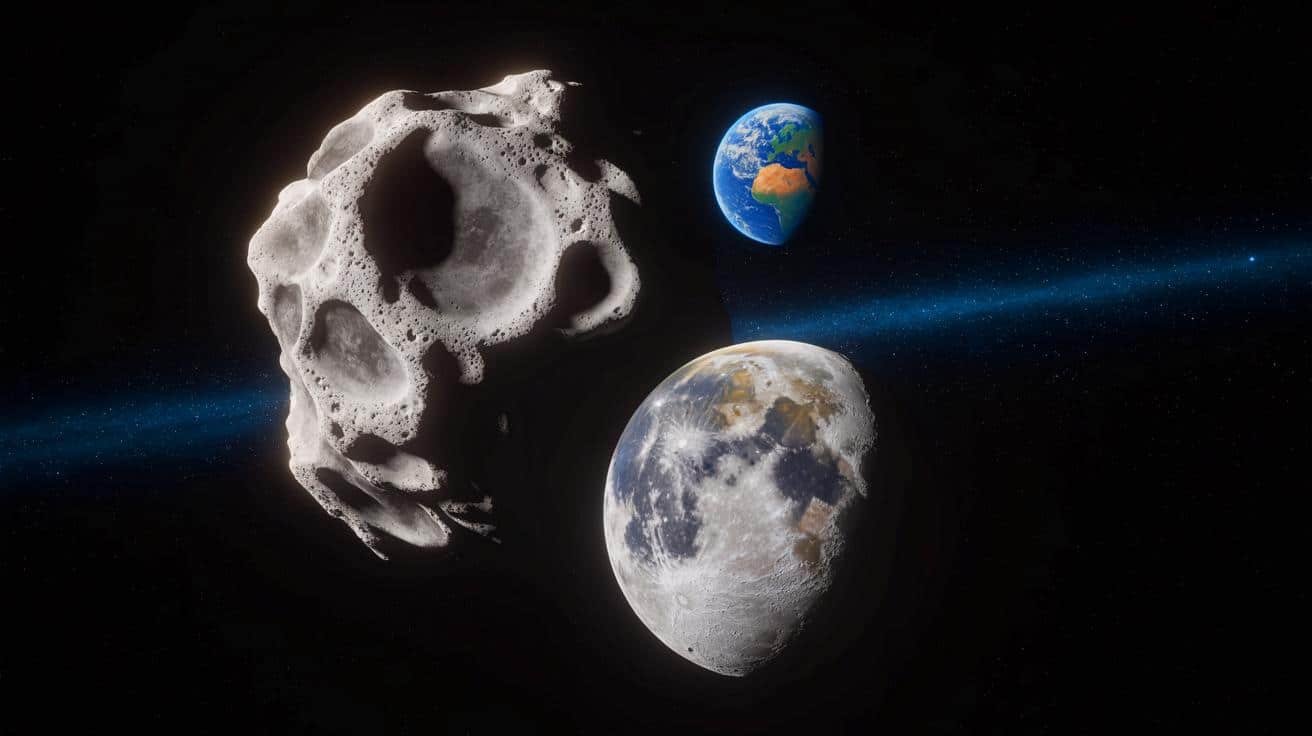
The prospect of a celestial body impacting Earth has long been a source of science fiction and anxiety alike. While modern science has alleviated some of those fears with advanced detection and tracking systems, the threat is never entirely absent. Recently, asteroid 2024 YR4 captured the attention of scientists and the public. Initially, it was believed to have a 3.1 percent chance of striking Earth. However, further calculations have now shifted the concern to a potential collision with the moon in 2032. This development has led to discussions on how to manage such a threat, including the drastic measure of a nuclear strike.
Understanding the Shift in Threat
Asteroid 2024 YR4 was first detected in December 2024, and it quickly became a topic of significant interest due to its size and initial impact risk. Measuring roughly 180 feet across, the asteroid was initially thought to have a 3.1 percent chance of hitting Earth. A strike of this magnitude could level a city, making it a serious concern for planetary defense.
However, by February 2025, revised measurements significantly reduced the likelihood of an Earth impact to just 0.28 percent. While this was a relief, it redirected the potential threat to the moon. A collision with the lunar surface would not endanger human life on Earth directly but could have significant consequences for our satellite systems and space missions.
If the asteroid were to collide with the moon, it would create an enormous spray of regolith. This debris could significantly increase the micrometeoroid flux in the vicinity of Earth, posing new risks to satellites and astronauts. Researchers estimate this surge could multiply the existing micrometeoroid levels by up to 1,000 times.
Risks Outweighing Safe Deflection
One option under consideration is deflecting the asteroid to avoid a collision altogether. However, researchers warn that this could create new risks. The mass of 2024 YR4 is not yet fully understood, and a miscalculation could inadvertently direct the asteroid closer to Earth. This uncertainty highlights the complexities involved in planetary defense.
NASA has experience with asteroid deflection, notably with its 2022 Double Asteroid Redirection Test (DART). This mission successfully altered the orbit of the moonlet Dimorphos. However, the challenges posed by 2024 YR4 are more severe. The limited observation window before 2032 and the unknown physical properties of the asteroid make deflection a risky endeavor.
The researchers caution that any attempt to deflect the asteroid could create unintended hazards.
https://visegradpost.com/en/2025/09/20/china-unveils-invisible-military-communication-the-world-is-not-ready-for-this-unseen-power/
Thus, while deflection remains a theoretical possibility, its execution in this case is fraught with potential pitfalls that could exacerbate the threat.
Breaking Rocks with Nukes
In light of these challenges, some scientists are considering a more dramatic approach: breaking the asteroid apart. This would involve a mission similar to DART, but with the aim of fragmenting the asteroid instead of altering its trajectory. If this method proves ineffective, a nuclear option could be considered.
Detonating a nuclear device near or on the asteroid could theoretically shatter it into smaller, less threatening pieces. This approach, while never tested in space, remains a theoretical possibility that could be employed if necessary. The timeline for such an operation would be tight, with a launch window between 2029 and 2031 to meet the asteroid's 2032 flyby.
Despite the risks, there is still a 96 percent chance that the asteroid will pass by the moon without incident. However, the situation with 2024 YR4 presents a valuable case study for building planetary defense capabilities. Scientists emphasize the need for detailed planning and the development of new mission concepts to prepare for future threats.
Building a Planetary Defense Framework
The potential threat from asteroid 2024 YR4 underscores the importance of developing a comprehensive planetary defense strategy. This entails not only technological advancements but also international cooperation and preparedness. The ability to rapidly assess and respond to threats is crucial in safeguarding both Earth and its celestial neighbors.
Researchers are calling for more investment in understanding the build times for spacecraft and designing mission concepts that could be deployed swiftly should a threat materialize. This proactive approach could make a significant difference in our ability to protect our planet and space infrastructure.
They call on others to estimate build times for spacecraft and design mission concepts.
As we look to the future, the lessons learned from 2024 YR4 could be instrumental in shaping a robust planetary defense framework that could be applied to other potential threats.
The evolving narrative of asteroid 2024 YR4 is a reminder of the constant vigilance required in planetary defense. While the immediate threat may have shifted from Earth to the moon, the implications for space safety remain significant. How will the scientific community balance the risks and benefits of different intervention strategies in the future? The answer could shape our approach to planetary defense for years to come.
Continue reading