



“Chinese Jets Simulate Missile Strikes on HMS Richmond”: Royal Navy Harassed in Taiwan Strait as Beijing Tests Britain’s Resolve in Disputed Waters
 By
Adam Kovács
By
Adam Kovács
| IN A NUTSHELL |
|
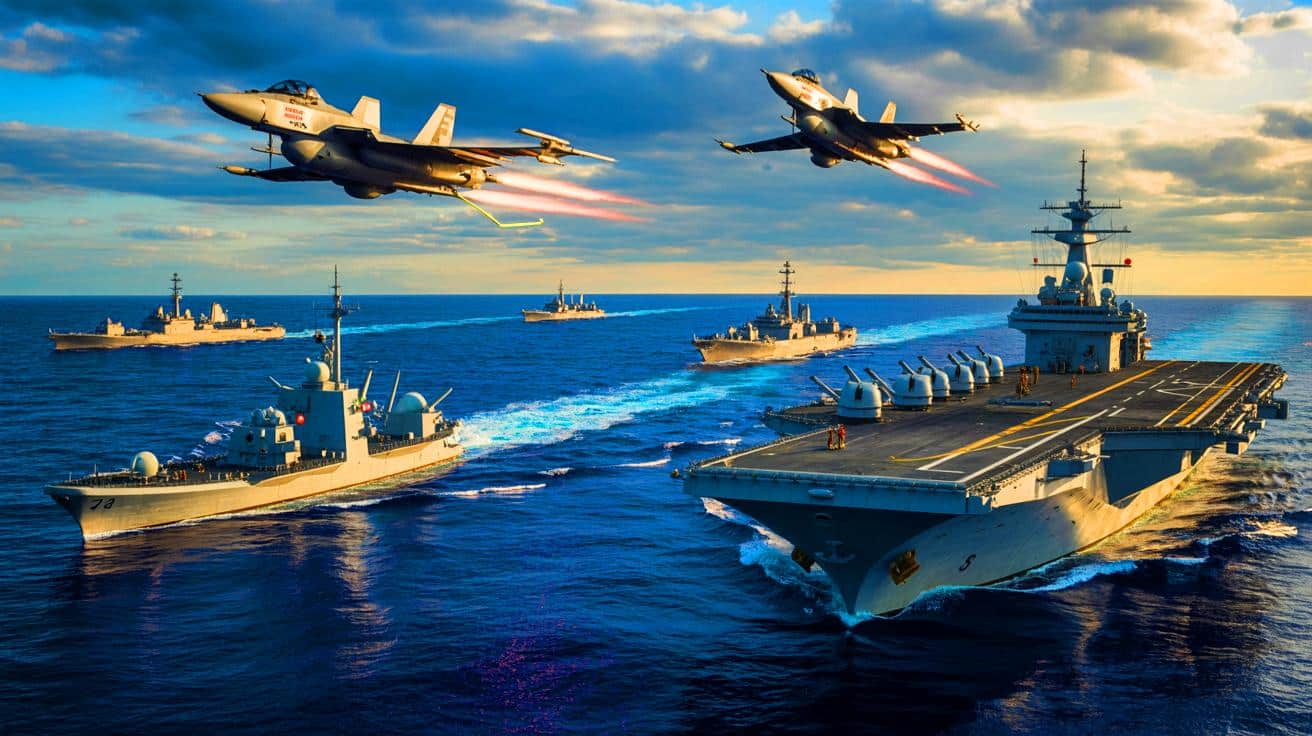
In a recent development that has captured global attention, the Chinese military conducted provocative drills near British Naval vessels in the Taiwan Strait and the South China Sea. British newspaper The Times reported that Chinese fighter jets performed simulated missile attacks on the warship HMS Richmond, while Chinese warships followed the Royal Navy’s aircraft carrier HMS Prince of Wales. These maneuvers have been described as a strategic calculation by China to test the Royal Navy’s boundaries. The U.K. Ministry of Defense acknowledged routine interactions with Chinese military forces but downplayed any notion of unusual or hazardous activity. This incident underscores the heightened tensions in a region already fraught with geopolitical complexities.
Understanding the Geopolitical Tensions
The recent activities underscore the escalating geopolitical tensions between China and Western powers in the Asia-Pacific region. China claims Taiwan as its own and asserts dominance over nearly the entire South China Sea, a region abundant in resources and crucial for global shipping routes. The exercises reported by The Times reflect a broader struggle for influence and control over these strategic waters. The maneuvers by Chinese forces are seen as a challenge to international norms, particularly the principle of freedom of navigation, which Western powers, including the United Kingdom, staunchly defend.
These simulated attacks and the shadowing of British naval vessels are not isolated incidents but part of a pattern of assertive Chinese military behavior in disputed areas. This behavior raises concerns about potential conflicts and the implications for international trade and security. The Royal Navy’s presence in these waters is a demonstration of support for allies in the region and a statement against unilateral territorial claims.
Details of the Naval Encounters
The U.K. Ministry of Defense has not disclosed specific details about the incident, but accounts from The Times reveal that the HMS Prince of Wales, leading the U.K. Carrier Strike Group, was trailed by Chinese forces. The HMS Richmond, during its passage through the Taiwan Strait, experienced "constructive kills", a practice where fighter jets simulate an attack without actual missile launches. This tactic serves as a warning and a test of the adversary’s response.
Chinese ships continued to monitor the carrier group as it navigated the contentious Spratly Islands. These waters are claimed by multiple countries, leading to frequent tensions. The Richmond’s Merlin MK2 helicopter was shadowed by a Chinese Changhe Z-10 helicopter, while Chinese jets performed dummy attacks. Despite the aggressive posturing, there was no expectation of actual combat, with Chinese forces maintaining a safe distance. However, Royal Navy officers described the actions as harassment designed to push the British forces and test the limits of their patience and operational boundaries.
Mixed Reactions and Statements
Sub-lieutenant Rohan Lewis from the Prince of Wales described the Chinese actions as an attempt to intimidate British forces. He noted that multiple Chinese jets tried to close in on the British vessels, testing how far they could go without provoking a military response. The Chinese state media, however, dismissed the British naval presence as a relic of colonial ambition, accusing the U.K. of indulging in nostalgia for its imperial past.
The U.K. Ministry of Defense, in its communication, maintained that the interactions were routine and posed no real danger. The Ministry reiterated that the Carrier Strike Group operates in accordance with international laws and norms, a sentiment aimed at reassuring both domestic and international audiences. This position reflects the delicate balance of acknowledging military provocations while avoiding escalation.
Looking Ahead: Future Implications
The Royal Navy’s Operation Highmast is scheduled to return to Portsmouth in December after an extensive deployment. Meanwhile, China's military activities in the South China Sea will continue to attract international scrutiny. The incident raises questions about the future of military engagements in this volatile area and the role of international bodies in mediating disputes.
As the world watches these developments, the emphasis remains on diplomatic efforts to prevent conflicts while ensuring that freedom of navigation is preserved. The international community will likely continue to monitor China’s military strategies closely, analyzing their implications for regional stability and global security. What strategies should global powers adopt to effectively manage and mitigate rising military tensions in such critical regions?
Continue reading