


“They Found the Building Blocks of Life”: Saturn’s Moon Enceladus Is Leaking Clues That Could Rewrite Everything We Know About Existence (and It’s Just Beginning)
 By
Adam Kovács
By
Adam Kovács
| IN A NUTSHELL |
|
Recent findings from Saturn’s moon, Enceladus, have reignited excitement within the astronomical community. Researchers have uncovered significant evidence of complex organic molecules being emitted from the moon, suggesting the potential for life. This discovery not only builds on past data collected by NASA and the European Space Agency’s Cassini spacecraft but also highlights Enceladus as an even more promising candidate in the search for extraterrestrial life. The presence of these molecules indicates that the moon’s subsurface ocean may host chemical reactions similar to those that led to life on Earth. This breakthrough could reshape our understanding of habitable environments beyond our planet.
Enceladus: A Promising Candidate for Life
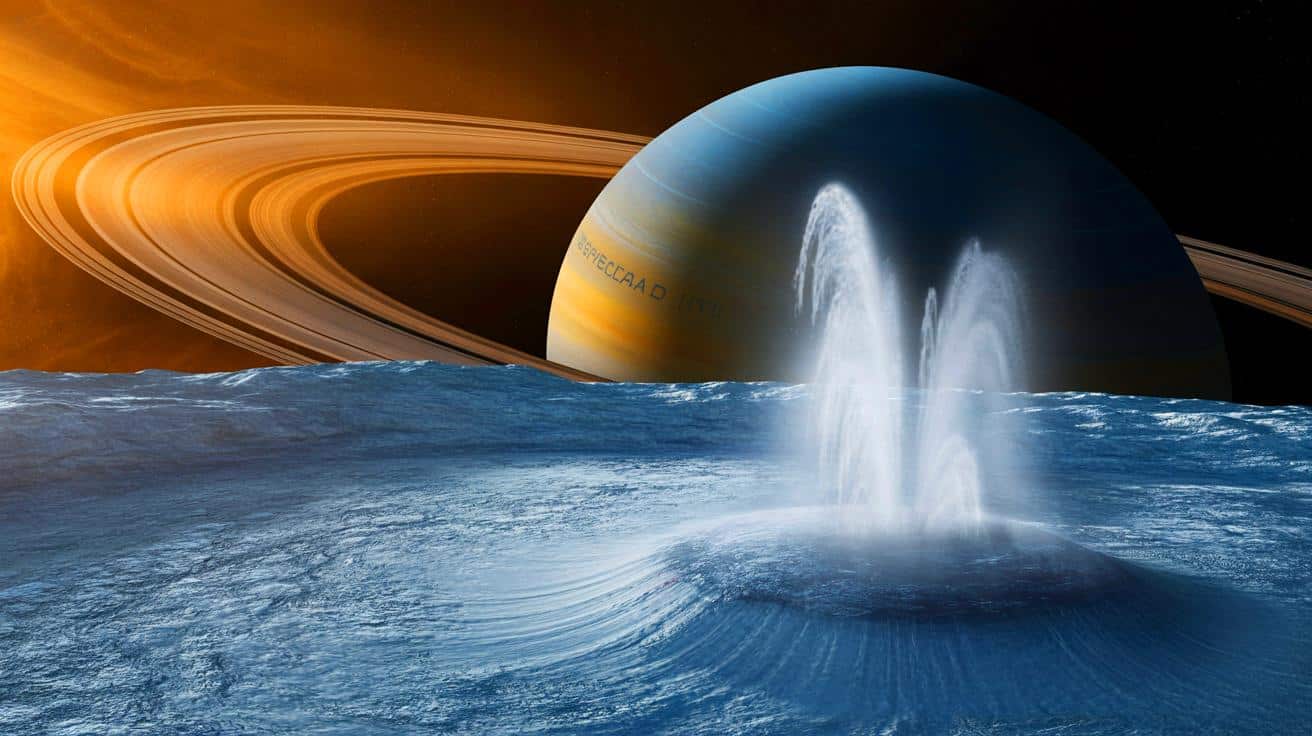
Saturn’s moon, Enceladus, has long been considered a candidate in the search for extraterrestrial life, but recent discoveries have elevated its status. Scientists have found that the moon is releasing complex organic molecules, which are typically associated with life on Earth. This revelation stems from data collected by the Cassini spacecraft, which orbited Saturn and its moons from 2005 to 2015. The spacecraft detected jets of water spewing from the moon’s underground ocean, propelling ice particles into space.
The presence of these organic molecules is significant because they are involved in chemical reactions analogous to those that likely led to life on Earth. According to Nozair Khawaja, a researcher at Freie Universität Berlin, these findings enhance the likelihood that Enceladus could be habitable. Nevertheless, while these discoveries are promising, they do not confirm the presence of life, necessitating further exploration and study.
Cassini’s Contributions to the Discovery
The Cassini spacecraft played a pivotal role in uncovering these exciting findings about Enceladus. By flying through Saturn’s E ring, Cassini collected samples from Enceladus, revealing a wealth of organic molecules within the ice grains. Notably, these molecules included precursors for amino acids, essential building blocks of life. The data was gathered using Cassini’s Cosmic Dust Analyzer, which detected fast-moving ice grains striking the instrument at approximately 11.2 miles per second. This speed prevented the particles from clustering, allowing researchers to discern previously hidden signals.
Among the newly discovered molecules are those containing nitrogen and oxygen, as well as ethers and esters. These compounds have never been observed before on Enceladus, raising hopes that the moon’s ocean may harbor biologically relevant chemical reactions. The data collected by Cassini continues to unveil new information, encouraging scientists to delve deeper into the secrets of Enceladus.
Future Exploration of Enceladus
The recent findings have sparked interest in further exploration of Enceladus. The European Space Agency (ESA) is considering sending a dedicated spacecraft to the moon to explore its potential habitability. Such a mission could provide critical insights into the conditions on Enceladus and whether life could exist there. The possibility of finding life, or even the absence of it, would offer valuable scientific insights.
Nozair Khawaja emphasized the importance of continuing to analyze the data from Cassini, as there is much more to discover. A future mission to Enceladus could help answer fundamental questions about the presence of life beyond Earth. Even the absence of life in a seemingly habitable environment would prompt new inquiries into the necessary conditions for life’s emergence.
The Implications of Discovering Life Beyond Earth
The discovery of life on Enceladus would have profound implications for our understanding of life in the universe. It would challenge our current knowledge of life’s origins and adaptability, suggesting that life may be more common than previously thought. Such a discovery would also raise questions about the diversity of life forms and the potential for life elsewhere in our solar system and beyond.
Even in the absence of life, the findings on Enceladus offer valuable insights into the chemical processes that occur in extraterrestrial environments. These insights could inform future exploration missions and guide the search for life on other celestial bodies. As scientists continue to analyze the data and plan potential missions, the quest to understand Enceladus and its secrets remains a captivating and evolving scientific endeavor.
As researchers delve deeper into the mysteries of Enceladus, the potential for groundbreaking discoveries continues to captivate the scientific community. What other secrets might this icy moon hold, and how could they reshape our understanding of life in the universe?
Continue reading