



“Did We Just Build a Killer Dog?”: This Armed Robot Reveals How AI Is Quietly Taking Over the Battlefield (and It’s Already Deployed)
 By
Adam Kovács
By
Adam Kovács
| IN A NUTSHELL |
|
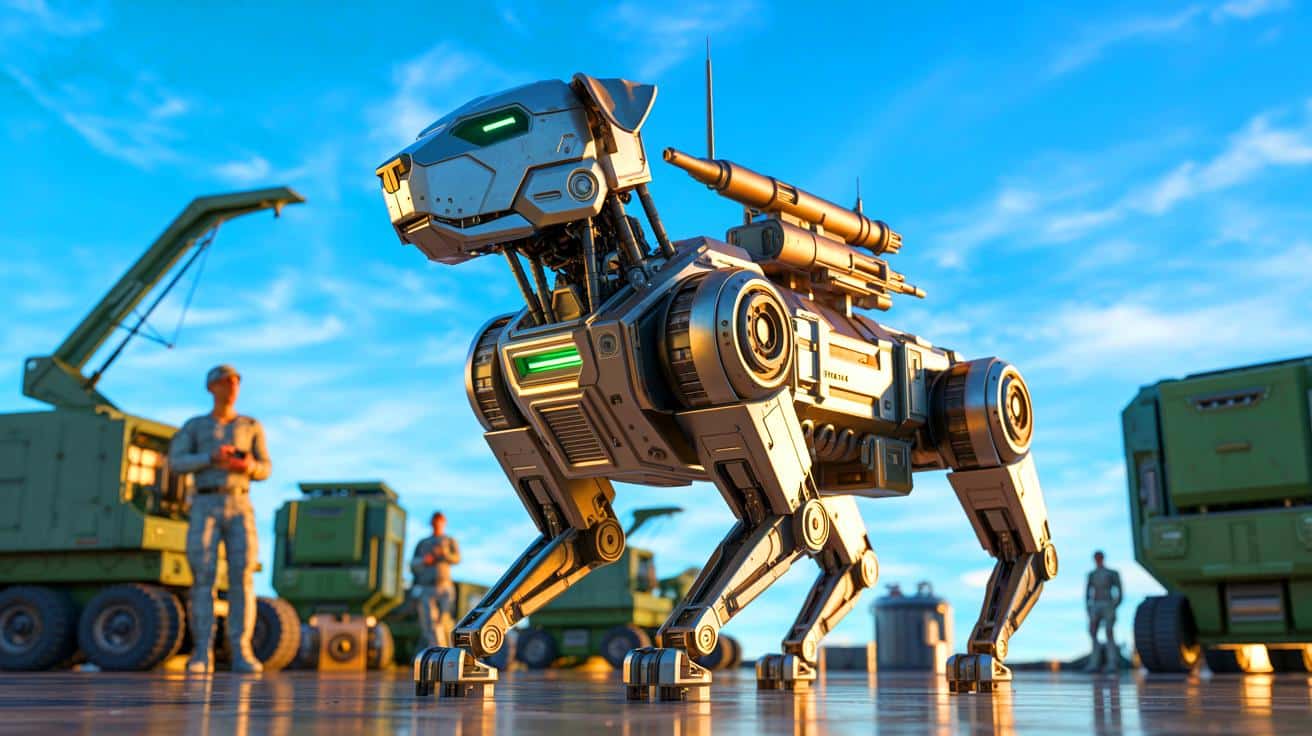
The debut of the CODiAQ, a war-ready robot dog by Skyborne Technologies, marks a significant advancement in military technology. Armed with advanced AI and modular weaponry, this quadruped robot is designed to execute precise attacks autonomously. Funded by the Office of the Assistant Secretary of Defense for Special Operations, the CODiAQ aims to provide a lethal, remote-controlled option for small units. It represents a leap forward in human-machine collaboration, offering new possibilities for battlefield operations while reducing risks to human soldiers. As technology continues to evolve, the CODiAQ could redefine military strategies and operations.
Modular, Lethal, and Intelligent
The CODiAQ’s design centers around Skyborne’s innovative modular payload system, featuring the HAVOC 40mm grenade launcher and the CHAOS 12-gauge shotgun module. These weapons are supported by AI-assisted targeting software, which facilitates autonomous aiming and ballistic calculations. The Targeting Electronics Optical Box (TEOB) enables accurate targeting and engagement of multiple targets over extended ranges, both day and night.
This robot can be deployed rapidly and operated remotely with a handheld controller, simplifying battlefield integration. Training operators takes only a few days, underscoring the system’s user-friendly design. The CODiAQ’s IP-67 certification ensures its durability in harsh environments, such as rain, mud, and desert conditions. It navigates rugged terrains, climbs stairs, and maneuvers through tight spaces that traditional vehicles cannot traverse.
The CODiAQ’s AI-driven autonomy allows it to operate independently, keeping human operators focused on strategic decisions. Its mobility and precision fire capabilities make it well-suited for urban combat, perimeter defense, and irregular warfare, offering a versatile tool for modern military operations.
Human-Machine Teaming
Skyborne Technologies envisions CODiAQ as part of a larger effort to integrate human-machine teaming in military operations. The company aims to connect the CODiAQ with its Cerberus MI small unmanned aerial system (sUAS), forming a cohesive network of aerial and ground robots that work together in real-time. This integration enhances the effectiveness of special operations and reconnaissance missions.
The CODiAQ is positioned as a cost-effective, force-multiplying platform that extends the reach and lethality of dismounted units while minimizing their exposure to enemy fire. Skyborne emphasizes that the CODiAQ can be deployed quickly, controlled easily, and can achieve mission objectives with reduced risk.
Currently, the CODiAQ is undergoing testing with select U.S. government partners to evaluate its performance in various mission scenarios, including irregular warfare and counterterrorism. This testing phase is crucial for refining the system’s capabilities and ensuring it meets the high demands of modern warfare.
Implications for Modern Warfare
The introduction of the CODiAQ could significantly alter the landscape of modern warfare. Its ability to perform direct-action missions autonomously represents a shift towards more AI-driven military strategies. The robot’s integration with existing systems exemplifies a move towards cohesive, networked warfare where human and machine work in tandem.
This innovation raises questions about the future role of soldiers on the battlefield. With technology like the CODiAQ, the traditional combat roles may evolve, emphasizing strategy and decision-making while machines handle execution. The potential for reduced casualties and increased operational efficiency makes this technology attractive to military planners.
However, the deployment of AI-driven robots also brings ethical and strategic considerations. The implications of autonomous weaponry on global conflict dynamics and rules of engagement need careful examination. As these technologies develop, international discourse on regulations and ethical use will become increasingly important.
Showcasing at AUSA Annual Meeting
The CODiAQ was officially unveiled at the Association of the United States Army (AUSA) Annual Meeting and Exposition in Washington, D.C. This event provided a platform for Skyborne Technologies to demonstrate the robot’s capabilities and emphasize its role in future military operations.
Skyborne highlighted their commitment to developing lightweight, low-cost solutions that enhance soldier effectiveness and adaptability on the battlefield. The CODiAQ exemplifies this mission, showcasing the potential for AI-driven military robots to transform combat strategies.
As the CODiAQ undergoes further testing and evaluation, its impact on military operations will be closely watched. The integration of such advanced technology could herald a new era in warfare, where human-machine collaboration becomes a cornerstone of military tactics.
The introduction of the CODiAQ raises numerous questions about the future of military operations and the role of AI in warfare. As technology continues to advance, how will military strategies evolve, and what ethical considerations will arise from the use of autonomous weaponry? The answers to these questions will shape the future of global defense strategies.
Continue reading