


Nation’s Defense Strategy Reveals Urgent Need: Three ARG/MEUs Essential for Security and Global Stability
 By
Adam Kovács
By
Adam Kovács
| IN A NUTSHELL |
|
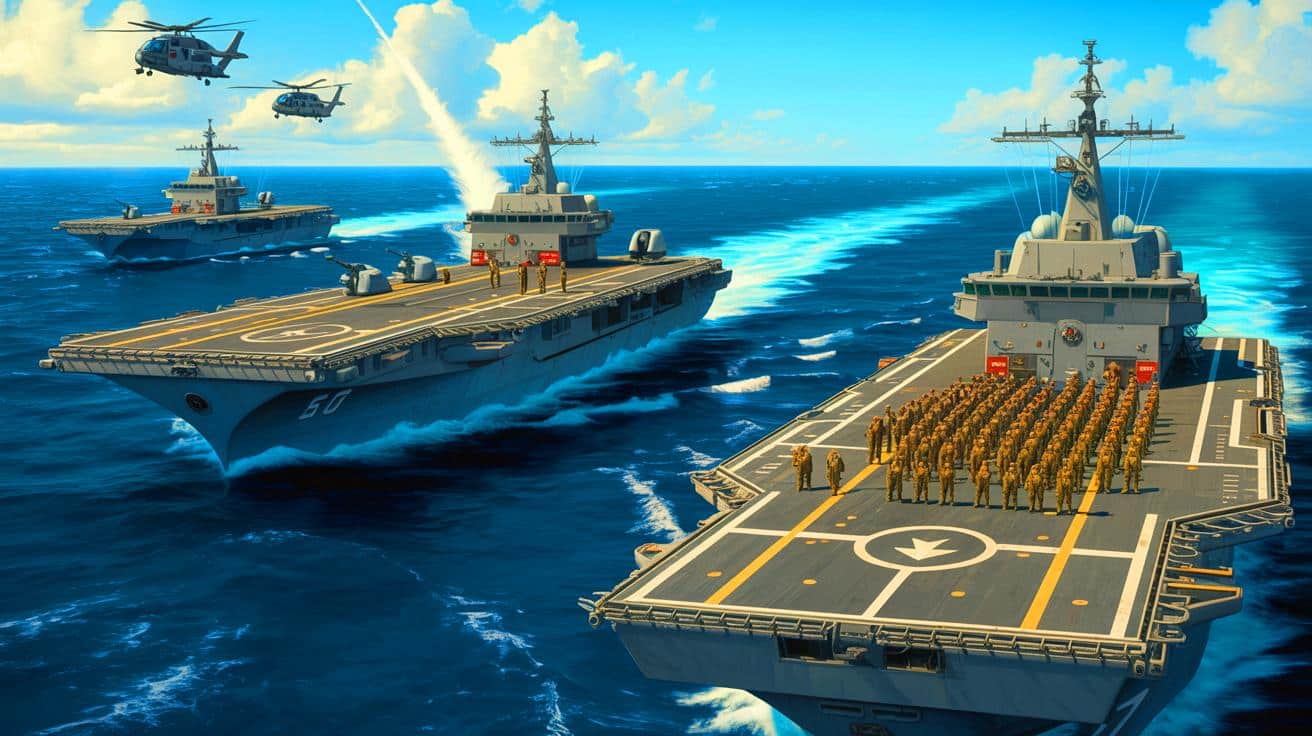
The Amphibious Ready Group and Marine Expeditionary Unit (ARG/MEU) represent a critical component of U.S. military capabilities, offering a unique blend of speed, flexibility, and power projection from the sea. This formation, comprising three ships and a 2,200-Marine combined arms team, operates as sovereign U.S. territory anywhere on the globe. With the capability to respond in hours, these units can deploy Marines ashore without requiring access to ports, airfields, or foreign permissions. As the global landscape evolves, maintaining and modernizing this crucial capability is imperative for national security and military readiness.
Addressing the Amphibious Capability Shortfall
The United States currently faces a significant shortfall in its amphibious capabilities, with only 32 amphibious ships available, barely meeting the congressionally mandated minimum. This situation is compounded by a readiness level below 50 percent, which hampers the nation’s ability to maintain three consistently forward-deployed ARG/MEUs. The Marine Corps has long recognized this gap, and the Department of the Navy is now prioritizing efforts to stabilize the fleet and invest in military shipbuilding infrastructure.
As part of his Planning Guidance, the Commandant of the Marine Corps has laid out two key initiatives to address this shortfall. First, there is a push to restore the amphibious capacity to a 3.0 ARG/MEU presence. This would ensure three forward-postured MEUs, each with three amphibious warships, are persistently positioned around the globe. This configuration has been a longstanding standard, serving as the Marine Corps’ guiding principle.
Moreover, modernizing the MEU through Force Design is essential to keep pace with the changing character of warfare. This involves equipping Marine Littoral Regiments and MEUs with advanced capabilities such as long-range fires, resilient command and control, unmanned systems, and enhanced sensing networks, ensuring they remain a versatile, multi-domain force from the sea.
The Historical Role of the MEU
For over 250 years, the Marine Corps has embodied the ethos of being first to fight, often operating from the sea. The ARG/MEU concept emerged in the aftermath of World War II, as global tensions necessitated a force capable of rapid response without reliance on ports or bases. This need became particularly acute during the Cold War, when the Navy and Marine Corps were tasked with countering nuclear-armed adversaries and dispersed threats.
The MEU was designed to be operationally ready, capable of maneuvering from the sea, projecting power inland, and shaping conflict dynamics before they erupted. The advent of nuclear weapons necessitated a rethinking of amphibious operations, shifting away from predictable beachhead assaults to more flexible approaches like vertical envelopment.
This evolution gave rise to the Marine Air-Ground Task Force (MAGTF) concept, integrating rotary-wing lift, aviation-delivered fire support, and logistics. By the late 1980s, MEUs were routinely deployed from the Mediterranean to the Western Pacific, reinforcing the value of forward-deployed forces in both deterrence and operational war plans.
Modernizing for the Future
As warfare evolves, driven by technological advances and a more connected world, the Marine Corps must adapt to remain effective. The Force Design initiative, launched in 2019, provides a framework for this adaptation, focusing on modernizing the Corps across various formations, including MEUs, Marine Expeditionary Brigades, and Marine Littoral Regiments.
This modernization involves a campaign of learning that informs how the force is manned, trained, and equipped to deter aggression in a contested, multi-domain environment. The integration of long-range fires, resilient command and control, and unmanned systems is central to this effort, enabling MEUs to function as agile, sea-based maneuver elements.
The MEU’s combat power is built on three core advantages: precision fires, adaptable command and control, and enhanced survivability. Equipped with advanced technologies like HIMARS, NMESIS, and fifth-generation F-35B sensor fusion, the MEU can deliver effects in areas inaccessible to other formations, maintaining its role as a forward-deployed, combined arms team.
Venezuela Buildup Sparks Regional Tensions as War Plans for Nigeria and China’s Third Carrier Unfold
Challenges in Sustaining a 3.0 ARG/MEU Presence
The modernization of the MEU is only part of the equation; sustaining a 3.0 ARG/MEU presence requires a robust fleet. Historically, the U.S. maintained over 60 amphibious warships, ensuring global presence and readiness across multiple theaters. However, the focus on land campaigns in the Middle East led to a deprioritization of the amphibious fleet, reducing its numbers significantly over the years.
Today, the amphibious fleet comprises 32 ships with an average readiness of around 45 percent. Shipyards face strain, timelines slip, and the aging fleet struggles to keep pace with demands. To support a 3.0 ARG/MEU presence, a fleet of 31 amphibious ships at 80 percent readiness is needed. Recent investments, such as the LHA/LPD block buy, are positive steps, but sustained cooperation and investment across government, industry, and the Department of Defense are crucial.
Achieving this goal will require broad cooperation, sustained investment, and shared urgency across the U.S. government, industry, and defense establishment. The future of the ARG/MEU depends on this collective effort to maintain readiness and capability.
As the Marine Corps continues to modernize and address capacity challenges, the question remains: how will evolving global dynamics and technological advancements further shape the role of the ARG/MEU in future conflicts?