


“Every 30 Hours”: Northrop Grumman’s Futuristic Assembly Line Delivers F-35 Fuselages At Unprecedented Speed To Meet Escalating Global Military Demands
 By
Adam Kovács
By
Adam Kovács
| IN A NUTSHELL |
|
The evolution of fighter jet manufacturing has taken a significant leap forward with recent advancements in the production of the F-35 Lightning II. Northrop Grumman, a leading American defense company, has integrated cutting-edge technology into its manufacturing processes, enabling the delivery of one F-35 center fuselage every 30 hours. This stride in efficiency not only meets the growing demands of both U.S. and international clients but also underscores the potential for further innovation in military aviation. The company’s facility in Palmdale, California, known as the Integrated Assembly Line (IAL), stands at the forefront of these advancements, representing a new era in aerospace engineering.
The Role of the Center Fuselage
The center fuselage is a crucial component in all three variants of the F-35 Lightning II. It plays a pivotal role in housing the aircraft’s internal weapons bay and fuel reservoir. Additionally, the fuselage incorporates a bifurcated inlet system, which is essential for the aircraft’s stealth and aerodynamics. Northrop Grumman’s production of the inflight operating doors, including the weapons bay doors and drive systems, further enhances the operational capabilities of the F-35. The meticulous attention to detail in edge alignment and coatings is integral to maintaining the jet’s unique stealth capabilities, making it a formidable asset in modern aerial combat.
To date, Northrop Grumman has delivered over 1,400 center fuselages, showcasing the company’s commitment to supporting the F-35 program. This achievement not only highlights the company’s manufacturing prowess but also reflects the strategic importance of the F-35 in military operations worldwide. The continuous delivery of these components plays a significant role in maintaining the operational readiness of air forces relying on this advanced fighter jet.
Advanced Automated Technology
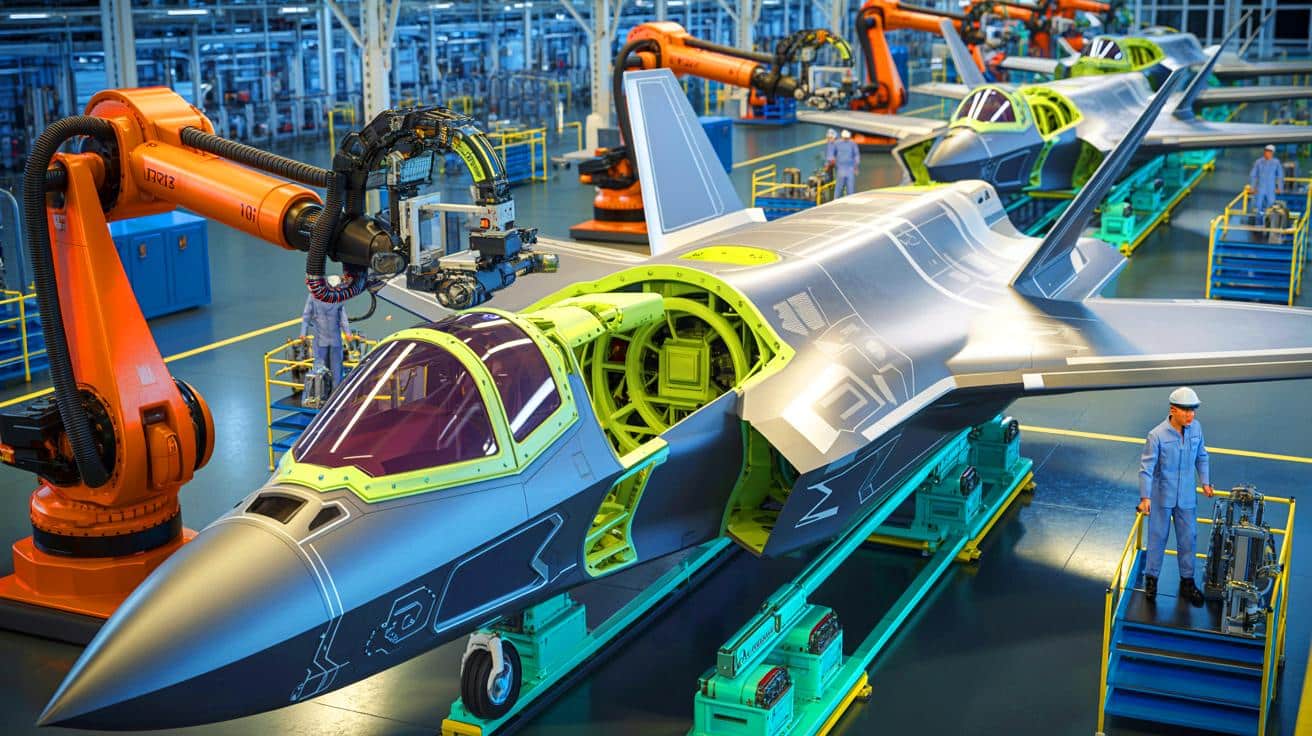
At the heart of Northrop Grumman’s manufacturing process is the innovative use of robotics and automation. The IAL employs a range of automated technologies, including automated guided vehicles and robotic drilling systems, to enhance production efficiency and precision. This integration of technology allows for high rates of production while ensuring that engineering tolerances are met with precision that is difficult to achieve manually. The facility accommodates all three variants of the F-35, along with production flight test articles and country-specific configurations.
Advanced data analytics and state-of-the-art automation not only improve quality control but also significantly reduce the time and labor involved in producing the center fuselage. Beyond the fuselage, Northrop Grumman develops critical components such as the AN/APG-81 AESA radar and communications subsystems. The company is also involved in mission systems development and the maintenance of low-observable technologies, underscoring its comprehensive role in the F-35 program.
IAL: A State-of-the-Art Facility
Northrop Grumman’s Integrated Assembly Line is considered one of the most advanced manufacturing facilities for military aircraft. Spanning the size of a football field, the IAL comprises over 3,000 parts and accommodates up to 115 assembly positions. The facility’s capacity to assemble 10 million parts annually highlights its immense production capability. Despite the complexity of assembling a center fuselage, the IAL completes one every 30 hours, a testament to its operational efficiency.
The facility exemplifies the synergy between human expertise and machine precision. This collaboration is central to producing the sophisticated center fuselage for all F-35 variants. Northrop Grumman’s partnership in the F-35 Lightning II industry team reflects its integral role in developing, producing, and sustaining this fifth-generation fighter aircraft. The company's commitment to innovation ensures that the F-35 remains at the forefront of military aviation technology.
The Future of Fighter Jet Manufacturing
The advancements at Northrop Grumman’s IAL represent a significant milestone in fighter jet manufacturing. The ability to deliver a center fuselage every 30 hours not only meets current demands but also sets a new benchmark for production efficiency in the defense sector. This capability is crucial as global military forces look to modernize their fleets with advanced fighter jets like the F-35. The integration of automation and robotics in manufacturing processes signifies a broader trend towards increased efficiency and precision in aerospace engineering.
The ongoing development and refinement of the F-35 program illustrate the dynamic nature of military technology. As Northrop Grumman continues to innovate, the defense industry must consider how these advancements will shape the future of air combat. How will emerging technologies further transform the production and capabilities of next-generation fighter jets?
Continue reading