



“Watch the Navy’s New Laser in Action”: This HELIOS Weapon Destroys Drones at Light Speed (and Could End Missile Warfare Forever)
 By
Adam Kovács
By
Adam Kovács
| IN A NUTSHELL |
|
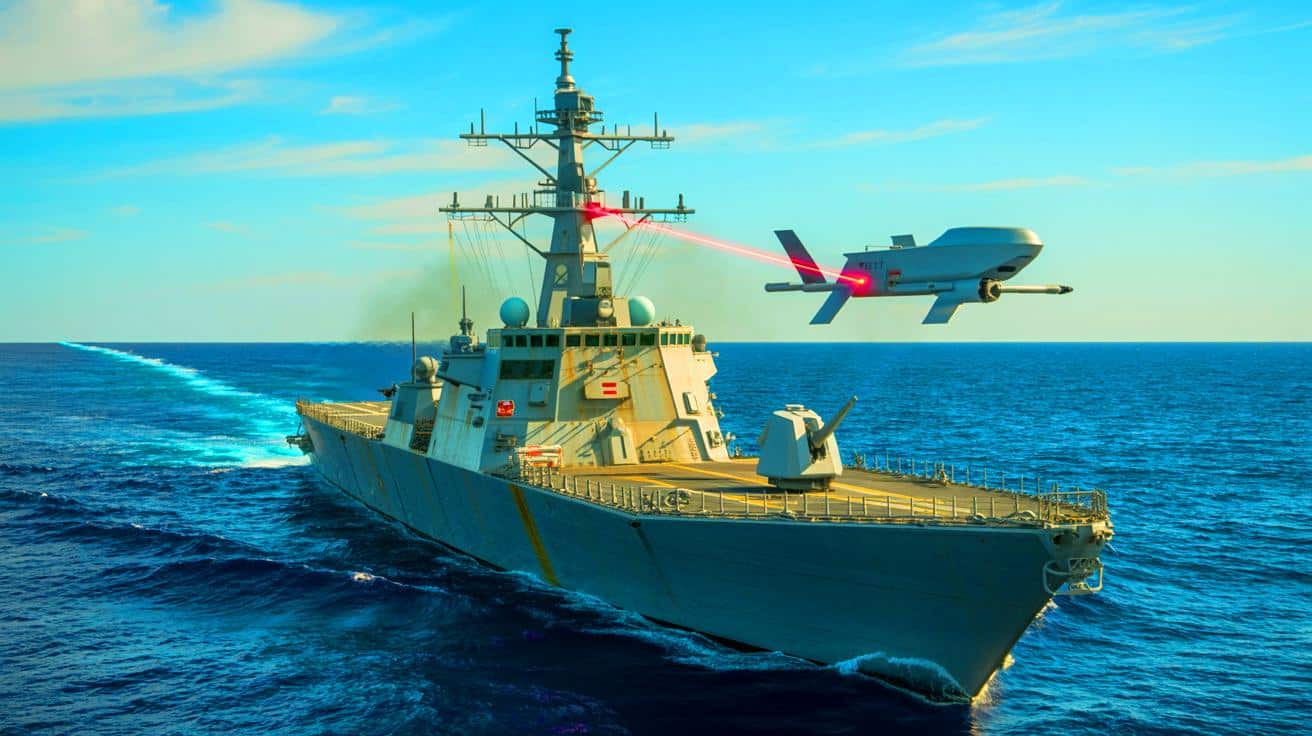
The U.S. Navy is advancing its capabilities in modern warfare with the introduction of the HELIOS laser weapon system. Designed to counter aerial threats at the speed of light, this innovative technology represents a significant shift in naval defense strategies. Recent tests aboard the USS Preble (DDG-88) successfully demonstrated its potential by engaging unmanned aerial vehicles (UAVs). As the Navy continues to explore the operational role of directed-energy weapons, HELIOS could redefine how military forces approach aerial defense, offering both strategic and economic advantages.
Functionality and Capabilities of HELIOS
The HELIOS system, which stands for High-Energy Laser with Integrated Optical Dazzler and Surveillance, is a product of Lockheed Martin’s cutting-edge research. Operating at 60 kilowatts (kW), HELIOS is capable of disabling or destroying targets through the application of thermal energy. Unlike traditional missile-based defense systems, HELIOS relies solely on electric power, which significantly reduces interception costs and minimizes dependence on conventional munitions. This makes it a cost-effective and sustainable option for naval defense.
In addition to its laser capabilities, HELIOS includes an optical dazzler. This feature is engineered to disrupt enemy sensors and surveillance equipment, providing a tactical advantage by impairing adversarial situational awareness. The system is designed to work as part of an integrated shipboard defense strategy, complementing existing missile-based countermeasures. This integration enhances the overall defensive posture of naval vessels, allowing for a more versatile and responsive approach to potential threats.
Strategic Importance in Modern Warfare
HELIOS is a critical component of the U.S. Navy’s broader strategy to develop directed-energy weapons capable of countering low-cost aerial threats, such as drones and anti-ship cruise missiles. As drone warfare becomes increasingly prevalent, naval forces require efficient and adaptable defensive solutions. HELIOS offers a viable response to these emerging threats by providing a rapid, cost-effective engagement method that can be deployed across a wide range of scenarios.
The deployment of HELIOS represents a proactive step in addressing the evolving nature of aerial threats. It underscores the Navy’s commitment to remaining at the forefront of military technology, ensuring that U.S. naval forces are equipped to handle the challenges posed by modern warfare. By investing in directed-energy weapons, the Navy aims to maintain a strategic advantage over potential adversaries, ensuring the safety and security of its operations at sea.
Comparative Advantages Over Missile-Based Systems
The introduction of HELIOS addresses several limitations associated with traditional missile-based defense systems. One of the most significant advantages is the lower cost per engagement. Conventional interceptors, such as the SM-6 missile, can cost up to $4 million per shot. In contrast, HELIOS operates using electricity, resulting in a dramatically reduced cost per use.
HELIOS also offers continuous operation capabilities, eliminating the need for reloading and enabling the system to engage multiple threats in quick succession. This is particularly beneficial in scenarios where rapid response is critical. The high-speed response of laser beams, traveling at the speed of light, further reduces engagement time compared to missile interceptors. These attributes make HELIOS an attractive option for naval defense, providing a more efficient and effective means of threat neutralization.
Key Figures in Laser Weapon Development
While HELIOS currently operates at 60 kW, the U.S. Department of Defense is actively working on developing systems with greater power capabilities. The High Energy Laser Scaling Initiative (HELSI) is focused on creating lasers that exceed 300 kW, aiming to enhance the effectiveness of directed-energy weapons in various military applications.
Additionally, the High Energy Laser Counter Anti-Ship Cruise Missile Project (HELCAP) is dedicated to testing lasers above 300 kW for anti-missile defense. This ongoing research and development effort highlights the strategic importance of laser weapons in modern military operations. Earlier iterations of U.S. Navy laser systems, such as the AN/SEQ-3 LaWS, which was tested in 2014, operated at 30 kW. The progression to more powerful systems signifies a commitment to advancing the capabilities of directed-energy weapons.
The development and deployment of the HELIOS laser weapon system mark a significant milestone in the evolution of naval defense technology. As the U.S. Navy continues to test and refine this system, it raises important questions about the future of military strategy and the role of directed-energy weapons in global defense. How will these advancements impact the balance of power in international relations, and what ethical considerations will arise as laser weapons become more prevalent in modern warfare?