


“China Exploits U.S. Hesitation”: Beijing Accelerates Autonomous Drone Arsenal As Washington Races To Justify $36 Billion Military AI Gamble
 By
Adam Kovács
By
Adam Kovács
| IN A NUTSHELL |
|
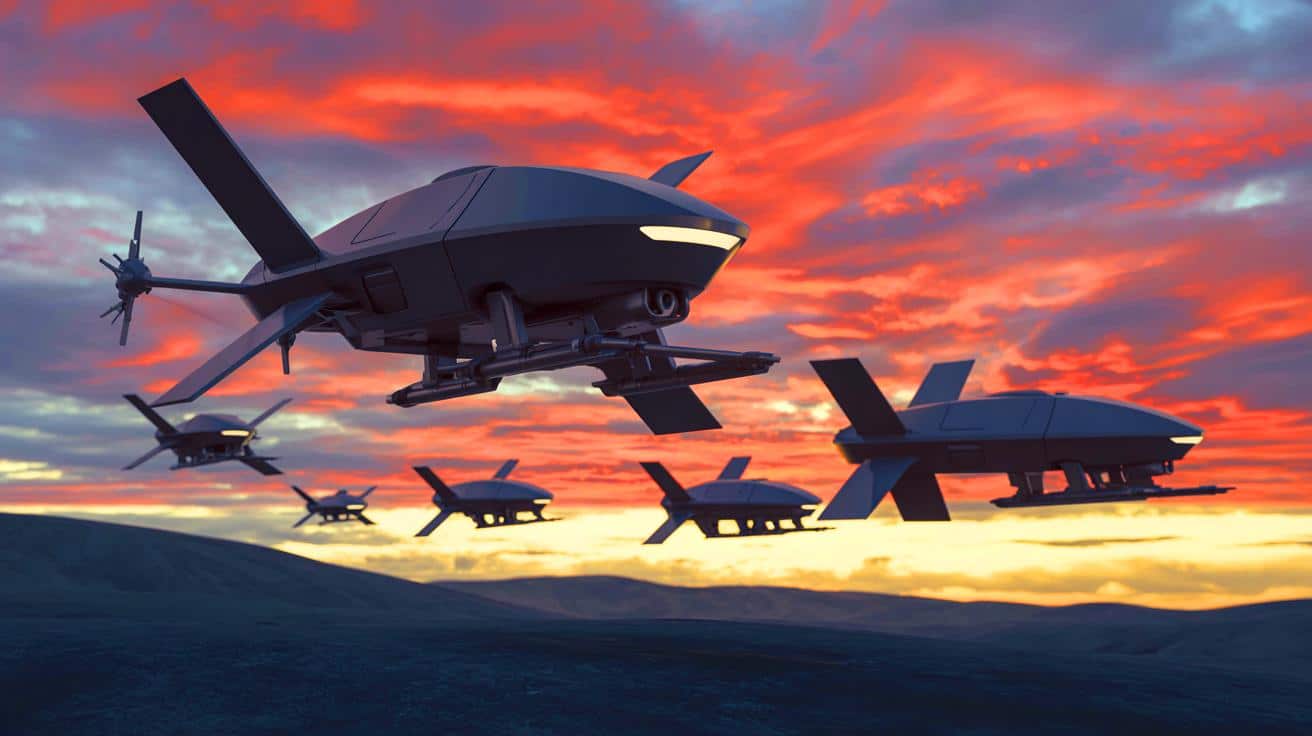
The face of warfare is rapidly evolving, driven by significant advancements in autonomous weaponry. Gone are the days when battles were solely about armies on the ground or jets in the sky. Today, the battlefield is dominated by swarms of small, intelligent drones capable of making life-or-death decisions without human intervention. Known as Lethal Autonomous Weapons Systems (LAWS), these innovations signal a new era in military strategy, where algorithms play a pivotal role. As these autonomous systems take center stage, major global powers are racing to adapt and redefine their military capabilities.
Drones as Game-Changers on the Battlefield
The use of autonomous drones has become increasingly prevalent, reshaping modern warfare significantly. This change has been particularly evident since the onset of the conflict in Ukraine, where both sides have embraced drone technology at scale. The Ukrainian forces, for instance, launched over 480 modified Aeroprakt A-22 drones in a coordinated attack on Moscow. These drones operated in swarms, showcasing a mix of autonomous and remotely piloted technologies, effectively functioning as low-altitude flying bombs.
Just days before, Russian forces targeted Kyiv with 140 Shahed drones, which incorporate Iranian and Israeli technology. This exchange highlights a new kind of warfare, driven by algorithms and artificial intelligence. The Ukrainian military has even developed a defensive “drone wall,” a mobile barrier designed to intercept enemy attacks in real time. This system relies heavily on sophisticated AI algorithms capable of predicting enemy trajectories and responding instantaneously.
These battlefield encounters serve as live laboratories for assessing the capabilities and risks associated with these weapons. The insights gained are becoming invaluable references for global military powers as they reevaluate their strategies and technologies.
U.S. Response to the Autonomous Weapons Race
The United States has long been a leader in drone technology. However, the swift advancement and global spread of autonomous weapons present a formidable challenge. Historically, the U.S. military's reliance on remotely piloted drones like the MQ-9 Reaper has been a cornerstone of its strategy. These drones, while effective, are costly and require human oversight.
Michael Horowitz, a security expert and former Pentagon advisor, criticizes the U.S. for its slow adoption of fully autonomous systems. He argues that the military's delay in integrating AI capable of rapid, independent decision-making has become a costly oversight, especially as adversaries rapidly advance their capabilities.
In response, Washington has announced a significant overhaul of its military capabilities, committing $36 billion to accelerate the development and deployment of autonomous drones. The goal is to deploy over 1,000 AI-powered drones within months, making these systems a backbone of American military strategy. Notable projects include the Manta Ray, an autonomous submarine, and the Loyal Wingman, an unmanned fighter jet designed to support human pilots tactically.
China’s Strategic Shift in Autonomous Weaponry
In the shadow of this technological race, China is emerging as a key player. Observing the Ukrainian conflict closely, Beijing is learning from these real-world applications to refine its technologies. Although China initially advocated for a strict ban on autonomous weapons, it now appears to be pivoting toward regulating their use while accelerating development.
This strategic shift is largely driven by the prospect of a potential invasion of Taiwan, which would require a risky amphibious assault. Autonomous weapons, like the amphibious Feiyi drone, offer a new operational dimension. Capable of moving through water and air, these drones can be launched from submarines, infiltrate underwater, and surface to attack specific targets, providing a significant advantage in an island conflict scenario.
Ethical Implications of Autonomous Warfare
The rise of autonomous technology in warfare raises profound ethical questions. Can society accept machines making unilateral decisions to take human lives? Who bears responsibility for errors or unintended consequences? Should there be international regulations governing these weapons?
Some experts argue that the train has already left the station. Braden Allenby, a military ethics specialist, highlights the growing gap between the pace of AI innovation and the slow-moving political and military decision-making processes. "Whoever dominates AI will dominate warfare," he warns, "the runner-up is doomed."
The recent conflicts illustrate that algorithmic warfare is no longer a futuristic concept but a present reality. These autonomous weapons, often small and discreet yet highly effective, are transforming the nature of combat. As the number of autonomous drones on the Ukrainian front could reach millions by 2025, the world witnesses a seismic shift in military strategies. Beyond technology, this marks a geopolitical and ethical revolution. Who will control these weapons? Who will set the rules? And most importantly, what will be the cost to humanity?
Continue reading